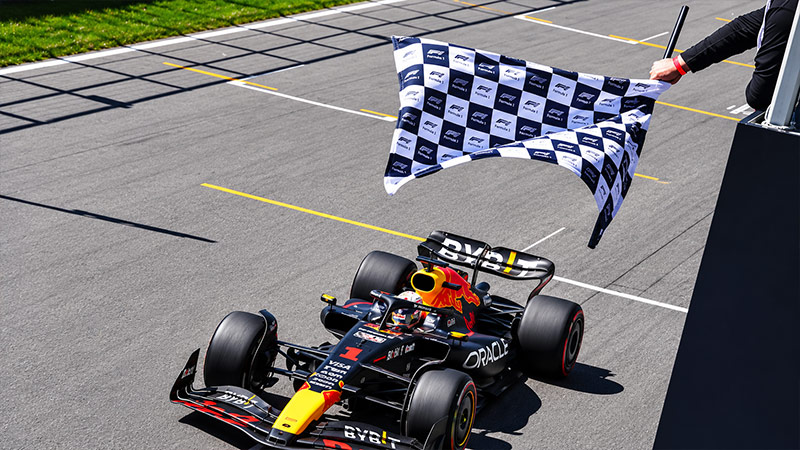
Every Formula 1 race ends the same way. After two hours of noise, strategy, and split-second decisions, someone at the finish line waves a black-and-white flag. In that instant, months of engineering and a full weekend of effort turn into a result that goes into the record books.
The checkered flag is motorsport’s most recognized symbol, yet few fans know the rules behind it. It has been waved a lap too early by mistake, briefly replaced by a light panel, and even wiped a hard-fought pass off the official results. Its story stretches back more than a century, to the earliest days of the automobile.
In this guide, you will discover what the checkered flag really means in F1, where it came from, how the FIA decides the exact moment it falls, and what happens once the leader crosses the line.
New to the sport or a long-time follower, you will finish with a sharper eye for the most important lap of every race.
Quick answer: In Formula 1, the checkered flag (officially spelled “chequered”) marks the end of a session. In a Grand Prix, the leader sees it first, on crossing the finish line once the scheduled distance is complete or the time limit has run out. Every other driver takes the flag the next time they cross the line, and the finishing order is locked in, subject to post-race checks.
What Does the Checkered Flag Mean in F1?
At its simplest, the checkered flag means “the session is over.” It closes every running session of a Grand Prix weekend: practice, each part of qualifying, the Sprint where one is held, and the race itself.
How it works depends on the session:
- Practice and qualifying: The flag comes out when the session clock hits zero. A driver who has already started a flying lap can complete it, which is why the final seconds of qualifying so often reshuffle the order.
- The race: The flag is shown to the leader first. After that, every other car finishes the next time it crosses the line, including lapped cars, which simply complete fewer laps.
- After the flag: Drivers must slow down, complete a cool-down lap and follow instructions to parc fermé. The flag ends the racing, not the rules.
Checkered or chequered? Both are correct. “Checkered” is the American spelling, while “chequered” is the British spelling used in FIA regulations and on most F1 broadcasts. They describe the same flag.
Where Did the Checkered Flag Come From?
No single document records the invention of the checkered flag, and a few charming myths have filled the gap. Here is what the historical record supports, and what it does not.
The best-documented origin: the 1906 Glidden Tour
The Glidden Tours were long-distance reliability runs held in the United States in the early days of the automobile. Historian Fred Egloff, in a 2006 study published by the International Motor Racing Research Center at Watkins Glen, traced the flag to a Packard employee named Sidney Waldon.
Waldon split the 1906 route into sections. The officials who recorded times at the end of each section were called “checkers,” and they marked their stations with checkered flags. A visual pun became a sporting tradition.
The earliest finish-line images
Later in 1906, the Vanderbilt Cup race on Long Island produced one of the earliest known photographs of a winner, Louis Wagner, receiving a checkered flag at the finish.
The popular legends
You may have heard that the flag began as a checkered tablecloth waved to call Midwest racers in for a meal, or that it came from horse racing or early cycling. These stories are fun, but little documentary evidence supports them, so treat them as folklore.
Why the pattern stuck
Whatever its exact origin, a high-contrast black-and-white grid has a practical edge. It stands out against crowds, sky, grandstands and spray, and it cannot be confused with any of the solid-color warning flags.
Formula 1 inherited the tradition when the World Championship began in 1950. Today, flag signals across FIA motorsport are set out in the International Sporting Code, and the checkered flag has only one job: ending the session.
The Rules: How the FIA Decides When the Flag Falls
The checkered flag is never waved on instinct. Race control works to precise rules in the FIA Formula 1 Sporting Regulations, and these six are the ones every fan should know.
1. The scheduled race distance
A Grand Prix runs for the fewest laps needed to exceed 305 kilometers, with Monaco the long-standing exception at around 260 kilometers. When the leader completes that final lap, the flag falls.
2. The two-hour limit
A race cannot exceed two hours of racing time. If the clock runs out first, the leader sees the flag at the end of the lap after the one in which time expired. In practice, that means one more lap once the timer hits zero.
3. The three-hour hard stop
When a red flag suspends a race, the stoppage time is added to the two-hour window, up to a maximum of three hours in total. That cap dropped from four hours to three from the 2021 season.
Unlike the two-hour rule, the three-hour limit has no bonus lap: the leader takes the flag the first time they cross the line after time is up.
That is exactly what happened at the rain-hit 2022 Japanese Grand Prix, which ended after just 28 of its 53 scheduled laps while several teams were still expecting one more lap.
4. If the flag comes out too early
If the end-of-race signal appears before the leader completes the scheduled distance, the race is treated as finished when the leader last crossed the line before the signal.
In real terms, an early flag on the penultimate lap wipes out the final two laps, not just one, and any overtakes in that window are canceled.
5. If the flag comes out too late
If the signal is delayed, the result is taken as it stood at the end of the scheduled distance. Extra laps run by mistake do not count.
6. Classification does not require taking the flag
To appear in the official classification, a car must have covered at least 90% of the laps completed by the winner. A driver who retires on the final lap can therefore still be classified and even score points. Taking the checkered flag is a proud moment, but it is not a requirement.
Who actually waves the flag?
The flag is shown at the finish line, normally by the event’s official starter working in step with race control. Organizers often hand the honor to a guest, from sports stars to musicians.
Behind the ceremony, light panels at the line and around the circuit display the same signal, and lights in the cockpit alert each driver too.
When the Checkered Flag Went Wrong: Three Races That Changed the Rules
Nothing explains the rules better than the moments they were tested. Three recent incidents shaped how Formula 1 handles its most famous flag.
2014 Chinese Grand Prix: the lap that never was
In Shanghai, race leader Lewis Hamilton was shown the checkered flag at the end of lap 55, one lap before the scheduled 56. Hamilton later admitted he wondered whether he was seeing things, checked with his team and kept racing.
Under the early-flag rule, the official result was declared at the end of lap 54. The podium was unchanged, but Kamui Kobayashi’s final-lap pass on Jules Bianchi no longer counted.
2018 Canadian Grand Prix: a guest, a wrong cue and a rule change
In Montreal, model Winnie Harlow, a guest at the race, waved the flag at the end of lap 69 of 70 after being given the wrong cue.
Race director Charlie Whiting blamed a miscommunication with the official starter, and the results were counted back to lap 68. Sebastian Vettel won for Ferrari but raised a serious safety concern: fans might have run onto the circuit while cars were still at racing speed.
F1 motorsport chief Ross Brawn later apologized to Harlow for the criticism she received, since the error was not hers.
2019: the light panel experiment
In response, the FIA made a checkered light panel at the finish line the official end-of-race signal for 2019, keeping the physical flag for ceremony.
Then, at the 2019 Japanese Grand Prix, the panel itself switched to checkered a lap early while Valtteri Bottas led.
The order after lap 52 of 53 became the final result. Months later, the World Motor Sport Council restored the physical flag as the definitive end-of-race signal from the 2020 season.
The lesson: Human error and technical error can both end a race early. Each incident pushed F1 to tighten the process around the signal, yet the sport ultimately chose to keep the flag itself in charge.
What Happens After the Checkered Flag?
For viewers, the race ends at the line. For drivers and teams, some of the most tightly controlled minutes of the day are just beginning.
- The cool-down lap. Drivers ease off, wave to fans and celebrate over team radio while marshals salute from their posts. You may see cars weaving off the racing line through loose rubber debris; a common explanation is that it sticks to the tires and adds a little weight before the weigh-in.
- Parc fermé. Cars head straight to a secure area where teams cannot work on them without permission. The top three finishers park in front of the podium.
- Post-race checks. Technical officials weigh the cars and inspect them against the technical rules. Each car must be able to supply a fuel sample of at least one liter. At the 2021 Hungarian Grand Prix, Sebastian Vettel was disqualified from second place because officials could not extract enough fuel.
- The podium. Anthems play, trophies are presented and the champagne flies.
- Results become final. The classification stays provisional until the stewards complete any investigations. A late penalty can still change the order hours after the flag.
The Checkered Flag and the Rest of the F1 Flag Family
The checkered flag is the most famous signal in F1, but it is one of several that marshals and race control use to keep drivers safe and racing fair. Use this table as a quick reference on race day.
| Flag | What it tells drivers |
|---|---|
| Checkered | The session is over |
| Green | Track clear; the hazard has passed |
| Single yellow | Danger ahead; slow down, no overtaking |
| Double yellow | Serious danger; slow significantly and be ready to stop |
| Red | Session suspended; return slowly to the pit lane |
| Blue | A faster car is approaching; let it through |
| White | Slow-moving vehicle on track ahead |
| Yellow with red stripes | Slippery surface ahead |
| Black and white (split diagonally) | Warning for unsporting behavior |
| Black with orange disc | Mechanical problem; pit immediately |
| Black | Driver disqualified; return to the pits |
Why the Checkered Flag Still Matters in a Digital Age
Formula 1 measures lap times to the thousandth of a second, and timing loops, LED panels and cockpit lights can relay any signal instantly. So why keep waving a flag?
Part of the answer is clarity. After the 2019 panel error, Vettel argued that the real flag is the ultimate signal drivers respond to, and the FIA chose to restore it. Part of the answer is emotion.
A first victory, a title decider or a home win is remembered as the moment a driver took the flag, not the moment a timing screen updated.
The flag also reaches far beyond the circuit. It appears on team merchandise and race posters; it is everyday shorthand for “finished,” and it is one of the few sporting symbols recognized in nearly every country on the calendar.
Conclusion
From a time checker’s marker on a 1906 reliability run to the most watched moment of every Grand Prix, the checkered flag has earned its place at the heart of Formula 1.
It looks like a simple signal, but precise FIA rules decide when it falls, what counts if it appears too early, and how results are confirmed long after the cars stop.
The blunders in Shanghai, Montreal and Suzuka proved how much one wave of fabric can change. They also showed why the sport chose tradition over technology. T
he next time a leader approaches the line, watch closely. That final wave of black and white settles strategy, rivalries and dreams in a single second, and that is pure racing.