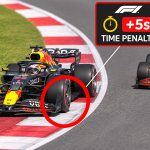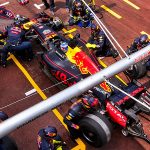
Ten seconds. In everyday life, it is barely enough time to tie a shoelace. In Formula 1, it can be the difference between standing on the podium and finishing outside the points.
The ten-second time penalty is one of the most common, and most debated, sanctions in modern F1. It flashes up on timing screens, sparks tense radio calls between driver and pit wall, and regularly reshapes the final results long after the chequered flag.
Yet many fans, including plenty who have followed the sport for years, are unsure how it actually works. Is it served in the pit lane or added to the race time? Can the crew change tyres while the clock runs? Why do some incidents earn five seconds while others earn ten?
This guide answers every one of those questions. You will learn exactly what a ten-second penalty is, how it is served, which offences trigger it, how it compares with other F1 penalties and why it carries so much weight in race strategy.
What Is a Ten-Second Penalty in F1?
A ten-second penalty in F1 is a time penalty the race stewards give a driver for breaking the sporting rules. The driver either waits ten seconds in the pit box before the crew may touch the car, or has ten seconds added to their total race time.
Think of it as a middle-tier punishment. It is harsher than the five-second penalty used for minor offences, but lighter than a drive-through or a stop-and-go, which send a driver through the pit lane purely to serve the sanction.
Ten-second penalty (F1): a sanction requiring a driver to remain stationary for ten seconds at their next pit stop before any work is done on the car, or to have ten seconds added to their race time if they do not stop again.
The decision appears on the official timing screens and is sent to the team, who relay it to the driver. From that moment, the clock is effectively running against them.
How Is a Ten-Second Penalty Served?
A ten-second penalty is served in one of two ways, depending on whether the driver makes another pit stop after it is issued.
Option 1: Served during a pit stop
If the driver pits after receiving the penalty, the stop follows a strict sequence:
- The driver enters the pit lane at the speed limit and stops in the team’s pit box.
- The car must remain completely stationary for the full ten seconds.
- No mechanic may touch the car during that time, with jacks, wheel guns or anything else.
- Once ten seconds have passed, the crew carries out the normal stop, such as a tyre change.
- The driver is released and rejoins the race.
The no-contact rule is enforced to the letter. Even a jack touching the car a fraction early can be judged an incorrectly served penalty, which brings further punishment.
Option 2: Added to the race time
If the driver does not stop again, ten seconds are added to their total race time at the finish. The same applies when the penalty arrives in the closing laps or after the race, when there is no chance to serve it in the pits.
This is why a driver can cross the line in third place yet be classified fifth. Their on-track position only becomes official once the penalty has been applied.
What if the penalty is not served correctly?
Failing to serve a penalty properly is treated as a fresh breach of the rules. The stewards can respond with an additional time penalty, a drive-through, a stop-and-go or, in extreme cases, disqualification.
Ten-Second Penalty vs Other F1 Penalties
The ten-second penalty sits in the middle of a clear ladder of sanctions, ranked here from lightest to most severe.
| Penalty | What the driver must do | Approximate time cost | Typical use |
|---|---|---|---|
| 5-second time penalty | Wait 5 s at the next stop, or have 5 s added to race time | 5 s | Minor collisions, repeated track limits breaches |
| 10-second time penalty | Wait 10 s at the next stop, or have 10 s added to race time | 10 s | More serious collisions, forcing a rival off track, safety car breaches |
| Drive-through | Drive through the pit lane at the speed limit without stopping | Pit lane loss, roughly 15 to 30 s by circuit | Serious breaches, ignoring an earlier sanction |
| 10-second stop-and-go | Enter the pits, stop for 10 s with no work allowed, then leave | Pit lane loss plus 10 s | Severe breaches |
| Grid penalty | Start the next race further back | Varies | Power unit limits exceeded, offences that could not be punished in the race |
| Disqualification | Removed from the results | Entire result | Technical illegality, very serious breaches |
Stewards can also hand out reprimands and super licence penalty points, either alone or on top of any of these.
Ten-second time penalty vs ten-second stop-and-go
These two are easy to confuse, but they are very different. A ten-second time penalty can be folded into a planned tyre stop or simply added at the finish, so its real cost is close to ten seconds.
A ten-second stop-and-go forces a dedicated trip through the pit lane, and no work is allowed on the car. The driver loses the full pit lane transit time plus the ten seconds, which can mean half a minute or more.
Common Offences That Earn a Ten-Second Penalty
There is no single fixed tariff that matches every offence to one penalty. The stewards follow penalty guidelines for consistency, then weigh the severity, the consequences and the degree of blame in each case. These are the offences most often punished with ten seconds:
- Causing a collision. When a driver is judged wholly or mainly to blame for contact, especially contact with heavy consequences, ten seconds is a common outcome. Lighter cases often draw five seconds instead.
- Forcing another driver off the track. Squeezing a rival wide when they have earned the right to racing room is a classic ten-second offence, particularly in wheel-to-wheel battles for position.
- Leaving the track and gaining a lasting advantage. Completing or defending an overtake with all four wheels beyond the white lines usually earns five seconds, but repeated or flagrant cases can earn ten.
- Safety car and virtual safety car breaches. Overtaking under a safety car, dropping too far behind the car ahead, or running faster than the required time under a virtual safety car can all lead to a ten-second penalty.
- Start procedure errors. Lining up outside the grid box or moving before the lights go out is penalised according to how much advantage the driver gained.
- Serving an earlier penalty incorrectly. If the crew touches the car too early while a penalty is being served, the stewards can add a further ten seconds.
- Erratic or dangerous driving. Unpredictable moves, such as sudden braking in front of a rival, are judged harshly because of the safety risk they create.
The pattern is consistent: the more dangerous the action and the bigger the advantage gained, the higher the penalty.
Who Decides? How the Stewards Hand Out a Ten-Second Penalty
Every ten-second penalty is decided by the race stewards, an independent FIA panel that usually includes an experienced former racing driver. Race Control monitors the event, but the stewards alone judge whether a rule has been broken.
The decision process step by step
- Incident noted. Race Control flags an incident, and the timing screens show it as noted.
- Under investigation. If the stewards believe a breach may have occurred, they open a formal investigation.
- Evidence review. The panel studies video from several angles, onboard footage, telemetry, GPS data and team radio.
- Hearing, if needed. Drivers and team representatives may be summoned, often after the race, to give their account.
- Decision published. The verdict is issued as an official document listing the offence, the penalty and the reasoning.
Some decisions arrive within minutes, while others are deferred until after the race when more evidence is needed.
Penalty points and the super licence
Ten-second penalties for driving offences often come with penalty points on the driver’s super licence. A driver who collects 12 points within 12 months receives an automatic one-race ban, so each penalty carries a longer-term cost.
Can a ten-second penalty be overturned?
Time penalties generally cannot be appealed. However, a team can request a right of review if significant and relevant new evidence emerges that was unavailable when the decision was made.
The Strategic Cost of Ten Seconds
Ten seconds rarely means losing just one place. In a tightly packed field, it can wipe out several positions, which is why teams react to a penalty the moment it is announced.
Putting the time in context
A well-executed F1 tyre change keeps the car stationary for roughly 2 to 3 seconds. A ten-second penalty served at that stop means the car sits still for around 12 to 13 seconds, four or five times longer than normal.
A worked example
Imagine a driver running third with a ten-second penalty to serve at the finish. The gaps to the cars behind decide where they are finally classified:
| Position on track | Gap to the penalised driver | Classified ahead after penalty? |
|---|---|---|
| 4th | 6.2 s behind | Yes |
| 5th | 9.8 s behind | Yes |
| 6th | 12.4 s behind | No |
In this scenario the driver finishes third on track but is classified fifth. Extending the gap to fifth place by just a few tenths would save a position.
How teams respond
- Build the gap. Engineers tell the driver to push hard and open a margin of more than ten seconds over the car behind, so the penalty costs nothing.
- Rethink the pit strategy. Serving the penalty at a planned stop can make an extra stop more costly, so teams may extend a stint or switch to a one-stop plan.
- Watch for safety cars. A safety car bunches the field and erases any cushion the driver has built, turning a harmless penalty into an expensive one.
- Manage the risk. With extra seconds already lost, drivers often avoid aggressive moves that could earn a second penalty or super licence points.
Memorable Ten-Second Penalty Moments
Real races show how a ten-second penalty can stack up, flip a podium or cost nothing at all. These recent cases are listed newest first.
| Race | Driver | What happened | The lesson |
|---|---|---|---|
| 2024 Mexico City Grand Prix | Max Verstappen | Two separate ten-second penalties for incidents with Lando Norris: forcing him off the track, then leaving the track and gaining an advantage. He finished sixth. | Penalties stack, and 20 seconds can end a race. |
| 2023 Saudi Arabian Grand Prix | Fernando Alonso | A rear jack touched his car while he served a five-second penalty, so ten seconds were added after the race, dropping him from third to fourth. Aston Martin won a right of review and his podium was restored. | Serving a penalty correctly is just as important as receiving it. |
| 2021 Saudi Arabian Grand Prix | Max Verstappen | A post-race ten-second penalty for his role in contact with Lewis Hamilton. His margin over third place was large enough to keep second. | A healthy gap can make a penalty cost nothing. |
Each case reinforces the same truth: in F1, a few seconds of discipline can be worth championship points.
Conclusion
A ten-second penalty in F1 is far more than a number on a timing screen. It is a carefully calibrated sanction that punishes clear rule breaches without removing a driver from contention.
Served either as a stationary wait in the pit box or as time added at the finish, it forces teams to rethink strategy, protect gaps and manage risk lap by lap.
Understanding how it works turns confusing race moments into compelling storylines. You will know why a podium finisher suddenly drops places, why engineers demand bigger gaps and why a single jack touching the car can change a result.
Next time the stewards announce a ten-second penalty, you will see the full strategic picture unfolding in real time.