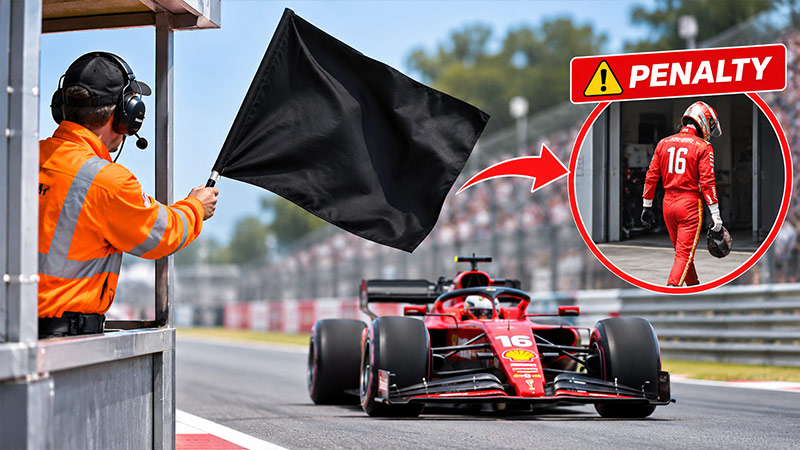
Of all the flags waved around a Formula 1 circuit, only one ends a driver’s race on the spot. The black flag is the sport’s ultimate sanction: a direct order to enter the pits, stop, and accept disqualification while the race goes on without you.
It is also one of the rarest sights in modern F1. Many fans have never seen it shown in a live race, yet it has decided championships, triggered race bans and changed how the sport is policed. Understanding it helps you read a race the way stewards and team strategists do.
What Does the Black Flag Mean in F1?
In Formula 1, the black flag means disqualification. A driver shown the black flag with their car number must enter the pit lane on the next lap and stop. Their session is over, and they are removed from the results.
Unlike most track flags, the black flag is aimed at one driver, not the whole field. Marshals at the start/finish line wave it alongside a board showing the car’s number, so there is no doubt about who it is for.
The same instruction appears on the circuit’s digital light panels and the car’s dashboard, and race control alerts the team, which radios the driver.
| Question | Answer |
|---|---|
| Who does it target? | One driver, identified by car number |
| What must the driver do? | Enter the pits on the next lap and stop |
| What does it mean? | Immediate disqualification from the session |
| Who orders it? | The stewards, acting through race control |
Think of it as motorsport’s red card. Formula 1 has its own yellow card too, the black-and-white flag, which we cover below. The black flag is the final step, used when a warning or a time penalty is no longer enough.
The Rules Behind the Black Flag
The black flag is defined in the FIA International Sporting Code, the rulebook for all FIA-sanctioned motorsport, including Formula 1. Its Appendix H sets out every flag signal used at circuits worldwide. That is why the black flag means the same thing at Monza, Suzuka or Las Vegas.
Who decides to show it?
In Formula 1, disqualification is a decision for the stewards, a panel of FIA-appointed officials that usually includes a former racing driver. Race control then carries out the order, instructing marshals to display the flag and sending the message to the team and the car.
When can it be shown?
The rules give stewards broad discretion, but the most common grounds include:
- Failing to serve a drive-through or stop-go penalty within the permitted number of laps
- Ignoring other flags or instructions from race control
- Dangerous or seriously unsportsmanlike driving
- Serious pit lane breaches, such as leaving the pits against a red light
- Persistent misconduct that continues after earlier warnings
What must the driver do?
The driver must enter the pit lane the next time they reach the pit entry, then stop. There is no option to keep racing and argue later. Ignoring the flag turns one offence into a second, more serious one, and history shows the stewards punish that harshly.
Does it apply outside the race?
Yes. The black flag can be shown in any track session: practice, qualifying, sprint or Grand Prix.
It is worth separating the flag from the outcome, though. Most disqualifications in today’s F1 are issued after the chequered flag, when checks uncover a technical breach. In those cases the driver is disqualified, but no black flag is ever waved.
Black Flag vs Black-and-White vs Black-and-Orange
Three F1 flags feature black, and mixing them up is one of the most common mistakes new fans make. Each one is aimed at a single driver, but each sends a very different message.
| Flag | What it means | What the driver must do | Severity |
|---|---|---|---|
| Black | Disqualification | Enter the pits on the next lap and stop; session over | Highest: the final sanction |
| Black-and-white (split diagonally) | Warning for unsportsmanlike or repeated offences, including track limits | Keep racing; a further offence brings a penalty | Formal warning |
| Black with an orange circle | Mechanical problem that puts the driver or others at risk | Pit on the next lap for repairs; may rejoin once fixed | Safety instruction, not a punishment |
The black-and-white flag: F1’s yellow card
The black-and-white flag tells a driver the stewards are watching. In recent seasons it has become familiar through track limits. A driver who runs wide too often typically receives it after the third offence, and the next one brings a time penalty.
The black-and-orange flag: the “meatball”
Fans call the black-and-orange flag the “meatball” because of its orange disc. It is about safety, not discipline. Loose bodywork, a dangling wing endplate or a fluid leak can all trigger it.
Haas driver Kevin Magnussen saw it several times during the 2022 season because of damaged bodywork. Once the team fixes the problem, the car can rejoin the race with no further penalty.
Why the Black Flag Is So Rare in Modern F1
The black flag was a regular part of F1 life in the 1980s and 1990s. Today it has almost disappeared from races; the most recent case most fans point to came at the 2007 Canadian Grand Prix. Five changes explain why.
- A wider penalty ladder. Stewards can choose 5- and 10-second time penalties, drive-throughs, 10-second stop-go penalties and grid drops. They match the punishment to the offence instead of ending a race outright.
- Superlicence penalty points. Drivers collect points on their licence for offences. Reaching 12 points within 12 months brings an automatic one-race ban, so discipline builds over a season rather than resting on one flag.
- Post-race review. Stewards study video, telemetry and team radio. They can investigate after the race instead of acting in the heat of the moment.
- Instant communication. Digital light panels, dashboard messages and constant team radio make it almost impossible to “miss” an instruction, which removes the old excuse.
- Technical checks after the finish. Breaches such as an underweight car are found in post-race scrutineering, so disqualification now happens on paper, not on track.
Recent high-profile disqualifications show that last point clearly. None of these drivers saw a black flag:
| Year | Race | Driver | Reason for disqualification |
|---|---|---|---|
| 2024 | Belgian Grand Prix | George Russell | Car below the minimum weight |
| 2023 | United States Grand Prix | Lewis Hamilton and Charles Leclerc | Excessive plank wear |
| 2021 | Hungarian Grand Prix | Sebastian Vettel | Insufficient fuel sample after the race |
The result is a sport that still disqualifies drivers, just rarely in front of the crowd.
Famous Black Flag Moments in F1 History
A handful of black flags have become part of F1 folklore. Each one changed a race, and some changed a championship.
| Year | Race | Driver(s) | Offence | Outcome |
|---|---|---|---|---|
| 2007 | Canadian Grand Prix | Felipe Massa, Giancarlo Fisichella | Left the pits against a red light | Both disqualified |
| 2005 | Canadian Grand Prix | Juan Pablo Montoya | Left the pits against a red light | Disqualified |
| 1994 | British Grand Prix | Michael Schumacher | Ignored the black flag after a formation-lap penalty | Disqualified, two-race ban |
| 1989 | Portuguese Grand Prix | Nigel Mansell | Reversed in the pit lane, then ignored the black flag | Disqualified, fined, one-race ban |
Nigel Mansell, Portugal 1989
At Estoril, Mansell overshot his Ferrari pit box and reversed back into it, which the rules forbid. The stewards black-flagged him, but he stayed out for several laps, later insisting he had not seen the flag.
Then he collided with Ayrton Senna at the first corner, ending both their races and denting Senna’s title hopes against Alain Prost. Mansell was fined $50,000 and banned from the next race in Spain.
Michael Schumacher, Britain 1994
At Silverstone, Schumacher passed Damon Hill on the formation lap and was handed a five-second stop-go penalty. Confusion between Benetton and race control meant he did not come in. He was then shown the black flag and ignored it for several laps before finally serving the original penalty.
He crossed the line second but was later stripped of the result and banned for two races, and Benetton was fined $500,000. Schumacher still won the 1994 title, but by a single point over Hill.
Montreal 2005 and 2007: the pit-exit trap
The Circuit Gilles Villeneuve produced black flags in two races three years apart, both for the same mistake. In 2005, Juan Pablo Montoya left the pits during a safety car period while the exit light was red. In 2007, Felipe Massa and Giancarlo Fisichella did exactly the same.
All three were black-flagged and disqualified. The lesson for every team was simple: the pit exit light is not a suggestion.
What a Black Flag Means for Drivers, Teams and the Championship
A black flag costs far more than one result. Its effects spread across the whole season.
For the driver
A disqualified driver scores zero points from that session. If the offence involves ignoring instructions or dangerous driving, the stewards can add fines, superlicence penalty points or a race ban. A single afternoon can dent a reputation built over years.
For the team
Constructors’ points vanish too, and those points shape prize money at the end of the season. The flag also tests a team’s processes. Benetton’s confusion in 1994 and the pit exit errors in Montreal show that teams share responsibility for relaying penalties and managing pit stops.
For the championship
Points lost to a black flag can swing a title. Schumacher’s 1994 disqualification and ban took a large bite out of a season he won by one point. In a close fight, a disqualification can matter as much as any crash or engine failure.
For fans
Knowing the signal helps you read a broadcast. When the black flag appears, the story of the race changes immediately, often before the commentators have caught up.
Conclusion
The black flag is Formula 1’s final word. It removes a driver from a session on the spot, and it is reserved for moments when a warning or a time penalty is no longer enough.
Today it appears far less often than in the 1980s and 1990s, thanks to a wider range of penalties, sharper race control systems and post-race reviews.
Yet its history still matters. Mansell’s clash with Senna, Schumacher’s lost points in 1994 and the pit-exit errors in Montreal all show how one ignored signal can reshape a season.
Knowing the difference between the black, black-and-white and black-and-orange flags helps you read every race with more confidence, and see the real decisions behind the drama as they happen.