A Formula 1 driver can lead for 50 laps, cross the line first, and still lose the win in the stewards’ room. Five seconds is all it takes.
In a sport where gaps are measured in thousandths of a second, a time penalty is one of the officials’ most powerful tools. It is also one of the most misunderstood.
If you have ever watched a race and wondered why a driver finished third on the road but was classified sixth, or why a pit crew stood frozen with their hands off the car, this guide is for you.
Below, we explain exactly what a time penalty in F1 is, who decides it, the different types, and how drivers serve them.
You will also learn what happens when a penalty goes wrong, see real examples from recent seasons, and find out how teams build race strategy around a penalty in real time.
What Is a Time Penalty in F1?
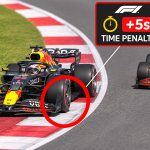
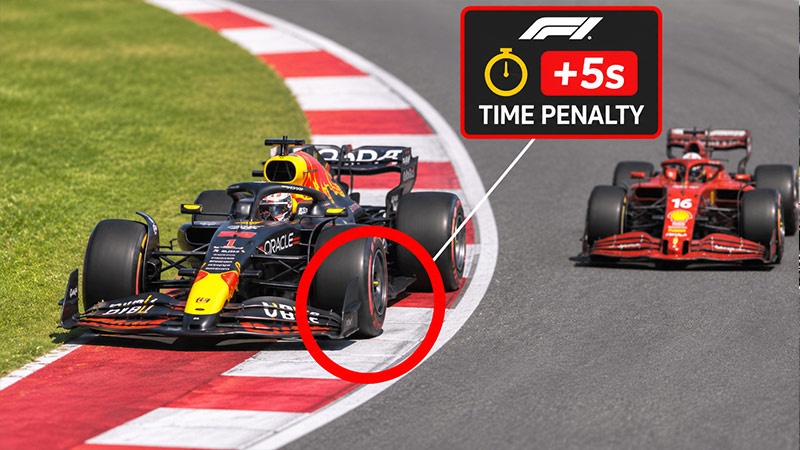
A time penalty in F1 is a punishment that adds a fixed number of seconds to a driver’s race. The stewards issue it when a driver breaks the FIA Sporting Regulations. The most common versions are the 5-second and 10-second penalties.
A driver serves a time penalty by stopping in the pit box for the penalty time before the crew can work on the car. If the driver does not pit again, the seconds are added to their total race time at the finish, and the results are reshuffled.
Think of it as a proportionate punishment. It is harsh enough to cost places, yet light enough to keep the driver in the race. That balance is why time penalties are the stewards’ first choice for most on-track incidents, from causing a collision to repeatedly exceeding track limits.
Who Hands Out Time Penalties? Meet the F1 Stewards
Penalties in Formula 1 come from the stewards, a panel of officials appointed for each event under the authority of the FIA, the sport’s governing body.
The panel is usually made up of four people: a chair, a former racing driver who brings first-hand experience, and stewards that include a representative of the host country’s motorsport authority.
Race control flags incidents during a session, but it does not decide the punishment. That job belongs to the stewards. They review onboard and broadcast video from several angles, along with telemetry, team radio and timing data. When needed, they call drivers and team representatives in for a hearing.
To keep decisions consistent, the stewards work from the FIA’s penalty guidelines and driving standards guidelines. These set a starting point for common offences, which the panel can raise or lower depending on the circumstances.
These guidelines change over time. Ahead of the 2024 season, the baseline penalty for causing a collision rose from 5 to 10 seconds to create a stronger deterrent. For 2026, the FIA updated its driving standards guidelines again after drivers argued that penalty points were being handed out too freely for minor offences.
The Different Types of Time Penalties in F1
The stewards can choose from a ladder of race-day time penalties, from the lightest to the most severe. Here is how each one compares.
| Penalty | How it is served | If it can’t be served in time | Typical cost |
|---|---|---|---|
| 5-second time penalty | Car waits 5 seconds in the pit box before any work begins | 5 seconds added to race time | About 5 seconds |
| 10-second time penalty | Car waits 10 seconds in the pit box before any work begins | 10 seconds added to race time | About 10 seconds |
| Drive-through penalty | Driver travels the full pit lane at the speed limit without stopping | 20 seconds added to race time | About 20 seconds |
| 10-second stop-and-go | Car stops in the pit box for 10 seconds with no work allowed, then rejoins | 30 seconds added to race time | About 30 seconds |
5-Second Time Penalty
This is the lightest and most frequent time penalty. It typically covers smaller offences, such as repeated track-limit breaches or lining up incorrectly on the grid. The driver can serve it at a planned pit stop or take it as 5 seconds added at the end.
10-Second Time Penalty
It works the same way at double the cost. It is now the standard starting point for causing a collision. In a tight midfield battle, where several cars can be covered by a handful of seconds, 10 seconds can easily cost multiple places.
Drive-Through Penalty
The driver must enter the pit lane, travel its full length at the pit-lane speed limit and rejoin the track without stopping.
Because the car runs slowly through the whole lane, this usually costs around 20 seconds. It must be served on its own, so the team cannot combine it with a tyre change.
10-Second Stop-and-Go Penalty
This is the harshest time penalty short of disqualification. The driver stops in the pit box for 10 seconds; the crew may not touch the car, and then the driver rejoins.
Combined with the pit-lane transit, it typically costs about 30 seconds, which is often enough to end any hope of a strong result.
How Drivers Serve a Time Penalty
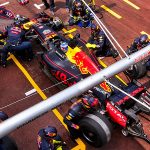
For 5- and 10-second penalties, the process is strict and very visible on TV. When the driver makes a pit stop, the car must stay stationary in its box for the full penalty time. Only then can the crew lift the car, change tyres or adjust the front wing.
These are the key rules every team must follow:
- No contact at all. Neither mechanics nor equipment may touch the car until the penalty time has passed. The FIA made this explicit in 2023: even a jack resting against the car counts as working on it.
- Cooling fans are allowed, as long as they do not physically touch the car.
- Penalties can be stacked. If a driver collects more than one time penalty before pitting, they can be served together. A 5-second and a 10-second penalty become one 15-second wait.
- The next stop counts. The penalty must be served the next time the driver pits, and that includes stops made under a Safety Car or Virtual Safety Car.
- Drive-throughs and stop-and-go penalties follow their own rules. They must be served separately, under green-flag conditions, within a short window after the team is notified.
In practice, a 5-second penalty served at a stop often costs slightly more than 5 seconds. The crew has to wait for the full time, react to the signal and then complete the stop, so a fraction of a second is usually lost on top.
What Happens If a Time Penalty Isn’t Served?
There are three common scenarios, and each one has a clear outcome.
- The driver doesn’t pit again. The seconds are simply added to the driver’s total race time at the finish. The results are then recalculated, which is why a driver can cross the line in one position and be classified lower.
- The penalty comes too late to serve. If a drive-through or stop-and-go is issued in the last three laps, or after the race, it can’t be served in the pit lane. Instead, a drive-through becomes 20 seconds added to race time, and a 10-second stop-and-go becomes 30 seconds.
- The penalty is served incorrectly. If the crew touches the car too early, the stewards can issue a further, heavier penalty. A wrongly served 5-second penalty can escalate into a drive-through.
There is one more case worth knowing. If a driver retires before serving a time penalty, the stewards may convert it into a grid penalty for the next event. Daniel Ricciardo found this out in 2024. A 10-second penalty for passing under Safety Car conditions at the Chinese Grand Prix became a three-place grid drop for the Miami Sprint, because he retired before it could be applied.
Common Offences That Earn a Time Penalty
Most time penalties fall into a handful of familiar categories:
- Causing a collision. The classic case. The guideline starting point is now 10 seconds, with more for aggravating circumstances.
- Forcing another driver off the track. Squeezing a rival beyond the track edge when they are entitled to racing room.
- Leaving the track and gaining an advantage. Cutting a corner to pass a rival, or to keep a position, without giving the place back.
- Repeated track-limit breaches. After a black-and-white warning flag, further breaches usually bring a 5-second penalty.
- Speeding in the pit lane. Pit-lane speed is monitored electronically, so even a small excess is caught.
- Start and grid offences. Jumping the start or stopping outside the correct grid slot.
- Safety Car and flag infringements. Overtaking under Safety Car conditions or failing to slow down enough for yellow flags.
- Unsafe release. Sending a car out of the pit box into the path of another car, which can lead to a time penalty for the driver or a fine for the team.
Time Penalties vs Grid Penalties vs Penalty Points
These three are often confused, but they work in very different ways.
| Sanction | When it applies | What it does |
|---|---|---|
| Time penalty | During a race or Sprint, or straight after it | Adds seconds at a pit stop or to the final race time |
| Grid penalty | At the start of the current or next event | Moves a driver back a set number of places on the starting grid |
| Penalty points | On the driver’s Super Licence, for 12 months | Build towards a ban: 12 points within 12 months means missing a race |
Grid penalties most often follow power unit or gearbox changes beyond the permitted allocation, or offences in practice and qualifying.
Penalty points, introduced in 2014, work much like points on a road driving licence. They usually come alongside a time penalty for driving offences, and each set expires 12 months after it was issued. Kevin Magnussen became the first driver banned under the system, missing the 2024 Azerbaijan Grand Prix after reaching 12 points. Oliver Bearman took his seat for that race.
Real Races Shaped by Time Penalties
Nothing shows the impact of a time penalty better than real examples from recent seasons.
Fernando Alonso, Saudi Arabian Grand Prix 2023
Alonso received a 5-second penalty for lining up incorrectly in his grid slot and served it at his only stop. The stewards then ruled that the rear jack had touched his car during the wait and added a further 10 seconds after the race, dropping him off the podium.
Aston Martin won a right of review, the extra penalty was withdrawn, and his podium was restored. The episode led the FIA to clarify that no equipment may touch a car while it serves a penalty.
Carlos Sainz, Australian Grand Prix 2023
A 5-second penalty for a collision at a late restart cost Sainz far more than it sounds. With the field finishing bunched together behind the Safety Car, he dropped from fourth to twelfth. The lesson: the real cost of a penalty depends on the gaps around the driver.
Fernando Alonso, Australian Grand Prix 2024
The stewards ruled that Alonso’s unusual move before George Russell’s crash was potentially dangerous. They issued a post-race drive-through penalty, converted into 20 seconds, which moved him from sixth to eighth and added three penalty points to his licence.
Charles Leclerc, Miami Grand Prix 2026
After a last-lap spin, Leclerc was found to have left the track and gained an advantage. His post-race drive-through became 20 seconds of added time, and he fell from sixth to eighth in the final classification.
How Teams Plan Strategy Around a Time Penalty
The moment a penalty is announced, the strategy calls on the pit wall change. Teams usually weigh three options.
- Build the gap. If the driver is in clear air, the team asks them to push and open a margin larger than the penalty over the car behind. A driver who finishes more than 5 seconds clear keeps the position despite a 5-second penalty.
- Serve it at the planned stop. Most teams take the penalty during a scheduled tyre change, which costs only the penalty time plus a small reaction delay.
- Leave it to the finish. If the driver has already made their final stop, the seconds go on at the end. The focus then shifts to managing the gap to rivals over the remaining laps.
Timing matters as much as size. A penalty hurts most when the field is close together, such as late in a race or after a Safety Car restart. It hurts least when the driver already has a large cushion.
Clear, calm communication between the strategist, the driver and the pit crew is critical. A single mistake in the box, such as a mechanic moving in too early, can turn a small penalty into a much bigger one.
Conclusion
A time penalty in F1 is far more than a few seconds on a timing screen. It is the stewards’ main tool for keeping racing fair, and it can decide podiums, points and championships.
Now you know how the 5- and 10-second penalties work, why the crew must keep their hands off the car, and how drive-throughs and stop-and-go penalties turn into 20 or 30 seconds when time runs out.
You also know how teams respond, by building a gap or timing the stop to limit the damage. Next time a penalty flashes up, you will understand exactly what it means for the result.