Picture this. You are leading a Formula 1 Grand Prix, the gap behind you is comfortable, and the win looks certain. Then a message from race control flashes up on the timing screens, and in the space of half a minute your race is gone.
That is the brutal power of the stop-go penalty. It is the harshest punishment the stewards can hand out during a race, short of disqualification, and it has turned certain victories into damage-limitation drives more than once.
Whether you are a new fan who just heard the term on a broadcast, or a long-time follower who wants to understand the finer rules, this guide covers everything.
You will learn what a stop-go penalty is, how it is served, what it costs, which offences trigger it, and how it compares with every other F1 penalty.
What Is a Stop-Go Penalty in F1?
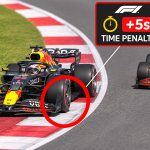
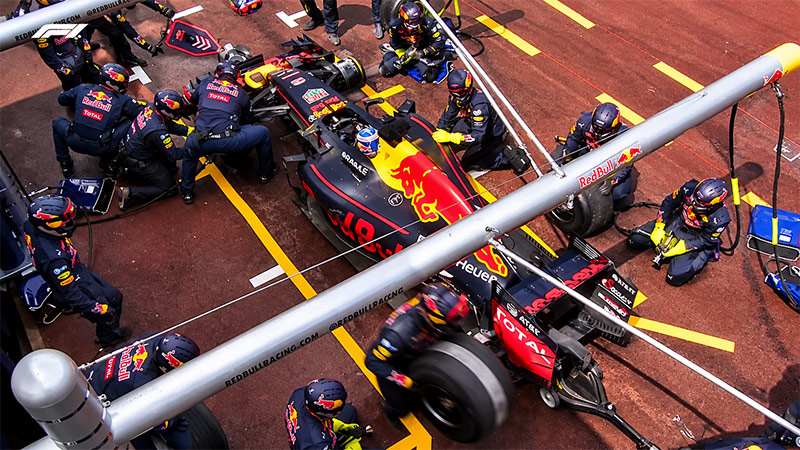
A stop-go penalty is an in-race punishment that forces a Formula 1 driver to enter the pit lane, stop in their pit box for 10 seconds, and then rejoin the race, with no work of any kind allowed on the car during the stop.
Its official name in the FIA Formula 1 Sporting Regulations is the “ten second stop-and-go penalty”. You will also hear commentators call it a stop-and-go, a stop/go, or simply a 10-second stop-go. They all mean the same thing.
The race stewards, a panel of experienced officials that includes a former driver, decide when it applies. Under the 2026 rules, it sits alongside the 5-second penalty, the 10-second penalty and the drive-through as one of the four penalties a driver serves in the pit lane during a race.
What makes it so severe is simple. A normal 5- or 10-second time penalty can be served during a routine pit stop, so the team still gets fresh tyres in the same visit. A stop-go cannot be combined with anything. The driver makes an extra, unplanned trip through the pits that brings no benefit at all.
How a Stop-Go Penalty Works, Step by Step
Serving a stop-go follows a strict sequence set out in Article B1.9.6 of the 2026 Sporting Regulations. Here is what happens from the moment the stewards make their call.
- The stewards decide. After reviewing telemetry, onboard video and team radio, the stewards confirm the offence. The team receives written notice, and every other team sees the decision on the official messaging system.
- The clock starts. From that notification, the driver may cross the start-finish line on track no more than twice before entering the pit lane. In practice, that gives the team two laps to bring the car in.
- The driver enters the pits. The car must obey the pit lane speed limit, usually 80 km/h, all the way to its pit box.
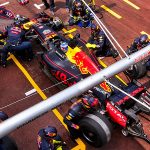
- The car stops for 10 seconds. The driver sits stationary in the team’s designated pit stop position while the 10 seconds count down.
- Hands off. While the car is stationary for the penalty, it may not be worked on. No tyre change, no front wing adjustment, no top-up of anything. The crew stands back and watches.
- The driver rejoins. Once the time has elapsed, the driver leaves the box, travels down the rest of the pit lane at the speed limit and rejoins the race.
There is one small safety valve. If the engine stalls during the stop and the driver cannot restart it alone, mechanics may help, but only after the full penalty period has passed.
How Much Time Does a Stop-Go Penalty Cost?
The 10 seconds in the name are only part of the story. A stop-go typically costs around 30 seconds of race time, and sometimes more.
That total comes from three pieces stacked on top of each other:
- The pit lane trip. Driving the length of the pit lane at the speed limit, instead of racing past it, usually costs somewhere between 15 and 25 seconds depending on the circuit.
- The stationary period. A full 10 seconds parked in the box.
- Slowing down and speeding up. Braking into the box and pulling away again adds a little more on top.
Real races show the scale. At Monza in 2020, Lewis Hamilton’s stop-go worked out at a net loss of roughly 30 seconds. At the 2024 Qatar Grand Prix, Lando Norris lost about 35 seconds to his.
Then there are the hidden costs. Because the crew cannot change tyres, the driver often still needs a normal pit stop later, so the penalty does not replace any planned visit.
And if the field is bunched up, for example just after a Safety Car, 30 seconds can mean dropping from the front to the very back.
Why Do Drivers Get a Stop-Go Penalty?
Stop-go penalties are kept for offences that put people at risk or hand a driver a large, unfair gain. The FIA’s 2026 penalty guidelines list them clearly, and they fall into a handful of groups.
Flags and safety
- Failing to slow for double-waved yellow flags, or overtaking under them
- Failing to slow for red flags (the stewards may also choose a black flag)
Safety Car and Virtual Safety Car
- Overtaking the Safety Car
- Passing more than two cars behind the Safety Car or under the Virtual Safety Car
- Driving well above the required pace under a Safety Car or Virtual Safety Car, measured across mini-sectors on the track
Pit lane
- Entering the pit lane when the pit entry is closed
- Speeding in the pit lane by more than 15 km/h
- Leaving the pit lane through a red light at pit exit
- An unsafe release, where the team sends a car away in an unsafe condition
Race start and formation lap
- A jump start, depending on how far the car moved early
- Failing to have all four wheels fitted by the five-minute signal
- Failing to enter the pit lane when out of position at the end of the formation lap
Tyres and driving conduct
- Failing to change onto the correct tyres within three laps when told to
- Causing a collision with apparently deliberate or reckless intent
- Forcing another driver off the track recklessly, dangerously or deliberately
One detail matters a great deal here. For some offences, such as entering a closed pit lane or an unsafe release, the stop-go is mandatory.
The stewards have no room to choose a lighter penalty, however unlucky the driver may have been. For others, like a collision, the stop-go is one option on a scale, and the stewards pick the level that fits the incident.
Stop-Go vs Drive-Through vs Time Penalties
The stop-go sits near the top of the F1 penalty ladder. Only disqualification, and in extreme cases suspension, sits above it among the sanctions handed out on race day. This table shows how it compares.
| Penalty | How it is served | Work on the car? | Approx. time lost | Typical offences |
|---|---|---|---|---|
| 5-second penalty | Held for 5 s at the next pit stop, or 5 s added at the finish | Only after the 5 s have passed | About 5 s | Track limits, minor contact |
| 10-second penalty | Held for 10 s at the next pit stop, or 10 s added at the finish | Only after the 10 s have passed | About 10 s | Collisions, forcing a rival off track |
| Drive-through | Drive through the pit lane at the speed limit without stopping, within two laps | No stop is made | About 15 to 25 s | Dangerous pit entry or exit, some collisions |
| 10-second stop-go | Stop in the pit box for 10 s, within two laps | Never during the stop | About 25 to 35 s | Double yellows, Safety Car breaches, closed pit lane |
| Disqualification | Removed from the results | Not applicable | The whole result | Technical breaches, ignoring a black flag |
The key difference between the two most severe in-race penalties is easy to remember. A drive-through means pass through without stopping.
A stop-go means stop, wait 10 seconds, then go. That extra 10 seconds of standing still is why the stop-go is the tougher of the two.
Special Rules Every Fan Should Know
The basic idea is simple, but the rulebook covers several edge cases. These are the ones that most often decide how a stop-go plays out.
Late-race penalties become 30 seconds
If the stewards hand out a stop-go during the last three laps, or after the race has finished, the driver does not stop at all. Instead, 30 seconds are added to their race time. A late drive-through becomes 20 seconds in the same way.
No serving under the Safety Car or Virtual Safety Car
A driver may not serve a stop-go while the Virtual Safety Car is running or once the Safety Car has been deployed, unless they were already in the pit entry or pit lane to do it. This stops anyone from using a neutralised race to soften the blow.
Retiring does not wipe the slate clean
If a driver retires before serving a stop-go, the stewards can give them a grid place penalty for the next race instead.
Ignoring it makes things worse
Failing to serve the penalty correctly can bring a further penalty, which replaces the original one. In practice, a driver who refuses to come in risks being shown the black flag.
There is no appeal
In-race penalties such as the stop-go cannot be appealed. Once the stewards decide, the team has to take it.
Penalty points may follow
Many stop-go offences also carry penalty points on the driver’s FIA Super Licence. Failing to slow for double yellows, for example, can bring up to three points, and reaching 12 points within 12 months triggers a one-race ban.
Famous Stop-Go Penalties in F1 History
Stop-go penalties are rare because they are so severe, which is exactly why the ones that do happen tend to become talking points for years.
Michael Schumacher, British Grand Prix 1998
The strangest stop-go story of all. Schumacher was penalised late in the race for passing Alexander Wurz under the Safety Car, and there was confusion over whether the stewards meant a time penalty or a stop-go.
Ferrari played it safe and called him in on the final lap. Because Ferrari’s pit box sat beyond the finish line, Schumacher crossed the line in the pit lane and won the race before he even stopped.
The penalty was later rescinded. Today’s rule, which turns late stop-go penalties into 30 seconds of added time, makes a repeat impossible.
Kimi Räikkönen, Belgian Grand Prix 2017
Räikkönen received a 10-second stop-go at Spa for failing to slow for double-waved yellow flags. It is still cited as a precedent whenever a yellow-flag stop-go is handed out.
Lewis Hamilton, Italian Grand Prix 2020
Hamilton was cruising to victory from pole at Monza when Mercedes called him in under a Safety Car, not realising the pit lane had just been closed so marshals could recover Kevin Magnussen’s stopped Haas.
He entered 12 seconds after the closure and received a mandatory stop-go, as did Antonio Giovinazzi. Hamilton served it after a red-flag restart, dropped to last, and fought back to seventh. Pierre Gasly took a shock first win.
Lando Norris, Qatar Grand Prix 2024
Norris was running second behind Max Verstappen when a mirror from Alex Albon’s Williams fell onto the main straight.
The stewards found that Norris had not lifted through the double-waved yellow zone, and gave him a 10-second stop-go.
He fell from second to 15th, then recovered to 10th and set the fastest lap. Norris accepted the penalty as fair and admitted he had simply missed the flags.
The Strategy Behind Serving a Stop-Go
A stop-go is pure damage limitation, but smart teams still find ways to lose less. Here is what goes on behind the pit wall once the penalty arrives.
- Pick the best of the two laps. The team does not have to pit immediately. It can use the window to bring the driver in when the gap to the cars behind is largest, or when there is clear track to rejoin into.
- Build a buffer first. If the penalty is announced early, the driver may push hard for a lap to stretch the gap. If the car behind is more than about 30 seconds back, the stop may not cost a single position.
- Re-plan the tyres. Since no tyres can be changed during the stop, the strategists must rethink the rest of the race around the set already on the car.
- Protect the restart. The crew stays clear of the car, and the driver focuses on a clean getaway. A stall would cost even more time, because help is only allowed once the 10 seconds are up.
- Mind the neutralisations. Because the penalty cannot be served under a Safety Car or Virtual Safety Car, a well-timed caution period can change the picture, and teams watch race control closely.
For fans, there is a simple trick to follow the drama at home. Watch the timing gap between the penalised driver and the car behind. If it is bigger than the cost of the stop at that circuit, the driver keeps the place. If not, the race is about to change.
Conclusion
A stop-go penalty is Formula 1’s toughest in-race punishment, and for good reason. It sends a driver into the pits for a 10-second wait with no help from the crew, usually costing around 30 seconds and sometimes a podium.
The stewards save it for serious offences, such as ignoring double yellow flags, breaking Safety Car rules or entering a closed pit lane, because those moments put drivers and marshals at risk.
Knowing how it works makes every race more gripping, from the two-lap serving window to the 30-second late-race rule.