Picture this. A driver takes the chequered flag in first place, the crowd is on its feet, and he still loses the win. No crash. No engine failure. Just five seconds.
That is exactly what happened to Sebastian Vettel at the 2019 Canadian Grand Prix. He crossed the line ahead of Lewis Hamilton, but a five-second time penalty for an unsafe rejoin handed the victory to his rival.
Vettel was so frustrated that he walked into parc fermé and swapped the position boards in front of the cars.
Five seconds sounds tiny. In a sport where races are often decided by tenths, it can be anything but. It can cost a podium, rewrite a pit strategy, or swing a championship fight.
In this guide, you will learn exactly what a five-second penalty in F1 is, how drivers serve it, which offences trigger it, how it compares with other penalties, and how teams try to limit the damage.
Whether you are brand new to Formula 1 or a long-time fan who wants the rules straight, this is the explainer to keep on hand for race day.
What Is a Five-Second Penalty in F1? The Quick Answer
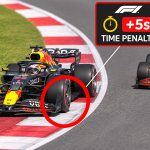
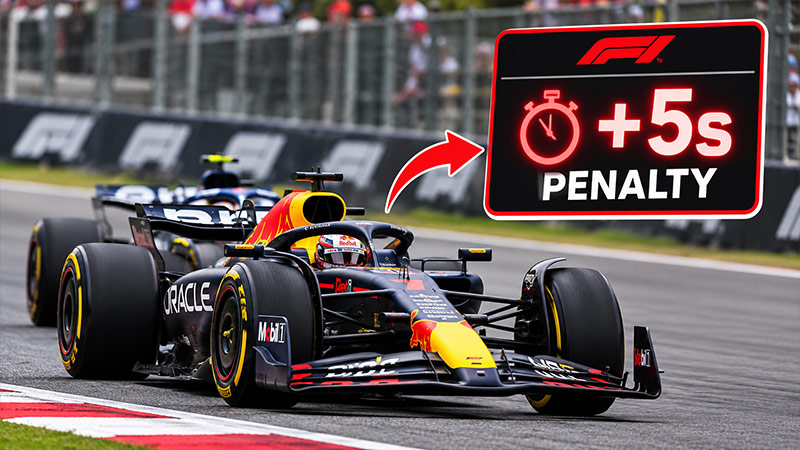
A five-second penalty is the lightest time penalty the FIA stewards can give a driver during a Formula 1 race or sprint.
The driver must stop in their pit box for five seconds before the crew is allowed to touch the car. If the driver does not pit again, five seconds are added to their final race time instead.
Here is the whole thing at a glance:
- Who gives it: the FIA stewards at each Grand Prix
- When: during a race or sprint, or after the chequered flag
- How it is served: a five-second stationary wait at the next pit stop, or five seconds added to race time
- Typical reasons: jump starts, lining up outside the grid box, pit-lane speeding, repeated track-limits breaches, and collisions with mitigating circumstances
- Can it be appealed? No. A team can only ask for a “right of review” if it finds significant new evidence
The five-second penalty arrived in the rulebook in 2014. Before that, the mildest in-race option was usually a drive-through, which could cost 20 seconds or more for a small mistake.
The new penalty gave stewards a way to punish minor offences without wrecking a driver’s whole afternoon.
How a Five-Second Penalty Is Served, Step by Step
The rule is simple on paper. In practice, it creates one of the tensest moments of any race. Here is how it works under the current FIA Sporting Regulations.
- The stewards announce the penalty. Race Control tells the team, and the decision appears on the timing screens and TV graphics.
- The driver serves it at the next pit stop. There is no extra stop. The penalty is taken the next time the car enters the pit lane to stop.
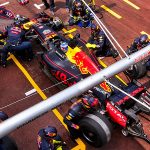
- The car sits still for five seconds. The driver stops in the pit box and waits. Nobody may work on the car during this time.
- The crew gets to work. Once five seconds have passed, the mechanics change the tyres as normal and release the car.
What counts as “working on the car”?
This is where teams get caught out. Under the 2026 rules, touching the car or the driver with hands, tools or equipment counts as work.
A jack resting against the rear of the car counts too. Cooling fans may sit close by, but they must not touch the car until the time is up.
What if the driver does not pit again?
A driver can choose not to stop again. In that case, five seconds are simply added to their total race time. The same happens when the penalty arrives after the race has finished. That is why a driver can cross the line in one position and be classified in another.
Can it be served under a Safety Car?
Yes. This was once banned, but today a driver who stops in their pit box under a Safety Car or Virtual Safety Car serves the penalty there. Rolling through the pit lane only to follow the Safety Car does not count. The car has to actually stop.
What if the driver retires first?
If a driver is not classified at the finish, the unserved penalty does not simply disappear. The stewards can turn it into a grid-place penalty at the driver’s next race.
Can penalties be stacked?
Yes. Several time penalties picked up before a stop can be served together. A five-second and a ten-second penalty, for example, can be served as one 15-second wait.
What Earns a Driver a Five-Second Penalty?
Five seconds is the go-to punishment for small breaches that gave a driver little or no lasting advantage. These are the offences you will see most often.
| Offence | What it means | Recent example |
|---|---|---|
| False start | The car moves before the start lights go out. Small movements usually draw five seconds; a bigger gain can mean ten seconds or a drive-through. | Lewis Hamilton, 2026 British GP |
| Out of grid position | The car lines up outside its marked grid box. | Fernando Alonso, 2023 Saudi Arabian GP |
| Pit-lane speeding | The driver exceeds the pit-lane speed limit during the race. In practice and qualifying, the team is fined instead. | Lewis Hamilton, 2026 Monaco GP |
| Repeated track limits | The car leaves the track more than three times. A black-and-white warning flag comes first; the next breach brings the penalty. | Common at tracks like Austria |
| Collision with mitigating factors | The driver is to blame for contact, but something lessens the blame or the impact. | Lando Norris, 2025 Canadian GP |
A quick word on track limits
The rule is precise. A driver has left the track when no part of the car is still touching it. The white lines count as part of the track, but the kerbs do not.
For 2026, stewards can also wipe out a track-limits strike if it came from a failed overtaking attempt and the driver gained no clear advantage.
Why collisions now usually cost ten seconds
For years, five seconds was the standard price for causing a collision or leaving the track to gain an advantage.
Drivers and teams argued it was too cheap, because a driver could commit a foul and still come out ahead. So for 2024, the FIA raised the baseline to ten seconds
Today, a five-second penalty for a collision usually means the stewards found a mitigating factor.
Remember that the FIA penalty guidelines are a starting point, not a price list. The stewards judge every case on its own facts.
Five-Second Penalty vs Other F1 Penalties
The five-second penalty sits at the bottom of a ladder of in-race sanctions. Each step up costs more time and signals a more serious offence.
| Penalty | How it is served | Rough cost in the race | If applied late or after the race |
|---|---|---|---|
| Five-second time penalty | Wait five seconds at the next stop, or add it at the finish | About 5 s | 5 s added |
| Ten-second time penalty | Wait ten seconds at the next stop, or add it at the finish | About 10 s | 10 s added |
| Drive-through | Drive the length of the pit lane at the speed limit without stopping | About 15 to 25 s, depending on the pit lane | 20 s added |
| Ten-second stop-and-go | Stop for ten seconds, with no tyre change allowed | About 30 s or more | 30 s added |
| Grid penalty | Drop a set number of places at the start of the next race | Varies | Applied at the next race |
| Disqualification | Removed from the results | Everything | Applied after the race |
The key difference is the stop. A time penalty can be folded into a pit stop the team was going to make anyway. A drive-through or stop-and-go forces an extra trip down the pit lane, which is far more costly.
What about penalty points?
Penalty points are separate from time penalties. They go on a driver’s Super Licence and stay there for 12 months. A driver who reaches 12 points within that window is banned for a race.
From 2026, stewards only hand out points for driving that is dangerous or reckless, deliberate contact, or unsportsmanlike behaviour. So many five-second penalties now come with no points at all.
There is also a limit on reprimands. Five reprimands in one season, at least four of them for driving, bring a ten-place grid penalty.
The Strategy Behind Five Seconds
A five-second penalty rarely costs exactly five seconds. Once it lands, it changes how both the penalised team and its rivals run the rest of the race.
Building the gap
If the penalty will be added at the finish, the driver has to beat the car behind by more than five seconds to keep the position. The pit wall turns that into a target on the radio: “Gap to car behind is 4.2, we need 5.5.”
Here is how the maths works in a simple case:
| Scenario | On the road | After the penalty |
|---|---|---|
| Driver A finishes 4.2 s ahead of Driver B | A is ahead | A is classified 0.8 s behind B |
| Driver A finishes 6.0 s ahead of Driver B | A is ahead | A keeps the place by 1.0 s |
At the 2023 Saudi Arabian Grand Prix, Fernando Alonso knew about his penalty early. He pushed hard and opened a gap of around seven seconds to George Russell, enough to protect third place.
Timing the pit stop
A normal stop keeps the car stationary for roughly two to three seconds. With the penalty, that becomes seven or eight.
That extra time can drop a driver behind cars they would otherwise have stayed ahead of. Teams may delay the stop to build a cushion, or wait for a Safety Car, when the whole field slows and a pit stop costs far less.
Taking it at the finish
A driver who no longer needs fresh tyres can skip a final stop and take the five seconds at the end. That works best when the gap behind is already large.
The rival’s view
The other side plays the same game in reverse. In Jeddah, Mercedes told Russell to stay within five seconds of Alonso, just in case. A penalty on one car can bring a quiet race back to life.
Five Famous Five-Second Penalties
These cases show how five seconds can decide a win, a podium or a points finish.
| Race | Driver | Offence | What happened |
|---|---|---|---|
| 2026 British GP | Lewis Hamilton (Ferrari) | False start | Served at his stop; lost second place and finished third behind Charles Leclerc and George Russell |
| 2025 Canadian GP | Lando Norris (McLaren) | Collision with teammate Oscar Piastri | Only five seconds instead of ten, because the crash changed no other driver’s result; Norris was already out of the race |
| 2023 Saudi Arabian GP | Fernando Alonso (Aston Martin) | Out of grid position | Served at his stop, then hit with ten more seconds for a jack touching the car; overturned on review |
| 2023 Australian GP | Carlos Sainz (Ferrari) | Collision with Alonso at a late restart | Dropped from fourth on the road to 12th, out of the points |
| 2019 Canadian GP | Sebastian Vettel (Ferrari) | Unsafe rejoin after running off track | Crossed the line first, classified second; Hamilton won |
The Alonso saga: why the pit crew matters
Alonso’s 2023 race in Jeddah is the best lesson in how not to serve a penalty, and how to fight back. He served his five seconds under the Safety Car. But the FIA’s Remote Operations Centre spotted the rear jack touching his car before the time was up.
After the podium ceremony, the stewards added ten seconds, which dropped him to fourth. Hours later, Aston Martin won a right of review.
The team argued that touching the car with a jack was not “working” on it. The penalty was cancelled and Alonso got his 100th career podium back.
The FIA then clarified the rule before the next race. Today, the wording leaves no doubt: hands, tools or equipment touching the car all count as work.
Who Decides? Inside the Stewards’ Room
No penalty is automatic. Every five-second penalty is a decision made by people, using evidence and a shared set of guidelines.
- Race Control spots an incident. The Race Director can report any on-track incident or suspected rule breach to the stewards.
- The stewards investigate. The panel, which usually includes a former racing driver, studies video, onboard footage, telemetry and team radio. They may call the drivers in to explain.
- They decide who is to blame. Stewards look at whether a driver was “wholly or predominantly” at fault, and whether anything lessens that blame.
- They choose the penalty. The FIA penalty guidelines give a baseline for each offence, which the stewards can raise or lower based on the facts.
- The decision is published. Every ruling comes with a written document explaining the reasoning.
Can a team fight a five-second penalty?
Time penalties cannot be appealed. A team’s only route is a “right of review”, and it only works when the team brings significant new evidence that the stewards did not have at the time. That is exactly how Aston Martin saved Alonso’s podium in 2023.
This process is a big part of why fans and teams trust the system. It is not perfect, and teams often call decisions harsh. But the reasoning is always on the record.
Five Myths About the Five-Second Penalty
Myth 1: The driver has to make an extra pit stop. No. The penalty is served at the next stop the team was already planning, or added to race time at the finish.
Myth 2: It always costs exactly five seconds. Rarely. Traffic, track position and pit timing can make it cost far more, or almost nothing if the driver already has a big gap.
Myth 3: Mechanics can start early as long as they are quick. They can stand ready, but any contact with the car before the five seconds are up, even from a jack, means the penalty was not served. That usually leads to a further, harsher penalty.
Myth 4: Five seconds is the standard punishment for a crash. Not anymore. Since 2024, the baseline for causing a collision is ten seconds. Five is now the reduced version.
Myth 5: A team can appeal it. Time penalties cannot be appealed. Only a right of review with significant new evidence can change the outcome.
Conclusion: Small Penalty, Big Consequences
A five-second penalty is the lightest time penalty in Formula 1, but it is rarely a small matter. The rule is simple: stop for five seconds at the next pit stop with nobody touching the car, or have the time added at the finish.
What makes it fascinating is everything around it. Gaps become targets, pit stops become gambles, and one jack touching a car can cost a podium.
Understanding it turns confusing results into clear stories. Next time the graphic flashes up, you will know exactly what it means.