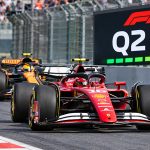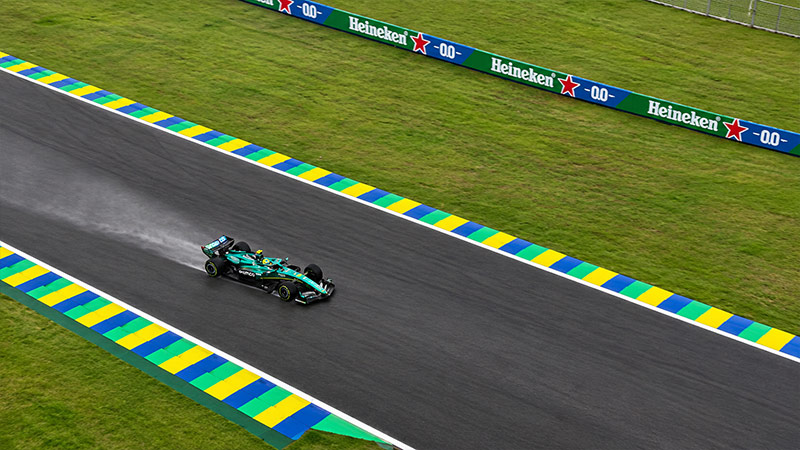
Saturday afternoon. Twenty-two cars, one perfect lap, and a gap between glory and disappointment measured in thousandths of a second. At the 2026 Hungarian Grand Prix, Lando Norris took pole by just 0.012 seconds over Lewis Hamilton. That is quicker than a blink.
That prize is called pole position, and it is one of the most celebrated achievements in Formula 1. Commentators count them, drivers chase them, and the record books treat them as the purest measure of raw speed.
If you are new to F1, the term can sound like insider language. This guide explains what pole position is, how a driver earns it under the 2026 rules, why it matters on race day, and which drivers have made it their own.
What Is Pole Position in F1?
Pole position is the first place on the starting grid of a Formula 1 Grand Prix. It goes to the driver who sets the fastest lap time in qualifying, as long as no penalty pushes them back.
That driver is called the pole-sitter, and they start the race at the very front of the field with an empty track ahead.
Think of it as the reward for being the fastest driver over one lap. At a standard race weekend, qualifying runs on Saturday, and its finishing order sets the grid for Sunday’s race.
A few related terms come up all the time:
- Pole-sitter: the driver who starts in first place.
- Front row: the first two grid slots, P1 and P2.
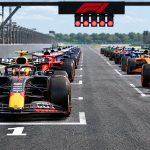
- Grid slot: each marked starting box on the track, set out in a staggered two-by-two pattern.
- Front-row lockout: when both drivers from the same team qualify first and second.
Where Does the Term “Pole Position” Come From?
The phrase comes from horse racing, not motor sport. On older racecourses, tall posts called poles marked the inside rail of the track. The horse that started next to the inside pole had the shortest route around the bends, which made it the best place to begin.
Motor racing borrowed the term, and Formula 1 has used it since the first World Championship race in 1950. The meaning never changed: it is the starting spot with the best route into the first corner.
What has changed, many times, is how F1 decides who gets it. Over the decades, drivers have qualified in a one-hour session with a lap limit and in single flying laps run one car at a time. Since 2006, F1 has used a three-part knockout.
A short-lived elimination format at the start of 2016 was dropped after just two races, because cars often sat in the garage as the clock ran down.
How Is Pole Position Decided? F1 Qualifying Explained
Pole position is decided in qualifying, a timed session split into three knockout rounds: Q1, Q2 and Q3. Every driver tries to set their best single lap. The slowest drivers drop out after each round, and the final 10 fight for pole.
With Cadillac joining as the 11th team in 2026, the grid grew from 20 to 22 cars, the largest field since 2016. The FIA kept the familiar structure but now removes six cars, instead of five, after both Q1 and Q2.
| Session | Length | Cars on track | Knocked out | Grid places decided |
|---|---|---|---|---|
| Q1 | 18 minutes | 22 | 6 slowest | P17 to P22 |
| Q2 | 15 minutes | 16 | 6 slowest | P11 to P16 |
| Q3 | 12 minutes | 10 | None | P1 to P10, including pole |
There is a seven-minute break between rounds. Lap times are wiped at the start of each new round, so a fast lap in Q1 counts for nothing in Q3. The pole-sitter is simply the driver with the quickest lap when Q3 ends.
What happens in each round
- Q1 is about survival. Drivers in strong cars try to get through on as few laps as possible to save fresh tyres for later.
- Q2 is the midfield battle. The line between P10 and P11 is often decided by hundredths of a second.
- Q3 is the shootout. Most drivers make two runs on fresh soft tyres, and the final attempt usually decides pole as the track gains grip.
The 107% rule
A driver whose best Q1 lap is slower than 107% of the fastest Q1 time may not be allowed to start the race. The stewards can make an exception, for example when a driver showed competitive pace in practice but hit a problem in qualifying.
Tyre choices
Since 2022, drivers who reach Q3 no longer have to start the race on the tyres they used in Q2. Every driver now has a free choice of starting tyre, so teams can chase pole without hurting their race strategy.
Sprint Weekends: Which Pole Counts?
Only the pole from Grand Prix qualifying counts as an official pole position. That matters on the six sprint weekends of the 2026 season, which have two separate qualifying sessions:
- Sprint Qualifying on Friday sets the grid for Saturday’s short sprint race.
- Grand Prix qualifying on Saturday sets the grid for Sunday’s main race.
The fastest driver in Sprint Qualifying earns sprint pole. It makes a nice headline, but it does not add to a driver’s career pole tally.
It was not always this way. When sprints arrived in 2021, the sprint winner was credited with pole for the Grand Prix, which frustrated drivers who had been fastest in qualifying. The rule changed in 2022, and since 2023 sprints have had their own qualifying session, keeping the two achievements apart.
Sprint Qualifying follows the same knockout idea with shorter rounds, called SQ1, SQ2 and SQ3, lasting 12, 10 and 8 minutes. With 22 cars, six drivers go out after each of the first two rounds.
Why Pole Position Matters
Starting first does not guarantee a win, but it hands a driver the strongest possible position. Here is why teams pour so much effort into one lap.
Clean air
Modern F1 cars rely on smooth airflow over their wings and floor to generate grip. A car following closely runs in turbulent air, which cuts downforce and makes the tyres slide and overheat.
The pole-sitter has nobody in front and can run at their own pace while rivals battle that disturbed air.
The best run to Turn 1
The pole slot usually sits on the racing line or on the inside of the first corner. That gives the leader the best line into the most chaotic moment of any race: the opening corner. Every other driver starts further back and has to find a way past.
Control of the race
The leader sets the pace. They can push to build a gap, or ease off slightly to protect their tyres. After a safety car period, the leader also decides when to accelerate at the restart, which can catch rivals off guard.
Strategy freedom
Track position gives the team options. They can respond to rivals’ pit stops instead of being forced into risky calls. A driver stuck in traffic often has to gamble on strategy just to gain places.
Tracks where pole is almost everything
On narrow, twisty circuits where passing is hard, qualifying can settle the race. Monaco is the classic example: its streets are so tight that overtaking is close to impossible, so Saturday often decides Sunday. Hungary and Singapore are other tracks where a strong grid slot carries extra weight.
Reputation and pride
There are no championship points for pole. Yet pole positions shape careers. They prove raw speed, impress team bosses and give partners a headline moment. For many drivers, a perfect qualifying lap is the purest test of their skill.
Does Pole Position Always Win? What the Numbers Say
No. Pole is a major advantage, but plenty can go wrong between lights out and the chequered flag: a slow getaway, contact at Turn 1, a poor strategy call, a badly timed safety car or a mechanical failure.
The conversion rate, meaning the share of poles a driver turns into wins, shows how much results vary:
- Lewis Hamilton has turned 62 poles into victories, more than any other driver. Michael Schumacher is next with 40.
- Max Verstappen entered 2026 having won about 77% of the races he started from pole, one of the best rates for any driver with a large pole tally.
- Charles Leclerc had converted only about 18.5% of his 27 poles into wins by the end of 2025, despite being one of the fastest qualifiers of his generation.
The lesson is simple. Pole puts a driver in the best place to win, but starts, race craft, tyre management and team strategy finish the job. When a pole-sitter goes on to win, fans say they “converted” their pole.
Fastest in Qualifying vs Official Pole: The Penalty Twist
In the official records, pole position goes to the driver who starts first on the grid, which is not always the driver who was fastest in qualifying. Grid penalties can separate the two.
Penalties can come from using more power unit parts than the rules allow, causing a collision at the previous race or failing to slow for yellow flags. When the fastest qualifier drops back, the next driver in line inherits pole.
Three well-known cases show how it works:
- Monaco 2012: Michael Schumacher set the fastest time but carried a five-place grid penalty for a collision with Bruno Senna at the previous race in Spain. Mark Webber, second fastest, was credited with pole.
- Mexico 2019: Max Verstappen topped qualifying but received a three-place grid penalty for not slowing under yellow flags after Valtteri Bottas crashed. Charles Leclerc started from pole.
- Turkey 2021: Hamilton was fastest, but an engine penalty pushed him down the grid. Bottas was credited with pole, while Hamilton received the pole award and signed it over to his teammate.
Many fans and drivers argue that the fastest qualifier deserves the credit. For now, the rule stands: pole is the first grid slot. That is why a driver’s tally of fastest qualifying laps and their official pole count can differ slightly.
Chasing Pole in the 2026 Rules Era
The 2026 season brought the biggest change to F1 cars in more than a decade, and it reshaped what a perfect qualifying lap looks like.
- New power units: Power is now split almost evenly between the combustion engine and the electric motor. Drivers and engineers must plan exactly where to deploy and recharge battery energy over a single lap. Running short of electrical power on the final straight can cost pole.
- Active aerodynamics: The front and rear wings can change angle, cutting drag on the straights and adding grip in the corners. Using these modes well adds another layer of skill to every lap.
- Smaller, lighter cars: The 2026 cars are shorter, narrower and lighter, and run on narrower tyres. That changes how drivers attack corners and how quickly the tyres reach their best grip.
- A bigger field: With 22 cars, traffic in Q1 and Q2 is heavier, so finding a clear gap on track matters more than ever.
The new era has already produced a landmark. At the 2026 Chinese Grand Prix, Mercedes driver Kimi Antonelli took his first Grand Prix pole at 19 years and 201 days old. He broke Sebastian Vettel’s 2008 record to become the youngest pole-sitter in Formula 1 history.
F1 Pole Position Records
Lewis Hamilton is the most successful qualifier in Formula 1 history. He broke Michael Schumacher’s record with his 69th pole at the 2017 Italian Grand Prix, then became the first driver to reach 100 poles at the 2021 Spanish Grand Prix.
The all-time top five, as of November 2026:
| Rank | Driver | Nationality | Poles | Milestone |
|---|---|---|---|---|
| 1 | Lewis Hamilton | British | 105 | First driver to 100 poles (Spain 2021) |
| 2 | Michael Schumacher | German | 68 | Held the record until 2017 |
| 3 | Ayrton Senna | Brazilian | 65 | Eight poles in a row, 1988 to 1989 |
| 4 | Sebastian Vettel | German | 57 | Youngest pole-sitter from 2008 until 2026 |
| 5 | Max Verstappen | Dutch | 50 | Reached 50 at Singapore 2026 |
Other records worth knowing:
- Youngest pole-sitter: Kimi Antonelli, 19 years and 201 days, 2026 Chinese Grand Prix.
- Oldest pole-sitter: Nino Farina, 47 years and 79 days, 1954 Argentine Grand Prix.
- Most consecutive poles: eight, a record shared by Ayrton Senna and Max Verstappen.
- Most wins from pole: Lewis Hamilton, with 62.
Since the first World Championship race in 1950, only around 110 drivers have taken an official pole. That small number shows just how hard the achievement is. Totals may change as the final races of 2026 play out.
The Pirelli Pole Position Award
Since 2018, the pole-sitter at every Grand Prix has received the Pirelli Pole Position Award. It replaced the old FIA Pole Trophy and takes the form of a wind tunnel tyre engraved with the driver’s name and pole time.
It is a small token, yet drivers clearly value it, as Hamilton’s gesture to Bottas in Turkey showed.
How to Watch Qualifying Like an Expert
Qualifying is easier to enjoy once you know what the timing screens and commentators are talking about. Keep these terms in mind:
- Out-lap: the slower lap after leaving the pits, used to bring tyres and brakes up to temperature.
- Flying lap: the timed lap at full speed.
- Purple sector: the fastest time anyone has set in that part of the lap. Green means a driver’s personal best; yellow means slower.
- Track evolution: the track gains grip as rubber builds up, so laps late in a session are usually faster.
- Tow: running behind another car on a straight to reduce drag and gain speed. Teams sometimes plan this between teammates.
- Track limits: a lap is deleted if the car goes beyond the white lines at the edge of the track.
- Yellow and red flags: a yellow flag in one sector can ruin a lap, and a red flag stops the session, sometimes ending a driver’s chances.
Three tips make a big difference:
- Watch the final two minutes of Q3, when most drivers start their last flying laps.
- Follow the sector colours on the timing screen to see who is on course for pole before they cross the line.
- Compare teammates. They drive the same car, so the gap between them shows who extracted more from it.
Conclusion
Pole position is more than the first box on the grid. It is the reward for the fastest lap of the weekend, earned through three knockout rounds where thousandths of a second separate heroes from the rest.
Under the 2026 rules, with 22 cars, new power units and active aerodynamics, that lap is harder to perfect than ever.
Pole does not promise victory, yet it gives a driver clean air, the best line into Turn 1 and control of the race.
That is why champions such as Hamilton, Schumacher, Senna and Verstappen made Saturday speed their sharpest weapon.