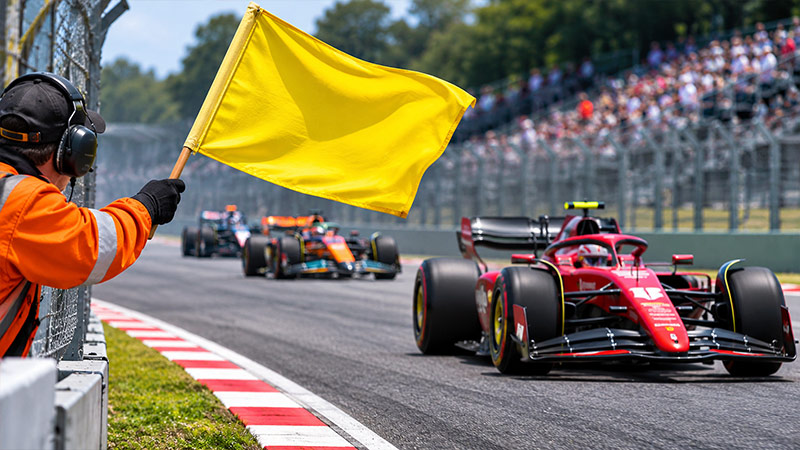
A yellow flag in F1 tells drivers there is danger ahead, and that they must slow down and hold position. It is one of the smallest signals of a race weekend, yet it can wipe out a pole lap, trigger a grid penalty, or decide who wins.
Picture the scene. A car spins into the gravel. Within seconds, a marshal is waving a yellow flag, and drivers travelling at over 300 km/h must react in a heartbeat. Lift too little and the stewards will call. Lift too much and a rival gains the edge.
What Does a Yellow Flag Mean in F1?
A yellow flag means danger on or near the track in that part of the circuit. Drivers must reduce speed, must not overtake, and must be ready to change direction or stop.
The flag is a local warning. It applies only to the marshalling sector where it is shown, not to the whole lap. That is what separates it from the Safety Car and the Virtual Safety Car, which neutralise the entire track.
Common reasons for a yellow flag include:
- A car stopped on track or in a run-off area
- Debris, such as a broken front wing or loose bodywork
- A driver who has spun and is about to rejoin
- Marshals or recovery vehicles working near the track edge
- A damaged barrier or tyre wall that needs attention
The rules come from Appendix H of the FIA International Sporting Code and the F1 Sporting Regulations. Before every Grand Prix, the Race Director also issues event notes with circuit-specific instructions for drivers.
Single Waved vs Double Waved Yellow Flags
The number of flags tells the driver how serious the danger is. One waved flag means caution. Two waved flags at the same post mean serious danger, with the track possibly blocked or marshals at work.
| Single waved yellow | Double waved yellow | |
|---|---|---|
| What it signals | A hazard beside or partly on the track | A hazard wholly or partly blocking the track, or marshals working on or beside it |
| What the driver must do | Reduce speed, no overtaking, be ready to change direction | Reduce speed significantly, no overtaking, be ready to change direction or stop |
| Practice or qualifying lap | Can still count if the driver clearly slowed | Deleted automatically |
| Standard grid penalty for not slowing enough | 5 places | 10 places |
| Typical example | A car parked safely behind a barrier | A car beached in the gravel with marshals recovering it |
Penalty figures are the standard starting points that stewards have quoted in recent decisions. They can lower them when a driver shows a genuine but insufficient attempt to slow down.
Race Control can also upgrade a single yellow to a double yellow within seconds. A driver who passes before the upgrade is judged against the single yellow, which is exactly what happened in a headline case in 2026, covered below.
What Drivers Must Do Under a Yellow Flag
The duties are simple: slow down, hold position, and stay alert. The hard part is proving it to the stewards, who study telemetry, mini-sector times, and throttle and brake traces after every incident.
- Slow down visibly. A clear lift or brake application is expected. A token dab of the brake that still produces a competitive sector time will draw an investigation.
- Do not overtake. Passing is banned from the first yellow flag until the car passes the green flag or green light panel that ends the zone. Seeing green ahead is not enough; the move must happen after the green.
- Be ready to change direction or stop. Under double yellows, the driver must expect a stationary car or marshals on the racing line.
- React in every yellow sector. When several sectors in a row are under yellow, a driver must show a significant speed reduction in each one, not only the first.
- Give up the lap under double yellows. In practice and qualifying, any lap through a double yellow sector is deleted automatically, so there is nothing to gain by pushing.
Why qualifying is the flashpoint
Qualifying is where yellow flags cause the most drama. Laps are separated by hundredths of a second, so the temptation to lift only slightly is real.
The automatic deletion rule grew out of the 2021 Turkish Grand Prix. Fernando Alonso set a competitive lap through a double yellow zone and avoided a penalty.
The FIA trialled automatic deletion from the next race in Austin and wrote it into the Sporting Regulations for 2022. Drivers welcomed it because it removed the grey area.
Single yellows are still a judgement call, and the 2026 Austrian Grand Prix showed why. Max Verstappen crashed late in Q3, and a single yellow was shown. George Russell lifted, kept his lap alive, and took pole.
Kimi Antonelli, believing it was a double yellow, abandoned his lap and qualified fourth. The flag was upgraded to double yellow only after both Mercedes cars had passed, so Russell’s pole stood.
How Yellow Flags Are Shown to Drivers
Drivers receive the warning in three layers at once, so “I didn’t see it” is rarely accepted as an excuse.
- Marshal posts. Trained marshals wave physical flags at posts around the circuit. Each post covers its own marshalling sector.
- LED light panels. Trackside panels flash yellow alongside the flags. They stay visible at night races and through rain and spray.
- Cockpit warnings. The FIA marshalling system sends the flag signal straight to the car, where it lights up on the steering wheel display.
Teams add a fourth layer by warning drivers over the radio, especially in qualifying.
The zone ends at the next green flag or green light panel. This is the detail many fans miss: a green panel also tells the driver they have just passed through a yellow zone.
At the 2025 Azerbaijan Grand Prix, stewards confirmed that drivers had been told to treat a green light as proof of a yellow condition, even if they never saw the yellow flag.
Oscar Piastri escaped with a reprimand only because the flag had been withdrawn less than a second after the green became visible to him.
Yellow Flag vs Virtual Safety Car vs Safety Car vs Red Flag
All four slow the action, but they differ sharply in scope and in how much they reshape a race.
| Signal | Scope | How speed is controlled | Overtaking | Effect on the race |
|---|---|---|---|---|
| Yellow flag | One marshalling sector | Driver judgement, with a visible lift | Banned in the zone | Small; racing continues elsewhere |
| Virtual Safety Car | Whole track | A minimum time delta shown on the dash | Banned | Gaps roughly frozen; a pit stop costs less time |
| Safety Car | Whole track | Cars queue behind the Safety Car | Banned | Gaps erased; the field bunches up |
| Red flag | Whole track, session stopped | Cars return slowly to the pit lane | Banned | Racing halted; teams may work on the cars |
The escalation usually runs in that order. A local yellow is the first response, and Race Control steps up to the Virtual Safety Car, the Safety Car, or a red flag as the hazard grows.
The Virtual Safety Car exists because of the limits of local yellows. After Jules Bianchi’s crash under double yellow flags at the 2014 Japanese Grand Prix, an accident that later cost him his life, the FIA introduced the Virtual Safety Car from 2015.
It forces every driver to slow by a set amount, removing judgement from the equation when recovery vehicles are on track.
Yellow Flag Penalties and Famous Moments
Penalties depend on the session and how serious the breach was. Stewards start from the FIA Penalty Guidelines, then weigh any mitigation, such as a genuine attempt to slow down.
The usual sanctions are:
- Lap time deletion, automatic under double yellows in practice and qualifying
- Grid drops, typically 5 places for a single yellow breach and 10 for a double yellow breach
- Time penalties or a drive-through for overtaking under yellow during a race
- Penalty points on the driver’s Super Licence
- A reprimand for minor or borderline cases
Recent cases show how these rules play out in the real world.
| Year | Event and driver | What happened | Outcome |
|---|---|---|---|
| 2026 | Azerbaijan GP, Carlos Sainz | Did not slow enough in the second of two yellow sectors in Q3 | 5-place grid drop, from 9th to 14th |
| 2026 | Hungarian GP, Kimi Antonelli | Slowed in qualifying, but not by enough | 3-place grid drop, cut from the standard 5 |
| 2026 | Austrian GP, George Russell | Lifted for a single yellow after Verstappen’s crash and kept his lap | Pole position stood, no investigation |
| 2025 | Azerbaijan GP, Oscar Piastri | Did not slow before a green light panel in practice | Reprimand |
| 2025 | Dutch GP, Lewis Hamilton | Too fast through double yellows on the lap to the grid | 5-place drop at Monza, cut from 10, plus 2 penalty points |
| 2023 | Las Vegas GP, Lance Stroll | Overtook Carlos Sainz under yellow in final practice | 5-place grid drop |
| 2023 | Mexico City GP, Logan Sargeant | Yellow flag breach in qualifying | 10-place grid drop |
| 2021 | Qatar GP, Max Verstappen and Valtteri Bottas | Failed to slow for double and single yellows | 5-place and 3-place grid drops |
| 2021 | Turkish GP, Fernando Alonso | Competitive lap through a double yellow zone | No penalty; led to automatic lap deletion |
The pattern is clear. Even the biggest names in the sport are not exempt, and a few tenths saved under yellow can cost a driver an entire row of the grid.
How Yellow Flags Shape Strategy and Results
A yellow flag rarely decides a race on its own, but it often sets off a chain reaction that does.
- Qualifying timing. A late crash can bring out yellows that ruin the final laps for everyone behind it. Teams that bank a strong early lap have insurance; teams that gamble on the last run can be left with nothing.
- Escalation risk. A local yellow can become a Virtual Safety Car, a Safety Car, or a red flag within seconds. Strategists watch where the stricken car is parked and decide whether to pit before the field is neutralised.
- Tyre and brake temperatures. Lifting through a long yellow zone cools the tyres and brakes, which can cost grip in the corners that follow.
- Track position. Because passing is banned, a driver stuck behind a slower car through the zone loses time they cannot win back there.
- Driver awareness. Engineers warn drivers of yellows ahead over the radio, especially at blind corners and night races where a stopped car can appear suddenly.
For fans, the lesson is simple. When yellow appears on the timing screen, watch the pit wall, because that is often where the next big decision is made.
Common Myths and Confusing Flags
A few misunderstandings come up again and again among new fans.
Myth 1: A yellow flag stops the race: It does not. Racing carries on everywhere outside the yellow sector.
Myth 2: Drivers only need to react if they see the flag: Drivers must respond to flags, light panels, and cockpit warnings. A green panel also signals that a yellow zone has just ended, so it counts too.
Myth 3: A small lift is enough: Stewards expect a clear, measurable drop in speed. A lift that still produces a competitive sector time usually leads to an investigation.
Myth 4: Overtaking is fine once green is in sight: The pass is only legal after the car has passed the green flag or panel.
Flags that are easy to mix up
| Flag | Meaning |
|---|---|
| Yellow with red vertical stripes | Slippery surface ahead, such as oil, water, or loose gravel |
| Green | Track clear; the end of a yellow zone |
| Blue | A faster car is approaching and must be let through |
| White | A slow-moving vehicle, such as a recovery truck, is on track |
| Red | The session is stopped |
Conclusion
The yellow flag may be small, but it carries enormous weight in Formula 1. It protects drivers, marshals, and recovery crews by demanding one thing above all: respect for danger.
A single waved yellow asks for caution, while a double waved yellow demands a dramatic slowdown and deletes any qualifying lap.
Modern technology, from light panels to cockpit warnings, means drivers have no hiding place, and stewards have the data to check every lift.
As the 2026 season has shown, one moment of judgement can win a pole position or lose five places on the grid.