Picture the scene. The race leader is on full attack through the final sector, chasing a rival for the win.
Right ahead sits a car a full lap down, locked in its own fight for 17th place. Who decides what happens next? In Formula 1, the answer is a rectangle of blue.
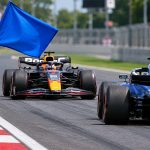
The blue flag is one of the most frequently shown signals in a Grand Prix, and one of the most misunderstood. It shapes title fights, fuels angry team radio and, as the 2026 Hungarian Grand Prix proved, can still turn a race upside down.
Quick answer: A blue flag in F1 tells a driver that a faster car is close behind. In a race, it means the driver is about to be lapped and must let the faster car pass at the first reasonable opportunity, normally before passing three flag or light panels. Ignoring it usually brings a five-second time penalty.
What Is a Blue Flag in F1?
A blue flag is a traffic signal, not a punishment. It tells a driver that a faster car is about to overtake and that they should not stand in its way.
The flag is defined in Appendix H of the FIA International Sporting Code, the rulebook that governs flag signals across international motorsport.
Its exact meaning shifts slightly depending on the session:
- In a race: you are about to be lapped, so move aside.
- In practice and qualifying: a faster car is approaching, so do not hold it up.
- At the pit lane exit: traffic is coming on the track, so take care as you rejoin.
The blue flag says nothing about danger on the circuit. Yellow flags warn of hazards and red flags stop a session, but the blue flag exists to protect the fairness of the race at the front.
Without it, a leader could lose several seconds, or even the win, because a lapped car fought hard for a position that has nothing to do with the lead.
How Blue Flags Work in a Race
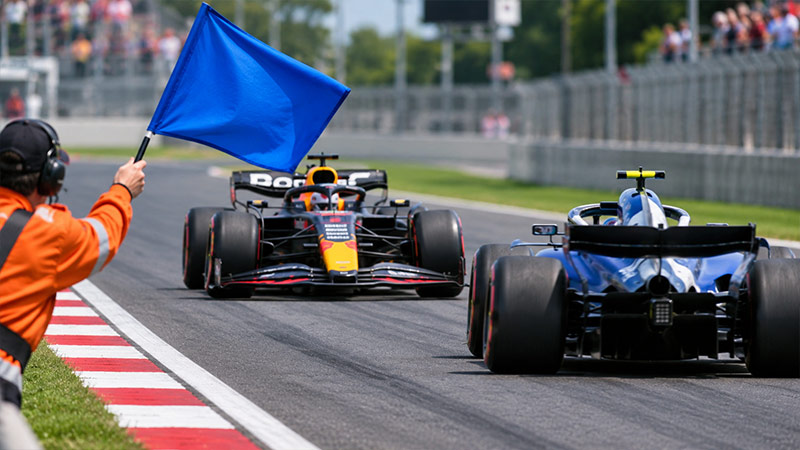
Modern F1 blue flags are largely automated. Race control tracks every car through timing loops and GPS, and when a lapping car closes to roughly one second behind a backmarker, the system triggers the signal. The lapped driver then gets the message in several ways at once:
- Marshals wave a physical blue flag at their post.
- Trackside LED light panels flash blue and display the race number of the car that must yield.
- A blue light flashes on the driver’s steering wheel display.
- The race engineer usually adds a radio call, naming the car coming through and where to let it by.
The three-panel rule
Once the blue flag is shown, the lapped driver must let the faster car past at the first reasonable opportunity.
Stewards use a simple benchmark: the driver should have moved aside before passing three flag posts or light panels. Go beyond that, and the case is likely to be referred to the stewards.
The phrase “first reasonable opportunity” matters. Nobody expects a backmarker to brake hard in the middle of a corner.
The accepted etiquette is to lift off on a straight, move off the racing line, or leave the inside open at the next corner entry.
What stewards will not accept is a driver who keeps a faster car stuck through a run of corners because they are busy defending against someone else.
Who receives blue flags?
Only the car being lapped. A driver on the same lap as the car behind is free to defend as hard as the rules allow, even if the chasing car is much quicker.
That is why you will sometimes hear a frustrated driver asking for blue flags, only for race control to decline: the car ahead is racing for position, not being lapped.
Blue Flags in Practice, Qualifying and at Pit Exit
Outside the race, nobody is being lapped, so the blue flag works as an early warning. It tells a driver that a faster car on a push lap is closing in. The slower driver, who may be on a cool-down lap or warming the tyres, must stay out of the way.
This is where the related offence of impeding comes in. A driver who unnecessarily blocks a rival on a flying lap in qualifying usually receives a three-place grid penalty for the race.
Teams track the gaps closely and warn their drivers over the radio long before the flag appears, because one badly timed moment can cost a rival pole position and cost their own driver a strong grid slot.
At the pit lane exit, a blue flag or flashing blue light warns a driver leaving the pits that cars are approaching on the track. The rejoining driver must respect the pit exit line and must not cut across the path of cars already at racing speed.
What Happens If a Driver Ignores Blue Flags?
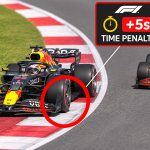
Ignoring blue flags in a race is a reportable offence, and the standard punishment is a five-second time penalty.
The driver can serve it at their next pit stop or have it added to their race time at the finish. The FIA’s penalty guidelines allow stewards to go up to ten seconds when a case is more serious.
| Offence | Typical penalty |
|---|---|
| Ignoring blue flags in a race | Five-second time penalty |
| A more serious or prolonged case | Ten-second time penalty, sometimes with super licence penalty points |
| Causing a collision while being lapped | Time penalty, often with penalty points |
| Impeding a rival in qualifying | Three-place grid penalty |
Penalty points matter more than many fans realise. A driver who collects 12 points within a 12-month period receives a one-race ban, so repeated blue flag offences can quietly add up.
For 2026, the FIA added a dedicated blue flag section to the stewards’ driving and penalty guidelines, after years of calls from drivers and teams for clearer rules.
Stewards judge each case using timing data, telemetry and onboard footage, so “I didn’t see it” is rarely a winning defence.
Famous Blue Flag Moments That Shaped the Rules
Singapore 2018: lost in his own battle
Romain Grosjean was so focused on his fight with Sergey Sirotkin that he held up race leaders Lewis Hamilton and Max Verstappen, even as light panels flashed his race number.
Race director Charlie Whiting later called it one of the worst cases of ignoring blue flags he had seen in a long time. Grosjean received a five-second penalty and two penalty points.
Spain 2020: the crackdown begins
At the 2020 Spanish Grand Prix, race director Michael Masi made blue flags a priority. Sergio Perez was penalised for holding up leader Lewis Hamilton in the twisty final sector, and Daniil Kvyat was penalised for a similar offence. Both received five-second penalties, the first of a new crackdown.
Perez’s penalty dropped him behind teammate Lance Stroll to fifth, and Masi later said rival team managers phoned to thank him for acting quickly.
Hungary 2026: when the system failed
The 2026 Hungarian Grand Prix produced the fiercest blue flag debate in years. The automatic system malfunctioned: light panels flashed blue but stopped showing the race numbers of the cars that had to yield.
With blue lights flashing almost everywhere, drivers could not tell which signal was meant for them.
In that confusion, Carlos Sainz, battling Fernando Alonso near the back, cut across Oscar Piastri at Turn 2 while Piastri was fighting Lando Norris for the lead.
The contact nearly spun the McLaren. Sainz received a five-second penalty for causing a collision and blamed the faulty system, while Piastri called it “one of the dumbest things I’ve ever seen on a race-track.”
Oliver Bearman also received a five-second penalty for ignoring blue flags while being lapped by Isack Hadjar.
The stewards found he had passed 11 blue flag light panels before moving aside. Bearman said there were blue flags on almost every lap from Lap 6 to Lap 70, making it hard to know which were real.
The lesson from Budapest is simple: a blue flag is only as good as the information that reaches the cockpit.
Blue Flags, the Safety Car and Unlapping
Blue flags are not used behind the safety car. Instead, race control can instruct lapped cars to overtake the cars on the lead lap and the safety car itself, so the leaders line up together for the restart. This process is known as unlapping.
Unlapping became the most debated rule in the sport after the 2021 Abu Dhabi Grand Prix, when only some lapped cars were let through before a final-lap restart that decided the championship. The rules were later rewritten to make clear that all lapped cars must be allowed to unlap.
A lapped car can also unlap itself under green flag conditions if it is genuinely faster than the leader, but it has to do so cleanly.
Brazil 2018 is the cautionary tale. Esteban Ocon, a lap down on fresher tyres, tried to unlap himself on race leader Max Verstappen and the two collided. Ocon received a ten-second stop-and-go penalty, and Verstappen lost the win to Lewis Hamilton.
Should F1 Scrap Blue Flags?
Not everyone believes blue flags belong in modern F1. Former driver and long-time commentator Martin Brundle said in November 2024 that he would ban them.
His view is that getting through traffic used to be a core racing skill, and the best drivers should earn their way past backmarkers instead of having the road cleared for them.
Other series take a looser approach. In IndyCar, lapped drivers often fight hard to stay on the lead lap, because a caution period can bring them back into contention. After Hungary 2026, that comparison returned to the paddock conversation.
The case for keeping blue flags:
- They stop the fight for the win from being decided by cars that are not part of it.
- Turbulent air from the car ahead makes following and passing difficult, so a leader could lose seconds behind a slower car.
- Closing speeds between leaders and backmarkers can be large, and a clear rule reduces the risk of contact.
The case for scrapping them:
- It would reward racecraft in traffic, a skill fans enjoy watching.
- Lapped drivers could keep racing their own battles without having to yield.
- There would be no confusion when the signalling system fails, as it did in Budapest.
For now, the FIA has chosen the middle path: keep blue flags, but sharpen the guidelines and make the signals clearer.
How to Spot Blue Flags When Watching a Race
Once you know what to look for, blue flags become one of the easiest storylines to follow on race day. Keep this quick checklist handy:
- Watch the gaps. When the leader closes to about a second behind a lapped car, expect blue flags within the lap.
- Look at the trackside panels. A flashing blue LED panel, usually with a race number, is the clearest sign.
- Listen to the radio. Lines such as “blue flags, let him through” or a leader complaining about traffic tell you the clock is ticking.
- Count the corners. A clean move usually comes on the next straight. If the lapped car is still ahead after three panels, trouble is likely.
- Check race control messages. A note that a car is under investigation for failing to respect blue flags usually means a five-second penalty is coming.
Blue flags also tend to arrive in waves. On short laps such as Monaco, Hungary and the Red Bull Ring, the leaders start lapping the tail of the field early, so the lapped drivers can see blue for much of the race.
Conclusion
The blue flag may be a simple signal, but it carries real weight in Formula 1. It keeps the fight at the front fair, protects drivers from risky closing speeds and asks backmarkers to show respect without giving up their own race.
When it works, nobody notices. When it fails, as Hungary 2026 showed, it can spark penalties, collisions and furious radio messages in a matter of laps.
Understanding the three-panel rule, the penalties and the debate around scrapping blue flags makes every Grand Prix easier to read.