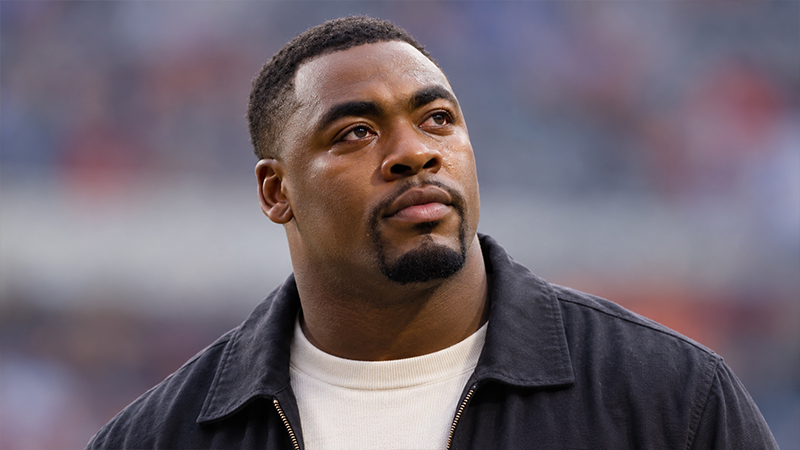
When television cameras pan across the Kansas City Chiefs bench during the playing of the national anthem, one image routinely catches the attention of millions: elite defensive tackle Chris Jones with tears streaming down his face.
While mainstream observers frequently interpret these tears through a conventional lens of solemnity or gratitude, the reality behind this ritual is far more intense.
For Jones, crying during the pre-game anthem is a deliberate psychological gateway—a mechanism used to transform internal focus into pure, targeted athletic aggression.
Beyond the Tears on the Sideline
The Game-Day Phenomenon
Moments before kickoff in high-stakes NFL matchups, stadium lights shine brightly on athletes preparing for brutal physical contact.
Among them, Kansas City Chiefs defensive tackle Chris Jones stands out not merely for his massive physical frame, but for his distinct pre-game ritual. As the national anthem plays across the stadium, tears flow openly down his cheeks.
Deconstructing the Public Misconception
For passive television viewers, weeping on the sideline during a national anthem is usually classified as an expression of sentimentality, national pride, or emotional overwhelm. However, reducing Jones’s reaction to simple tenderness misses the true psychological mechanism at work.
The True Reality Behind the Ritual
Kansas City Chiefs defensive tackle Chris Jones cries during the national anthem because he uses the moment to mentally channel intense anger and transition into a warrior mindset for battle.
The tears are not a signal of softness; rather, they serve as the physical output of extreme mental recalibration, channeling deeply rooted frustration, anger, and focus directly into performance readiness.
The “300” Mindset – Converting Emotion into Pure Athletic Intensity
Cinematic Inspiration: The Spartan Framing
To understand why tears accompany intense anger on game day, one must examine the specific cultural and cinematic framework Jones uses to align his psychological state. Jones compares his pre-game mental shift to the movie 300, where soldiers cry because they are intensely angry and preparing for a brutal fight.
In that cinematic context, weeping is portrayed not as fear or sadness, but as the involuntary physical overflow of extreme rage and impending combat. By adopting this specific mental construct, Jones reinterprets tears as an indicator of maximum emotional readiness.
Chris Jones’ Pre-Game Ritual
- The Catalyst: The national anthem begins, triggering a shift in his emotional and mental state.
- Mental Retracing: He recalls past career obstacles and recent slights from the week.
- Emotional Intensification: Those reflections turn into focused anger and emotional intensity.
- Physical Manifestation: Tears may flow involuntarily as he releases built-up psychological tension.
- The Warrior Mindset: He enters a “300” mental state, approaching the game as a high-stakes battle.
Framing Football as Physical Survival
To compete at the highest level of professional sports, elite defensive linemen must cultivate an extraordinary level of physical drive and focus. He forces himself into a frame of mind where the game feels like a physical war where he might not make it out.
By elevating the psychological stakes of an NFL football game to those of a life-or-death battle, he eliminates complacency, hesitation, and distraction.
The Psychological Paradox: Tears as an Aggression Release
In high-stress environments, human physiology responds to extreme surges of adrenaline and emotional tension in distinct ways.
For Jones, the crying functions as a physiological pressure-relief valve. By allowing tears to fall during the anthem, he purges excess nervous energy while solidifying an unyielding, aggressive posture for the very first snap of the game.
Turning Doubts and Criticisms into Competitive Fire
Reviewing the Journey: Personal Historical Obstacles
The minutes spent standing on the sideline during the national anthem offer a quiet window amidst the deafening noise of thousands of stadium spectators. As the anthem plays, Jones retraces the obstacles he has overcome to reach his career.
Instead of reflecting merely on successes, he intentionally revisits the hardships, doubts, and sacrifices required to achieve elite athletic status.
Weaponizing Recent Criticisms
In addition to long-term career hurdles, Jones brings recent, short-term grievances directly into his pre-game emotional prep work.
During those same quiet moments, he remembers recent negative comments or criticisms from weeks prior, which fill him with a deep, competitive anger.
Whether derived from sports media commentary, opposing players, or fan skepticism, these negative inputs are systematically processed and repurposed into motivational fuel.
The Mechanics of Fueling Performance
- Step 1: Collection: Gathering external doubts, negative press, and personal hurdles accumulated throughout the preceding week.
- Step 2: Internalization: Processing these slights during the playing of the national anthem.
- Step 3: Emotional Transformation: Converting resentment into sharp, controlled anger.
- Step 4: On-Field Execution: Channeling that emotional surge into explosive physical pressure at the line of scrimmage.
The Genesis – The 2018–19 AFC Championship Game
The Sparking Point
Rituals of this magnitude rarely appear spontaneously without a pivotal origin event. He first experienced this overwhelming surge of emotion and tears during the national anthem ahead of the 2018–19 AFC Championship Game against the New England Patriots.
Why That Matchup Mattered
The 2018–19 AFC Championship game represented an exceptionally high-stakes moment in franchise history. Facing a championship-caliber opponent led by legendary figures, the atmosphere and internal expectations created unprecedented psychological strain.
Under that immense pressure, Jones experienced a convergence of intense desire, high stakes, and raw emotion that permanently reshaped his pre-game routine.
From Single Event to Mandatory Protocol
What began as an spontaneous breakthrough in emotional preparation quickly solidified into a permanent component of his game-day routine.
Recognized for its ability to unlock his highest level of physical play, the anthem ritual became a mandatory boundary separating his off-field self from his on-field persona.
High-Performance Psychology in Professional Sports
The Role of Emotional Framing in Elite Athletics
In modern elite athletics, technical physical skill and conditioning are baseline requirements. The true competitive edge often resides in psychological conditioning.
Athletes employ various mental strategies—ranging from quiet meditation to aggressive visualization—to reach peak operational states.
Controlled Anger as a Performance Enhancer
While unguided rage can lead to mistakes and penalty flags, controlled anger acts as a powerful catalyst for explosive power.
By intentionally directing thoughts toward slights and intense battle scenarios, elite athletes increase focus, reduce pain sensitivity, and maintain raw intensity throughout demanding physical contests.
| Emotional Framing Method | Primary Objective | Psychological Mechanism | Athlete Outcome |
|---|---|---|---|
| Traditional Mindfulness | Stress reduction & calm | Lowering heart rate & breathing focus | Steady execution & low error rate |
| Intense Channeling (“Warrior”) | Maximum power & aggression | Adrenaline activation & anger focus | High explosive effort & dominant physical presence |
Conclusion
Chris Jones’s tears during the national anthem redefine traditional views on pre-game emotion. Rather than showing vulnerability, his tears signal an intense transition into a warrior mindset inspired by the movie 300, treating every matchup like a high-stakes physical battle.
By reflecting on past personal obstacles and weaponizing recent criticisms during the anthem—a ritual born before the 2018–19 AFC Championship game—Jones transforms deep anger into elite gridiron performance.
Ultimately, his unique pre-game ritual proves that controlled emotional intensity can become an athlete’s ultimate competitive edge.