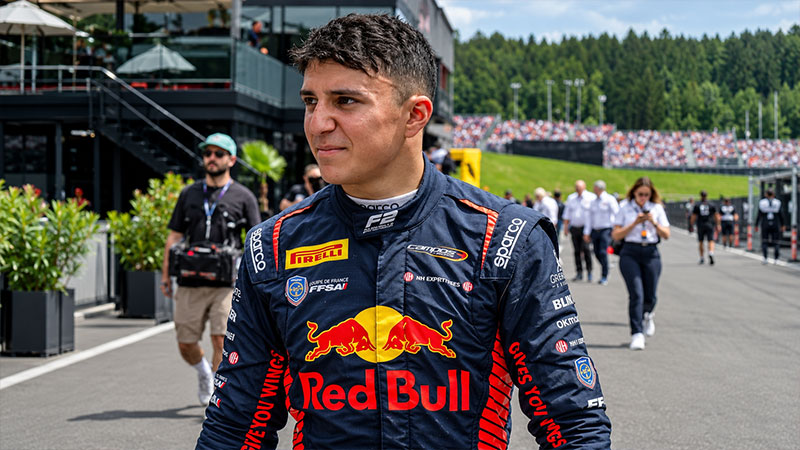
Isack Hadjar fractured his wrist in the gym, not in the car. During Formula 1’s 2026 summer break, the Red Bull driver finished a workout, moved to a heavy punching bag, and landed a bad hit without his wrist strapped. The result was a hairline fracture that kept him out of three Grands Prix.
For a driver in his first season at Red Bull Racing, the timing could hardly have been worse. Hadjar earned the seat after a standout rookie year with Racing Bulls in 2025. Then a few seconds of routine training took him out of the car at Zandvoort, Monza and Madrid.
Below, we break down exactly what happened, why he stayed quiet at first, who took his seat, and why one small injury matters so much at more than 300 km/h.
What Happened in the Gym
Hadjar described the incident himself on Beyond the Grid, Formula 1’s official podcast. He had wrapped up a conditioning session and moved on to a heavy bag. One punch landed badly, with no strapping to support the joint.
He did not hold back about the equipment either, calling it a “s*** bag” in the interview. The frustration is easy to understand. A piece of kit meant to make him stronger ended up taking him out of the car.
Boxing work is common in F1 training. It builds shoulder and core endurance, sharpens reactions and keeps the heart rate high for long stretches, much like a race. Hand wraps and properly filled bags exist for a reason: the wrist is the weak link in any punch.
When a strike lands off-angle, force that should travel straight up the forearm bends the joint instead. One mistimed hit on an unprotected wrist is all it takes to crack a bone.
Why He Kept It Quiet for a Day
Hadjar did not realise straight away that the wrist was broken. Rather than raise the alarm, he kept the injury to himself for about a day to see how it settled before telling the team.
That instinct is common among athletes. A hairline fracture can feel like a bad sprain at first, with swelling and soreness but decent movement. Many people only suspect a break when the pain refuses to fade or flares every time they grip something.
There is also a racing-driver mindset at play. A reported injury triggers medical checks, and checks can cost a race seat, even temporarily. For a young driver in a team known for quick line-up decisions, that worry is real.
For anyone who trains hard, the takeaway is simple. Wrist pain after an impact that does not ease within a day or two deserves a proper check by a doctor, usually with an X-ray. Some wrist fractures, especially of the small scaphoid bone, can heal poorly if they are missed.
The Races He Missed and Who Replaced Him
The fracture cost Hadjar three rounds straight after the summer break, with Liam Lawson taking his Red Bull seat for each one.
| Round | Circuit | Driver in Hadjar’s Red Bull seat |
|---|---|---|
| Dutch Grand Prix | Zandvoort | Liam Lawson |
| Italian Grand Prix | Monza | Liam Lawson |
| Spanish Grand Prix | Madrid | Liam Lawson |
| Azerbaijan Grand Prix | Baku City Circuit | Isack Hadjar (return) |
Zandvoort stings twice. It was there, in 2025, that Hadjar scored his first F1 podium, finishing third for Racing Bulls. Coming back as a Red Bull driver should have been a celebration. Instead, he watched from the sidelines.
Madrid hurt in a different way. It was the first Grand Prix at the new Madrid circuit, a once-in-a-career debut that every driver on the grid wanted to be part of.
Lawson’s call-up carried its own storyline. The New Zealander began 2025 in the senior Red Bull team before being moved back to Racing Bulls after just two rounds. Getting the seat back, even briefly, gave him a fresh chance to show what he could do in the car.
Why a Wrist Injury Is So Serious in Formula 1
From the outside, a cracked wrist sounds minor. Inside a modern F1 car, it is a major problem, because the wrists do far more work than most fans realise.
- Steering load: drivers hold heavy steering through fast corners and over kerbs, and every input runs through the wrists.
- Constant vibration: bumps and kerb strikes send shocks up the steering column for well over an hour.
- Fine control: the wheel carries buttons, rotary switches and paddles that drivers operate mid-corner, often with one hand.
- Emergency exit: drivers must be able to climb out of the cockpit within seconds after a crash, which needs strong, stable wrists.
Before any return, the FIA’s medical delegate has to declare a driver fit to race. Teams will not risk a driver who cannot grip the wheel firmly for a full race distance.
Hairline fractures commonly take several weeks to knit, with grip strength returning gradually after that. Missing three rounds fits that pattern and suggests a sensible, not rushed, recovery.
The Fan Debate: Is Boxing Too Risky for F1 Drivers?
The injury split opinion on Reddit’s r/FormulaRacers. One camp argued that boxing carries needless risk for an athlete whose hands are his livelihood. The other pointed out that it is a routine part of Hadjar’s fitness regime, and that freak injuries can happen in any gym.
Both sides have a point. Boxing builds the endurance, reflexes and upper-body strength drivers need. Yet F1 history is full of reminders that time away from the track carries risk:
- Lance Stroll broke both wrists in a cycling accident before the 2023 season, then raced in Bahrain after surgery.
- Juan Pablo Montoya missed two races in 2005 with a shoulder injury picked up away from the circuit.
The sensible middle ground is not to drop boxing but to manage it. That means wrapping hands every session, checking equipment before use, and easing off heavy-bag power work when a driver cannot afford any downtime.
The Comeback in Baku
Hadjar returned at the Baku City Circuit for the Azerbaijan Grand Prix. It was a demanding place to test a healing wrist.
The track mixes long flat-out straights with tight, wall-lined corners and a narrow stretch through the old town, where precise steering matters more than almost anywhere else.
His return also says something about how he handled the setback. He spoke about the accident openly on a podcast instead of hiding behind a vague team statement. He admitted he waited a day before reporting it. Then he worked his way back within a few rounds.
For a young driver under Red Bull’s spotlight, that honesty counts. Teams value speed, but they also value drivers who learn quickly from mistakes. A frank account of a gym accident may even build trust inside the garage.
Conclusion
Isack Hadjar’s wrist injury came from a single bad punch on a heavy bag during the 2026 summer break, not from a crash or a track incident.
That hairline fracture, unnoticed at first and kept quiet for a day, cost him Zandvoort, Monza and Madrid, with Liam Lawson filling his Red Bull seat until Hadjar returned in Baku.
The episode shows how fine the margins are in Formula 1. One unprotected wrist can reshape a season, test a team’s depth and spark debate about how drivers train.