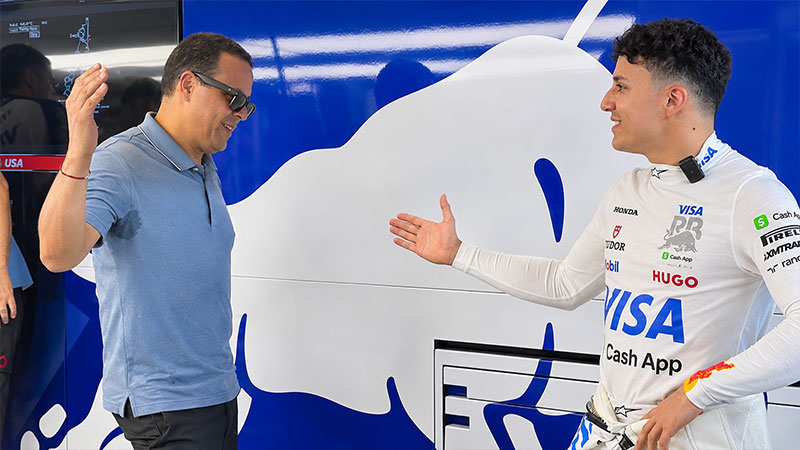
Yes, Isack Hadjar’s dad is a physicist, and that single fact has turned into one of the most searched details about the young French driver.
Formula 1 fans know Hadjar as the fierce, emotional racer who climbed through Red Bull’s junior ranks and reached the top of motorsport in 2025.
Yet the question keeps popping up in search bars, comment threads and fan forums: is his father really a scientist?
His father, Yassine Hadjar, is widely reported to work as a researcher in quantum physics. That is a rare backstory in a sport often filled with racing dynasties and wealthy team owners.
The Quick Answer: Yes, His Father Is a Quantum Physicist
Isack Hadjar’s father, Yassine Hadjar, is a quantum physicist who has built his career in scientific research in France. Isack has spoken about his father’s profession in interviews, and it has become a regular talking point since his Formula 1 debut.
Here are the key facts at a glance:
| Detail | Answer |
|---|---|
| Father’s name | Yassine Hadjar |
| Father’s profession | Researcher in quantum physics |
| Isack’s birthplace | Paris, France |
| Isack’s date of birth | 28 September 2004 |
| Heritage | French-Algerian; races under the French flag |
| Formula 1 debut | 2025 Australian Grand Prix, with Racing Bulls |
For readers who only wanted the headline, that’s it. For everyone curious about how a physicist’s son became one of the most talked-about young drivers on the grid, keep reading.
Who Is Yassine Hadjar?
Yassine Hadjar is a scientist of Algerian heritage who works in quantum physics research in France. He keeps a deliberately low public profile, which is a big reason so many fans want to know more about him.
Unlike former drivers or team bosses who appear on paddock broadcasts every weekend, Yassine is known mostly through his son’s comments. He is not a celebrity parent, and the family has never built its public image around him.
What quantum physics actually involves
Quantum physics studies how matter and energy behave at the smallest scales, from atoms to subatomic particles. It sits behind technologies such as lasers, semiconductors and the emerging field of quantum computing.
A research career in this area usually means a doctorate, years of laboratory or theoretical work, and a tolerance for problems that take months to crack. In short, it rewards patience, precision and stubborn curiosity.
A household built on study
Isack was born in Paris and grew up in the Île-de-France region in a family where education carried real weight. That academic setting gives his story a different flavour from the typical motorsport biography, where a parent’s racing past or business empire often opens the first door.
From the Physics Lab to the Karting Track
A physicist is not the obvious person to launch a racing career, and that is exactly what makes the Hadjar story so appealing. Isack started karting as a young child, and his father’s interest in motorsport helped open that first door.
From there, he followed the classic European ladder. He moved from karting into single-seaters with French F4 in 2019, then stepped up through the Formula Renault Eurocup and the Formula Regional European Championship.
The hidden hurdle: money
Junior motorsport is famously expensive. A season in FIA Formula 3 is commonly estimated at around €1 million, and Formula 2 costs considerably more. Few families can fund that alone, whatever their jobs.
That is why results mattered so much. Strong performances earned Isack a place in the Red Bull Junior Team in 2022, which brought backing, coaching and a clear route toward Formula 1. Without that kind of support, many talented drivers never get past the junior categories.
How a Scientific Upbringing Shows Up on Track
It would be too neat to say Isack Hadjar drives like a physicist, but the parallels between his father’s world and modern Formula 1 are hard to ignore. Today’s F1 is a data sport as much as a driving one.
- Data is the daily language. Drivers study telemetry traces, tyre wear models and simulator results after every session. Growing up where analysis and evidence were normal makes that environment feel familiar rather than foreign.
- Failure is part of the method. Scientific research runs on experiments that do not work the first time. Hadjar’s F1 career began with a crash on the formation lap in Melbourne in 2025, yet he regrouped, scored points regularly and finished third at the Dutch Grand Prix later that year.
- Precision under pressure. Physics depends on exact measurement, and racing depends on exact braking points, steering inputs and tyre management, lap after lap.
- Patience over the long run. A research project can take years, and so can a path from karting to F1. Isack spent more than a decade climbing the ladder before his debut.
None of this means talent is inherited from a laboratory. It does suggest that the habits a scientific household encourages, such as curiosity, discipline and learning from mistakes, line up well with what elite racing demands.
Isack Hadjar’s Career Path at a Glance
Isack Hadjar earned a Red Bull Racing seat after seven seasons of car racing, starting in French F4 in 2019.
| Year | Series | Team | Highlight |
|---|---|---|---|
| 2026 | Formula 1 | Red Bull Racing | Promoted to partner Max Verstappen |
| 2025 | Formula 1 | Racing Bulls | Rookie season; third place at the Dutch Grand Prix |
| 2024 | FIA Formula 2 | Campos Racing | Championship runner-up |
| 2023 | FIA Formula 2 | Hitech | Rookie season in F2 |
| 2022 | FIA Formula 3 | Hitech | Joined the Red Bull Junior Team |
| 2021 | Formula Regional European Championship | R-ace GP | Championship runner-up |
| 2020 | Formula Renault Eurocup | R-ace GP | Step up to international single-seaters |
| 2019 | French F4 | FFSA Academy | First season in car racing |
Along the way, he picked up the nickname “Le Petit Prost” because of his resemblance to four-time world champion Alain Prost, a fellow Frenchman.
Why This Family Story Connects With Fans
The physicist-dad detail spreads so quickly because it makes Isack Hadjar relatable in a sport that can feel out of reach. Here is why the story keeps resonating.
It breaks the dynasty mould
Formula 1 has a long list of drivers whose fathers raced, ran teams or led global businesses. A son of a research scientist reaching the top shows that the grid is not reserved for one kind of family.
It reflects a modern, global France
Hadjar’s French-Algerian heritage gives him a following in France, Algeria and across North Africa. For many young fans, he represents a path into a sport where they rarely see themselves.
It shows the human side of the sport
The image of a tearful Hadjar after his Melbourne crash, comforted by Anthony Hamilton, father of Lewis Hamilton, went around the world. Fans saw a young driver under enormous pressure, and stories about his own family helped explain the grounded person behind the helmet.
It inspires students and parents
For families who value education, Hadjar’s background sends a useful message. Academic and sporting ambition do not have to compete, and the discipline learned in one can strengthen the other.
Conclusion
So, is Isack Hadjar’s dad a physicist? Yes. Yassine Hadjar’s work in quantum physics gives his son’s story a rare twist in a sport often shaped by racing dynasties and family fortunes.
Isack grew up in a home that valued study, patience, and careful thinking, and those same traits matter in modern Formula 1, where data and composure decide races.
From karting as a child to a Red Bull Racing seat, his rise shows that talent can come from anywhere, including a scientist’s household in Paris.
As his career unfolds, expect his family background to stay part of the conversation.