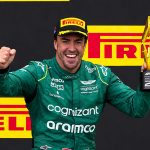
Fernando Alonso has two Formula One World Drivers’ Championships, won back-to-back in 2005 and 2006 with Renault.
He also won the 2018–19 FIA World Endurance Championship with Toyota, giving him three senior world championships in total.
On top of those titles, he has won the 24 Hours of Le Mans twice (2018 and 2019) and the 24 Hours of Daytona once (2019). Long before any of that, he was a junior world karting champion at just 15.
Every Major Title at a Glance
Here is every championship and headline race win in Alonso’s career, in the order he earned them.
| Year | Achievement | Series and team |
|---|---|---|
| 1996 | Junior World Karting Champion | International karting |
| 1999 | Euro Open by Nissan Champion | Formula Nissan, Campos |
| 2005 | Formula One World Drivers’ Champion | Formula One, Renault |
| 2006 | Formula One World Drivers’ Champion | Formula One, Renault |
| 2018 | 24 Hours of Le Mans winner | WEC, Toyota |
| 2019 | 24 Hours of Daytona winner | IMSA, Wayne Taylor Racing |
| 2019 | 24 Hours of Le Mans winner | WEC, Toyota |
| 2018–19 | FIA World Endurance Champion | WEC, Toyota |
That adds up to two Formula One crowns, one endurance world title, three wins in 24-hour classics and two junior championships.
The Two Formula One World Championships
Alonso’s Formula One titles came in a two-year burst with Renault. Together, they ended one of the most dominant eras the sport has ever seen.
2005: Ending the Schumacher Era
Michael Schumacher and Ferrari had won five straight drivers’ titles from 2000 to 2004. In 2005, Alonso and the Renault R25 broke that streak.
He won seven races and paired speed with remarkable consistency. His main rival, Kimi Räikkönen, had a fast McLaren that often broke down. Alonso clinched the title in Brazil with two races to spare, finishing on 133 points to Räikkönen’s 112.
At 24 years and 58 days old, he became the youngest world champion in history at that time. He was also Spain’s first Formula One world champion, and his success sparked a wave of interest in the sport across the Spanish-speaking world.
2006: Beating the Legend Head-On
If 2005 proved Alonso could win, 2006 proved he could beat the best driver of the era in a straight fight. Schumacher and Ferrari came back strong, and the season turned into a duel.
Alonso won six of the first nine races, including his first Monaco Grand Prix. Ferrari then surged in the second half while Renault lost ground. The decisive moment came at Suzuka, where Schumacher’s engine failed while he was leading and Alonso went on to win.
A second-place finish in Brazil sealed the crown, 134 points to 121. He became the youngest double world champion of that time, and Renault took the constructors’ title in both seasons.
The Near Misses That Shaped His Legacy
Alonso’s two titles could easily have been four or five. In two separate seasons, he lost the championship by a combined seven points.
| Season | Team | Champion | Alonso’s finish | Gap to champion |
|---|---|---|---|---|
| 2007 | McLaren | Kimi Räikkönen | 3rd | 1 point |
| 2010 | Ferrari | Sebastian Vettel | 2nd | 4 points |
| 2012 | Ferrari | Sebastian Vettel | 2nd | 3 points |
| 2013 | Ferrari | Sebastian Vettel | 2nd | 155 points |
2007: In a tense first season at McLaren, Alonso finished level on 109 points with rookie teammate Lewis Hamilton. Both ended one point behind Räikkönen, and Alonso was classified third on countback.
2010: Alonso arrived at the Abu Dhabi finale leading the standings. A strategy call left him stuck behind a slower car for most of the race, and Vettel snatched the title.
2012: This is often called the finest season of his career. Driving a Ferrari that was rarely the fastest car, he led the standings for much of the year. First-lap crashes at Spa and Suzuka proved costly, and he lost out by three points in Brazil.
2013: Alonso finished runner-up for a third time, though Vettel’s Red Bull was in a class of its own that year.
Beyond Formula One: Endurance Racing Glory
When Alonso’s McLaren years left him without a winning car, he went looking for new challenges. Endurance racing gave him his third world championship.
The 2018–19 FIA World Endurance Championship
Alonso joined Toyota Gazoo Racing for the WEC “super season,” which ran from May 2018 to June 2019. For much of 2018, he raced in both Formula One and WEC at the same time, a schedule few drivers would attempt.
He shared the No. 8 Toyota TS050 Hybrid with Sébastien Buemi and Kazuki Nakajima. The trio won the drivers’ world title, making Alonso a world champion in two different FIA disciplines.
Two Wins at the 24 Hours of Le Mans
Alonso won Le Mans in June 2018, giving Toyota its first overall victory at the race after decades of trying. His night stints that year are still talked about for their pace and precision.
He won again in June 2019. That second victory also sealed the world championship, closing the super season in the best possible way.
Victory at the 24 Hours of Daytona
In January 2019, Alonso won the Rolex 24 at Daytona with Wayne Taylor Racing. He shared the Cadillac with Jordan Taylor, Renger van der Zande and Kamui Kobayashi.
The race was hit by torrential rain and eventually stopped early. Alonso’s driving in the treacherous conditions played a key part in the win.
The Triple Crown Chase
Alonso has completed two of the three races in motorsport’s unofficial Triple Crown. Only Graham Hill has ever won all three.
| Triple Crown race | Alonso’s record |
|---|---|
| Monaco Grand Prix | Won in 2006 and 2007 |
| 24 Hours of Le Mans | Won in 2018 and 2019 |
| Indianapolis 500 | Not yet won; best showing in 2017 |
In 2017, Alonso famously skipped the Monaco Grand Prix to race at Indianapolis with McLaren and Andretti Autosport. He qualified fifth and led 27 laps before an engine failure ended his race late on. He was still named Rookie of the Year.
His later attempts were tougher. He failed to qualify in 2019 and finished 21st in 2020. The missing Indy 500 win remains the one gap in his crossover résumé.
Alonso also tried his hand at rally raid. At the 2020 Dakar Rally, he drove a Toyota Hilux with co-driver Marc Coma and finished 13th overall on debut.
Where It All Began: Karting and Junior Titles
Alonso’s winning habit started early in Oviedo, Spain, where he was born in 1981. He first drove a kart at age three, in a machine his father had built for his older sister.
He collected several Spanish karting titles as a youngster. In 1996, at 15, he won the Junior World Karting Championship, announcing himself on the international stage.
His next big step came in 1999, when he won the Euro Open by Nissan series with Campos. That title earned him a move to Formula 3000 and, soon after, a Formula One debut with Minardi in 2001 at just 19.
Renault signed him as a test driver for 2002 and promoted him to a race seat in 2003. That year, he became the youngest pole-sitter and youngest race winner in Formula One history at the time, setting up everything that followed.
Why Two Titles Undersell Fernando Alonso
Championship totals reward being in the right car at the right time. By that measure, Alonso’s timing has often been cruel, while his driving has rarely faltered.
| Career Formula One figure | Total |
|---|---|
| Race wins | 32 |
| Pole positions | 22 |
| Podium finishes | More than 100 |
| Race starts | More than 400, the all-time record |
He rarely had the best car after 2006: His Ferrari years coincided with Red Bull’s peak, and his return to McLaren brought an uncompetitive, unreliable package. Many of his finest drives came in machinery that had no business fighting for wins.
His longevity is unmatched: No driver in Formula One history has started more Grands Prix. He passed 400 starts in 2024, more than two decades after his debut.
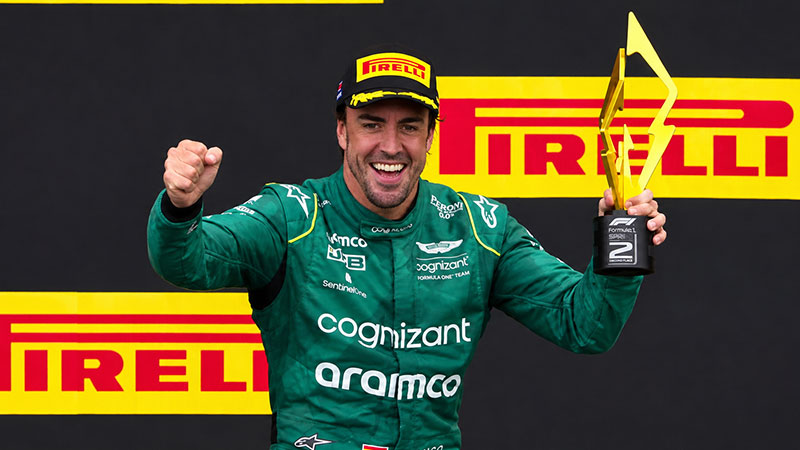
He keeps delivering in his forties: In his first season with Aston Martin in 2023, aged 41, he scored eight podium finishes.
Aston Martin’s move to Honda power and its design partnership with Adrian Newey for the 2026 rules reset was built partly around one goal: giving him a shot at a third title.
Conclusion
So, how many championships does Fernando Alonso have? The headline answer is two Formula One World Drivers’ Championships, won in 2005 and 2006 with Renault.
Add his 2018–19 FIA World Endurance Championship, and he owns three senior world titles. His two Le Mans victories, his Daytona win and his junior karting crown complete one of the most varied résumés in modern motorsport.
Yet the numbers only tell part of the story. Near misses in 2010 and 2012, more than two decades at the top and a record number of starts reveal a driver whose talent outweighs his trophy count.