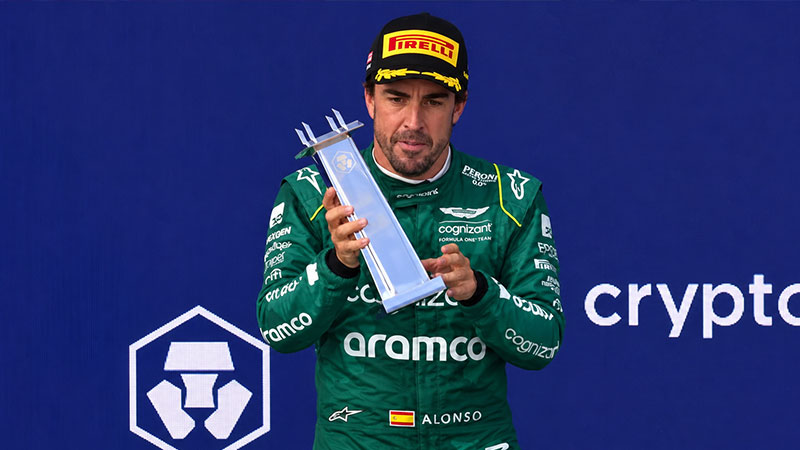
Fernando Alonso has two Formula 1 World Championships, won with Renault in 2005 and 2006. Yet ask paddock insiders, rival drivers or longtime fans, and many will tell you that number should be far higher. Flavio Briatore, who ran Renault during those title years, has gone as far as saying Alonso deserved eight.
The case rests on one striking fact: Alonso missed three further titles by a combined eight points. Add his reputation for dragging uncompetitive cars into title fights, a run of badly timed team moves, and a career that overlapped with two of the most dominant dynasties in the sport, and the “what if” becomes hard to ignore.
This article breaks down why so many people see Alonso as the most under-rewarded driver of the modern era, where that argument is strongest, and where critics push back.
Two Titles That Announced a Generational Talent
Alonso’s early peak set the bar every later season was measured against. In 2005, aged 24, he became the youngest world champion in history at the time, ending Michael Schumacher’s run of five straight titles with Ferrari.
In 2006 he beat Schumacher again in a season-long duel, this time against the seven-time champion at full strength in his final year before his first retirement.
Those back-to-back crowns did more than fill a trophy cabinet. They established Alonso as the driver who had dethroned the sport’s greatest benchmark before turning 26. Most observers assumed a long string of titles would follow.
Instead, those two remain his only championships, and the gap between that expectation and the outcome is where the debate begins.
Eight Points From Five Titles: The Near-Misses That Define the Debate
No part of the argument carries more weight than how close Alonso came. Across three seasons with two different teams, he lost the championship by a combined eight points.
| Season | Team | Champion | Alonso’s gap to the title |
|---|---|---|---|
| 2007 | McLaren | Kimi Räikkönen | 1 point (third on countback) |
| 2010 | Ferrari | Sebastian Vettel | 4 points |
| 2012 | Ferrari | Sebastian Vettel | 3 points |
2007: A One-Point Heartbreak at McLaren
Alonso arrived at McLaren as the reigning double champion and was paired with rookie Lewis Hamilton.
The relationship broke down quickly amid an intense internal rivalry, the Hungarian Grand Prix qualifying controversy, and the espionage scandal that saw McLaren excluded from the constructors’ standings.
Alonso and Hamilton finished level on 109 points, one behind Räikkönen. A calmer team environment could easily have produced a third crown.
2010: The Abu Dhabi Strategy Call
In his first year at Ferrari, Alonso led the championship heading into the final race in Abu Dhabi. F
errari pitted him early to cover Mark Webber, and he rejoined behind Vitaly Petrov’s Renault, a car he could not pass for the rest of the afternoon. He finished seventh. Vettel won the race and took the title by four points.
2012: Dragging a Midfield Ferrari to the Final Race
Many fans consider 2012 Alonso’s finest season. The Ferrari started the year well off the pace, yet he won in Malaysia, Valencia and Germany, the Valencia victory coming from 11th on the grid.
By the summer break he held a 40-point lead. A first-lap pile-up at Spa triggered by another driver and a first-corner puncture at Suzuka then cost him heavily. He reached the Brazil finale still in contention and lost the title by three points.
Doing More With Less: Why His Racecraft Fuels the Argument
The second pillar of the case is how Alonso drives, not just where he finished. Engineers and rivals consistently point to the same strengths:
- Consistency under pressure: He rarely makes unforced errors, which lets him bank points in races where faster cars stumble.
- Starts and opening laps: He has a long-standing reputation for gaining places off the line and through the first few corners.
- Defensive skill: Holding off quicker cars, sometimes for dozens of laps, has become one of his signatures.
- Adaptability: He has pulled results from almost every kind of car, era and rule set.
The numbers back up the reputation. In 2014, alongside former champion Kimi Räikkönen in an uncompetitive Ferrari, Alonso outscored his teammate 161 points to 55.
In 2023, aged 41, he took eight podiums in his first season with Aston Martin, a team that had finished seventh in the constructors’ championship the year before.
This pattern explains why “inferior car” comes up so often in the debate. When a driver keeps finishing higher than his machinery suggests, people naturally wonder what he could have done with the best car on the grid.
The Career Moves That Cost Him Winning Cars
Timing has been the cruelest variable in Alonso’s career. Several decisions that looked sensible at the time aged badly:
- Leaving McLaren after one season (2007): He returned to Renault for 2008, and McLaren won that year’s title with Hamilton.
- Joining McLaren-Honda (2015): The reunion was meant to revive a famous partnership. Instead, slow and unreliable Honda power units left him in the lower midfield, a frustration captured by his “GP2 engine” radio message at the 2015 Japanese Grand Prix. Honda power later helped Max Verstappen win championships with Red Bull.
- Later midfield projects: His comeback with Alpine and his move to Aston Martin brought flashes of front-running pace, but no title-capable car.
Critics note, fairly, that Ferrari did not win a drivers’ title after he left either, so not every exit was a mistake. But the broader pattern holds: he was rarely in the right seat at the right moment.
Racing Against Dynasties: The Red Bull and Mercedes Eras
Even in a competitive seat, Alonso often faced a car that was simply better. From 2010 to 2013, Sebastian Vettel and Red Bull won four consecutive titles with Adrian Newey’s designs, and Alonso finished runner-up in three of those seasons.
From 2014, Mercedes opened the turbo-hybrid era with a power unit advantage that delivered the drivers’ title every year through 2020.
In practice, his best drives often produced podiums or individual wins rather than championships.
Across the most competitive stretch of his career, one team was almost always operating on a different level from the rest, and Alonso was rarely in it.
What Insiders and Rivals Say
The belief that Alonso deserved more is not limited to fans. Flavio Briatore, who managed his Renault title years, has claimed his talent was worth as many as eight championships.
Adrian Newey, the most successful designer in the sport’s history and now working with Alonso at Aston Martin, has spoken of him in the highest terms.
Rivals have shown the same respect. Hamilton, his former teammate, has spoken warmly about the challenge of racing him, and many drivers describe his racecraft as a benchmark. When the people who know the sport best reach the same conclusion, it carries weight beyond fan loyalty.
The Counterargument: Formula 1 Is a Team Sport
Not everyone accepts the premise. Critics argue that championships are not awarded for talent alone, and that several factors in Alonso’s career were at least partly in his hands:
- Team dynamics: The 2007 breakdown at McLaren involved Alonso as much as anyone, and strained relationships can affect which teams want a driver.
- Career choices: Picking the right team at the right time is part of the job. Hamilton’s better-timed move to Mercedes for 2013 is the obvious comparison.
- Car development: Titles go to organizations that build the fastest car, and drivers shape that through feedback, leadership and stability.
There is also a philosophical point. “Deserved” is a feeling, not a statistic. The championship goes to whoever scores the most points across a season, and by that measure every title Alonso missed went to someone who earned it. The fairer conclusion may be that his talent outran his results, not that he was robbed.
A Legacy Bigger Than Two Titles
Whichever side you take, Alonso’s career reaches well beyond his championship count. He holds the record for the most Grand Prix starts in Formula 1 history and has won more than 30 races.
Outside Formula 1, he won the 24 Hours of Le Mans twice with Toyota, in 2018 and 2019, took the 2018–19 World Endurance Championship title, won the 24 Hours of Daytona, and led laps on his Indianapolis 500 debut in 2017.
That range strengthens the core argument. A driver who can win in endurance prototypes and contend at Indianapolis at the first attempt is not a two-title talent by any reasonable measure.
Conclusion
People say Fernando Alonso deserved more championships because the evidence keeps pointing the same way.
He lost three titles by a combined eight points, regularly outperformed his machinery, and spent his prime years facing dominant Red Bull and Mercedes cars.
Poorly timed moves, from McLaren in 2007 to McLaren-Honda in 2015, cost him further opportunities.
Critics are right that Formula 1 rewards the whole package, including team choices and relationships, and that no title is ever simply handed out.
Still, few drivers in history have shown so much ability for so little championship reward. That gap is why the debate endures.