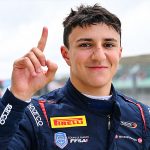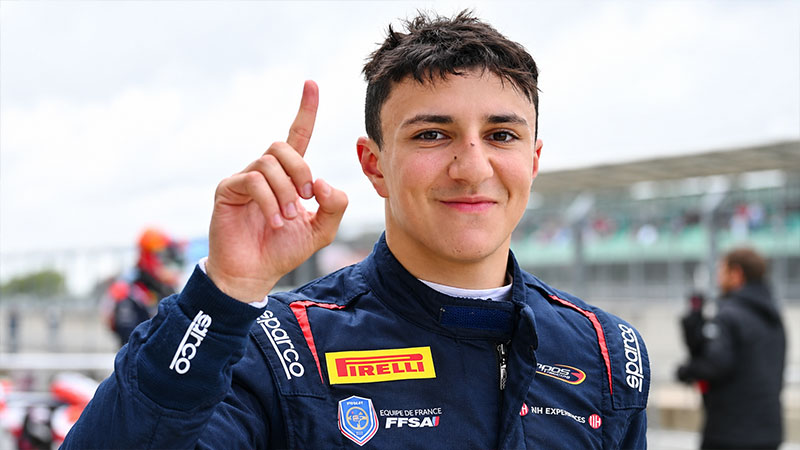
Isack Hadjar has not publicly confirmed his religion. The French-Algerian Formula 1 driver has family roots in Algeria, a heritage closely tied to Islam, but he keeps his personal faith out of interviews and social media.
That gap explains why “Is Isack Hadjar Muslim?” keeps appearing in search bars. Fans want to know more about the young driver who rose from the Red Bull Junior Team to a seat beside Max Verstappen.
Many Muslim fans, especially across France and North Africa, also hope to see themselves reflected on the grid.
This article sets out what is known, what is not, and why the difference matters. Facts here reflect public information available up to mid-2026.
Who Is Isack Hadjar?
Isack Hadjar is a French racing driver born in Paris on 28 September 2004. He reached Formula 1 in 2025 with Racing Bulls and moved up to Red Bull Racing for 2026.
His path followed the classic junior ladder. He impressed in karting, then climbed through French F4 and the Formula Regional European Championship. In 2022 he joined the Red Bull Junior Team and won races in FIA Formula 3 with Hitech.
Formula 2 tested his patience. A difficult 2023 was followed by a strong 2024 with Campos, where he finished runner-up in the championship. That result earned him his F1 chance.
His rookie year carried real emotion. A crash on the formation lap at the 2025 Australian Grand Prix left him in tears, and a consoling hug from Anthony Hamilton, father of Lewis Hamilton, became one of the season’s most shared moments. Months later he answered with third place at the Dutch Grand Prix, his first F1 podium.
| Fact | Detail |
|---|---|
| Born | 28 September 2004, Paris, France |
| Nationality | French, racing under the French flag |
| Heritage | Family roots in Algeria |
| Nickname | “Le Petit Prost” |
| F1 debut | 2025 Australian Grand Prix, Racing Bulls |
| First podium | 3rd, 2025 Dutch Grand Prix |
| 2026 team | Red Bull Racing |
| Religion | Not publicly confirmed |
French-Algerian Roots
Hadjar grew up in France in a family of Algerian descent. His father, Yassine, has Algerian roots and a background in science, which fits the driver’s reputation for an analytical approach to racing.
Algeria is a country where the large majority of people identify as Muslim. France, meanwhile, is home to one of Europe’s largest Muslim communities, much of it with North African ancestry. Put these two facts together, and many fans assume Hadjar shares that faith.
Yet heritage and belief are not the same thing. French-Algerian families span a wide range of religious practice. Some are devout, some observe traditions as part of family culture, and some are not religious at all.
What is certain is the pride his rise inspires. His results are followed closely by fans in Algeria and across the French-Algerian community, who see one of their own competing at the highest level of motorsport.
Has Hadjar Spoken About His Religion?
No public interview, press conference, or social media post confirms Hadjar’s religious beliefs. His public voice centers on racing: car balance, tire management, and the pressure of delivering for Red Bull.
Three clues often appear in online discussions, yet none settles the question:
- His Algerian heritage. This points to family background and culture, not to personal faith.
- His first name, Isack. It is a form of Isaac, a figure honored in Judaism, Christianity, and Islam, so it signals no single religion.
- The absence of visible religious gestures. This proves nothing either way, since many drivers of every faith keep worship private.
The accurate answer, then, is that Isack Hadjar’s religion is not publicly known. Any article that states otherwise as fact goes beyond what he has chosen to share.
Why Fans Ask: Muslim Representation in Formula 1
Interest in Hadjar’s faith reflects a wider wish for representation. Formula 1’s calendar has included Bahrain, Saudi Arabia, Qatar, Abu Dhabi, and Azerbaijan, all Muslim-majority countries with large and growing fan bases.
The driver line-up has rarely mirrored that audience. A fan in Algiers, Marseille, or Jeddah can watch a full season without seeing a driver who shares their background. So when a French-Algerian talent lands at Red Bull, one of the sport’s most famous teams, attention follows naturally.
For many fans, Hadjar already represents something meaningful through his heritage alone. Young people from North African families in France can now picture a route from local karting tracks to the top tier of motorsport. That message stands regardless of what he believes privately.
Heritage Versus Belief: Why Respectful Coverage Matters
Religion is personal information. Assigning a faith to someone based on ancestry, a name, or appearance risks spreading errors and reinforcing stereotypes.
France adds another layer. The country’s strong tradition of laïcité, or secularism, shapes how public figures talk about belief. Many French athletes treat religion as a private matter, and Hadjar appears to follow the same approach.
Responsible coverage of any athlete’s faith rests on three simple rules:
- Report what the person has said, not what others assume.
- Separate cultural heritage from individual belief.
- Update the facts promptly if the person chooses to speak.
If Hadjar ever discusses his faith publicly, his own words should be the final word. Until then, respecting his privacy is both the fair choice and the accurate one.
What Truly Defines Isack Hadjar
Hadjar’s public identity rests on his driving. His smooth inputs and calm racecraft drew comparisons with four-time world champion Alain Prost, which is how he earned the nickname “Le Petit Prost.”
He is also known for raw honesty. He speaks openly about mistakes, frustration, and pressure, which has made him one of the most relatable young drivers on the grid. That candor, paired with a podium in his rookie season, convinced Red Bull to place him alongside Verstappen.
Fans who follow Hadjar closely tend to value exactly these traits: speed, resilience, and openness about the realities of the sport. Those are the qualities he chooses to share, and they offer plenty to admire.
Conclusion
So, is Isack Hadjar Muslim? Based on everything he has shared publicly, the answer remains unknown. He has French-Algerian heritage, a background linked to Islam, but he has never confirmed his faith.
His name, family roots, and nationality offer clues about culture, not proof of belief. That distinction matters, because religion is a private choice that only Hadjar can define.
What is clear is the story he does share: a Paris-born talent who climbed the junior ladder, won hearts in Melbourne, stood on the podium at Zandvoort, and earned a Red Bull Racing seat.