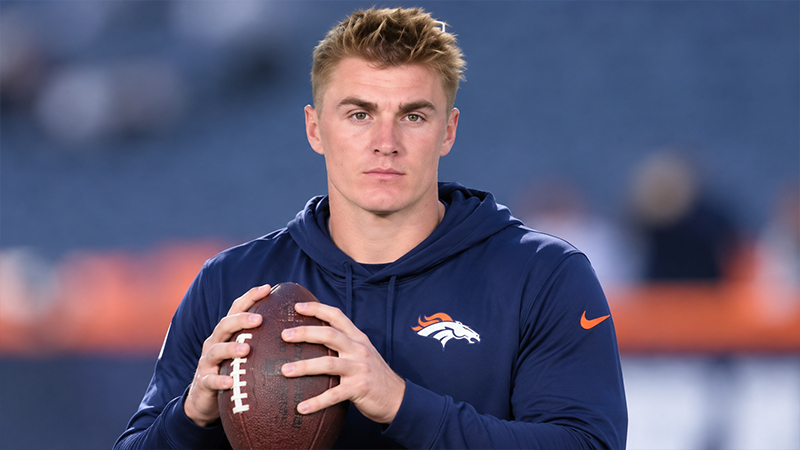
On January 17, 2026, the Denver Broncos beat the Buffalo Bills 33–30 in overtime. The win came in the AFC Divisional Round.
But the joy soon turned to shock for the team and its fans. After the game, Head Coach Sean Payton shared bad news.
He said starting quarterback Bo Nix had a broken right ankle. Doctors found that the break was bad enough to need surgery.
The injury also ended Nix’s postseason run. The news was hard to believe for another reason. Nix did not show clear signs of a major injury late in the game.
He did not limp off or fall to the ground. Instead, he finished the drive and made a key pass. He also stood during his post-game interview.
So how could a quarterback play through a break that needed surgery? The answer involves stress on the body and pain tolerance. It also involves how doctors find and judge bone injuries.
Deconstructing the Mystery Play: Biomechanics and Misconceptions
After Sean Payton announced Bo Nix’s injury, fans and media debated when the fracture occurred. Some rumors pointed to post-game celebrations or the final kneel-down, but film review and team confirmation clarified what happened.
The injury occurred with about six minutes remaining in overtime after a defensive penalty. Denver called a quarterback sweep to the left, and Buffalo safety Cole Bishop tackled Nix for a 2-yard loss.
Two forces contributed to the injury:
- Forced Plantar Flexion: Nix’s right foot landed toes-first while he changed direction, placing heavy stress through the ankle.
- Rotational Torque: His body weight shifted over the planted foot, creating additional twisting force.
Despite the injury, Nix completed a key pass to Marvin Mims, setting up Will Lutz’s game-winning field goal.
Orthopedic Breakdown: Medical Diagnostics and Underlying Factors
Understanding Nix’s injury requires looking at the foot and ankle anatomy. Terms such as “fracture,” “break,” and “full break” all describe disrupted bone continuity, with no clinical difference.
The ankle primarily involves the tibia, fibula, and talus, with the calcaneus forming the heel.
- Medial Malleolus Fracture: Severe eversion can strain the deltoid ligament and pull off a bone fragment.
- Distal Fibula Fracture: Rotational force can break the lower fibula and destabilize the ankle.
- Calcaneus Avulsion: Forceful plantar flexion can cause the Achilles tendon to pull a bone fragment from the heel.
Payton also indicated Nix had a preexisting ankle issue, potentially weakening the bone. X-rays and examination confirmed the fracture, while its instability required surgical fixation for proper alignment and healing.
Surgical Intervention, Rehabilitation, and Long-Term Outlook
Managing an unstable ankle fracture in an elite athlete requires careful surgery followed by a structured rehabilitation plan. Days after the divisional playoff game, Nix traveled to Alabama for corrective surgery.
Surgery for unstable fractures commonly involves Open Reduction and Internal Fixation (ORIF), using titanium plates and screws to stabilize the broken bones. If the syndesmosis is unstable, surgeons may also use suspensory button devices or minimally invasive techniques.
Recovery generally progresses through several stages:
- Osseous Healing Phase (Weeks 1 to 10): Bone healing typically takes eight to ten weeks. Early non-weight-bearing protects the surgical site and hardware.
- Soft Tissue & Mobility Restoration (Months 2 to 3): Physical therapy restores ankle mobility while addressing stiffness, muscle loss, ligaments, tendons, and joint function.
- Strength, Endurance, and Functional Agility (Months 3 to 6): Quarterbacks need strong legs for throwing, scrambling, cutting, and changing direction. Training gradually adds dynamic loading, balance, and sport-specific movements.
During recovery, Nix reportedly underwent a routine follow-up cleanup procedure to address scar tissue or minor hardware irritation.
With proper alignment and rehabilitation, long-term complications can be minimized. Although severe fractures may increase arthritis risk, successful surgery and full rehabilitation can support a complete return to athletic activity.
Executive Summary and Key Takeaways
Bo Nix’s season-ending ankle injury stands as a testament to the extreme physical demands of professional football and the remarkable toughness of elite athletes.
Sustained on a designed sweep in overtime due to a combination of forced plantar flexion, rotational torque, and potential preexisting bone fatigue, the fracture required precise surgical fixation in Alabama.
Through systematic orthopedic care, proper structural repair, and dedicated physical therapy, Nix successfully navigated his recovery timeline to return to full health, ensuring his long-term career outlook remains promising.