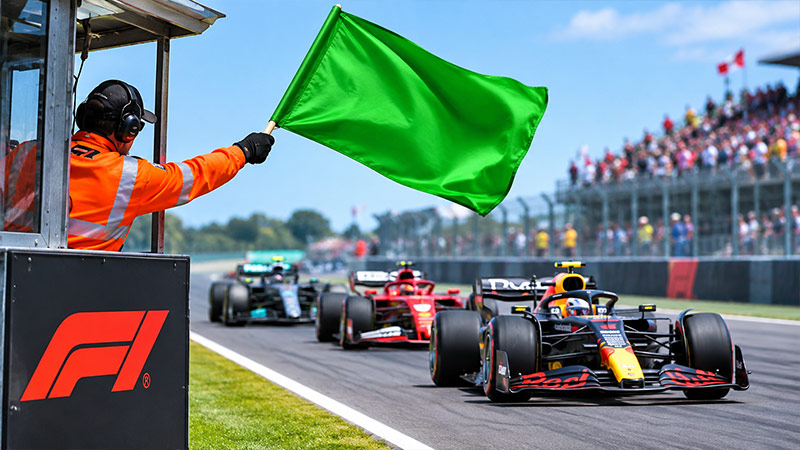
Five red lights go out, twenty-two cars surge toward Turn 1, and many new fans assume a green flag just started the race. It didn’t.
In Formula 1, the green flag plays a quieter but far more frequent role: it tells drivers that danger has passed and full-speed racing can resume.
That simple strip of green fabric, and its LED twin on the trackside light panels, appears dozens of times across a Grand Prix weekend.
It closes yellow flag zones, ends safety car and virtual safety car periods, opens practice sessions and confirms the grid is ready for the start. Misread it, and a driver can lose a lap time, a position or even a result to the stewards.
Whether you discovered the sport last season or have watched for decades, you will never look at a restart the same way again.
What Does the Green Flag Mean in F1?
The green flag in F1 means the track is clear. Drivers may return to full racing speed and overtake again from the point where the green flag is shown. It marks the end of a hazard zone covered by yellow flags, or the end of a neutralised period such as a safety car.
Think of it as the sport’s “all clear” signal. A yellow flag tells drivers to slow down and hold position because something is wrong ahead. The green flag, shown at the next marshal post after the incident, tells them the danger is now behind them.
Where the rule comes from
F1 flag signals are not informal habits or broadcast graphics. They are defined by the FIA, the world governing body of motorsport, in Appendix H of the International Sporting Code, the rulebook that covers circuit marshalling and signalling. The Formula 1 Sporting Regulations then add the specific procedures for race starts, safety cars and virtual safety cars.
Under Appendix H, the green flag is waved at the marshal post immediately after the incident that required one or more yellow flags. The clerk of the course may also use it to signal the start of a warm-up lap or a practice session.
Two details matter for every driver on the grid:
- It is waved, not held still. A waving green flag is easy to spot at more than 300 km/h, even in spray or low sun.
- It applies from that point forward. Yellow flag restrictions only end once the car passes the green flag post, never before it.
When Is the Green Flag Shown? Six Moments Across a Race Weekend
Across a typical Grand Prix weekend, the green signal appears in six distinct situations. Each one tells drivers something slightly different.
| Moment | What the green signal tells drivers |
|---|---|
| Start of practice, qualifying or sprint qualifying | The pit exit is open and the session is live |
| Grid formed after the formation lap | The last car is in its slot, so the start sequence can begin |
| End of a local yellow flag zone | The hazard is behind you; racing and overtaking resume |
| End of a safety car period | The safety car has peeled off; racing resumes at the control line |
| End of a virtual safety car | The speed delta is lifted; full pace is allowed again |
| Session resuming after a red flag | Practice or qualifying is back on and cars may leave the pits |
1. Opening a session
When practice or qualifying begins, the pit exit light turns green and the clock starts running. Teams often send cars out immediately to bank a lap before conditions change.
2. Confirming the grid is ready
The formation lap itself begins when green lights appear at the start line. When the cars return and stop in their grid slots, a marshal at the back of the grid waves a green flag. That tells the starter the field is in position, and the five red lights can begin their sequence.
3. Closing a yellow flag zone
This is the green flag’s most common job. After a spin, a stopped car or debris, marshals show yellow flags before the incident and a waved green flag at the post just after it.
4 and 5. Ending a safety car or virtual safety car
When race control decides the track is safe, green flags and green lights return the race to full speed. The exact timing depends on whether a physical safety car or a virtual one was deployed, which we cover in detail below.
6. Resuming after a red flag
In practice and qualifying, the pit exit light turns green when a red-flagged session restarts. A race restart after a red flag follows its own procedure set out in the Sporting Regulations.
Myth Busted: The Green Flag Does Not Start an F1 Race
An F1 Grand Prix starts when the five red lights go out, not when a green flag waves. It is one of the most common misunderstandings among new viewers, and it usually comes from watching American racing.
Here is how the F1 start actually works. After the formation lap, the cars stop in their grid slots. The five red lights then come on one at a time, at one-second intervals. After a short, deliberately unpredictable pause, all five go out together. That moment, “lights out,” is the start.
Before starting lights became standard, F1 and other FIA events traditionally started races by dropping the national flag of the host country, not a green flag. That heritage is part of why green never became F1’s starting signal.
How F1 compares with NASCAR and IndyCar
| Series | How the race starts | Role of the green flag |
|---|---|---|
| Formula 1 | Standing start, five red lights go out | Track clear, end of caution, grid ready, sessions open |
| NASCAR | Rolling start behind a pace car | Waved by the starter to begin the race and every restart |
| IndyCar | Rolling start behind a pace car | Waved by the starter to begin the race and every restart |
This is why the phrase “green flag racing” is so common in American broadcasts. F1 commentators now use it too, but in Formula 1 it simply means normal, unrestricted racing conditions.
Green Flags, Light Panels and Cockpit Displays: How F1 Signals “Go” Today
Modern F1 shows the green signal in three ways at once, so no driver can miss it. The cloth flag is still there, but it now works alongside technology that reacts in a fraction of a second.
- The marshal’s flag. Trained volunteer marshals at posts around the circuit wave the physical green flag. They remain the backbone of track safety at every Grand Prix.
- FIA-approved LED light panels. Large digital panels at marshal posts and key points around the lap flash the flag colour. Race control can switch them instantly, sector by sector.
- The in-car marshalling display. Lights on the steering wheel dashboard show the current flag for the part of the track the car is in. A driver sees green the moment their sector is clear, without taking their eyes far from the road.
Why the redundancy? Spray can hide a flag in heavy rain. Night races such as Singapore, Las Vegas and Abu Dhabi demand illuminated signals. Street circuits like Monaco and Baku hide marshal posts behind walls and blind corners.
Layering flag, panel and dashboard means the message gets through in every condition, on every continent.
Teams add a fourth layer: the race engineer. On the radio, you will often hear a short call such as “Green, green, green” or “Track clear, push now” the instant a hazard ends.
From Yellow to Green: The Rules Every Driver Must Respect
The green flag only makes sense alongside the yellow flag that comes before it. Between the two, drivers are bound by strict rules, and the stewards enforce them closely.
- Single waved yellow: reduce speed, do not overtake and be prepared to change direction. There is a hazard beside or partly on the track.
- Double waved yellow: reduce speed significantly, do not overtake and be prepared to stop. The track may be partly blocked, or marshals may be working on it.
- Green flag: the restrictions end once the car passes the green flag post. Overtaking is allowed again from that point.
What happens if a driver gets it wrong
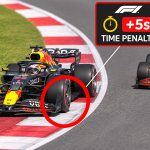
Overtaking under yellow flags is one of the most serious sporting offences in F1. Depending on the situation, stewards can order a driver to hand the position back, issue a time penalty or apply a grid penalty for the next race.
Qualifying brings an extra layer. A driver who sets a fast lap through a double yellow zone without slowing enough can have that lap deleted or face a grid drop.
Since 2021, the FIA has used a system to identify cars that pass double waved yellows without slowing as required, which takes much of the guesswork out of these decisions.
This is why drivers often visibly lift or brake through a yellow zone even when they are on a flying lap. It is also why the green flag matters so much in qualifying: a driver who reaches a yellow zone as it turns green may get a clean lap, while a rival a few seconds behind may not.
Safety Car and VSC Restarts: Where Races Are Won and Lost
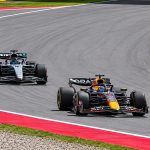
The green flag after a safety car is one of the most decisive moments in any Grand Prix. The field is bunched, tyres are cooler than normal, and every driver is ready to pounce.
How a safety car restart works
- Race control sends the message “SAFETY CAR IN THIS LAP” to all teams.
- The orange lights on top of the safety car switch off, telling drivers it will pit at the end of the lap.
- The race leader now controls the pace and chooses when to accelerate, as long as they stay within the required distance.
- As the safety car enters the pit lane, yellow flags and “SC” boards are withdrawn and replaced by waved green flags and green lights at the control line.
- Overtaking is allowed again only once each car crosses the control line.
Before that final lap, race control may also let lapped cars overtake to rejoin the lead lap. Once the “LAPPED CARS MAY NOW OVERTAKE” message is sent, the safety car normally comes in at the end of the following lap.
How a virtual safety car ends
Under a virtual safety car, drivers must stay above a minimum lap time, or delta, shown on their dashboards. When race control is ready to end it, teams receive the message “VSC ENDING.”
Roughly 10 to 15 seconds later, the VSC boards disappear and green flags and green lights appear. Because no physical car leads the pack, gaps between cars are mostly preserved, and drivers try to time their throttle perfectly for the green.
Real-race lessons
Abu Dhabi 2021: The championship was decided by a final-lap restart after only some lapped cars were allowed to unlap themselves. Max Verstappen passed Lewis Hamilton on that last green-flag lap to win the title.
The FIA later reviewed its race control setup and tightened the wording of the lapped car rule from “any” to “all.”
British Grand Prix 2026: Max Verstappen crashed with four laps remaining at Silverstone, bringing double waved yellows and then the safety car. A “SAFETY CAR IN THIS LAP” message appeared, but the FIA explained it had been displayed in error due to a software fault.
With the lapped car procedure still to complete, the race finished behind the safety car, to boos from parts of the crowd.
The takeaway is simple: no rule in the F1 Sporting Regulations requires a race to finish under green flag conditions. A late incident can end the racing early, which makes every earlier restart even more valuable.
Green Flag Strategy: Pit Stops, Tyres and Timing
For F1 strategists, the green flag is not just a safety signal. It is a timing cue that shapes pit stops, tyre choices and overtaking plans.
The scale is bigger than many fans realise. The 2022 season alone featured 25 safety car interruptions and 18 virtual safety car periods. Every one of them ended with a green signal, which adds up to more than 40 restarts in a single year, each a fresh chance to gain or lose places.
Green flag pit stops vs safety car pit stops
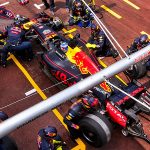
A “green flag pit stop” is a stop made while the rest of the field is racing at full speed. Driving through the pit lane at the speed limit, plus the stop itself, typically costs around 20 seconds of race time, depending on the circuit.
Under a safety car, the rest of the field is also slowed, so the relative cost can drop to roughly half. A virtual safety car offers a smaller but still useful saving.
That is why teams react so quickly when a safety car appears, and why a driver who has just made a green flag stop can feel unlucky when a safety car follows a lap later.
Winning the restart
- Heat management: behind the safety car, tyres and brakes cool down. Drivers weave and brake hard to keep them in their working window for the green flag.
- Leader’s advantage: the leader chooses when to accelerate, aiming to catch the car behind off guard before the control line.
- Energy at the ready: with the 2026 power units relying far more on electrical energy, a well-charged battery at the green flag can decide who attacks and who defends into Turn 1.
- Undercut and overcut: once green flag running returns, fresh tyres can be worth a big chunk of lap time, so the pit wall reassesses strategy immediately.
In short, the minutes before the green flag are packed with decisions. Teams that prepare for the restart, not just the stop, usually come out ahead.
Green Flag vs Other F1 Flags: Quick Reference
The green flag is one of roughly ten flags F1 marshals and race control can show. This table puts it in context.
| Flag | What it means | What the driver must do |
|---|---|---|
| Green | Track clear, hazard has passed | Resume racing; overtaking allowed |
| Yellow (single waved) | Hazard beside or partly on the track | Slow down, no overtaking, be ready to change direction |
| Double waved yellow | Serious hazard; marshals may be on track | Slow significantly, no overtaking, be ready to stop |
| Red | Session or race suspended | Slow down and return to the pit lane; no overtaking |
| Blue | A faster car is about to lap you | Let it past at the first safe opportunity |
| White | Slow-moving vehicle ahead | Take care and expect a slower car |
| Red and yellow stripes | Slippery surface ahead, such as oil or water | Take care; grip has changed |
| Black and white diagonal | Warning for unsporting driving | Clean up driving or risk a penalty |
| Black with orange disc | Car has a dangerous mechanical problem | Pit at the end of the lap |
| Black | Driver excluded | Return to the pits immediately |
| Chequered | End of the session or race | Slow down and complete the in-lap |
Notice the pattern: almost every other flag asks drivers to slow down, give way or take care. The green flag is the only one whose message is simply “go.”
How to Spot the Green Flag as a Fan
You do not need to sit in a grandstand to follow the green flag. Whether you watch on TV, stream on your phone or attend in person, these cues help you read the race like an insider.
- Watch the track status graphic. Broadcasts show messages such as “TRACK CLEAR” or “SAFETY CAR IN THIS LAP” from race control. They are your early warning that a restart is coming.
- Check the onboard cameras. On many onboards, you can see the steering wheel lights flash green the instant a sector clears.
- Follow the live timing map. Yellow sectors on the circuit map return to normal colours when the green flag comes out.
- Listen to team radio. Engineers often call “Green” or “Push now” before you see any graphic.
- At the circuit, find a marshal post. Grandstands near a post or LED panel give you a front-row view of the flag changes.
Why this matters beyond F1
The same FIA flag system is used across international racing, including Formula 2, Formula 3, Formula E and the World Endurance Championship, as well as many national and club events.
Learn the green flag once, and you can follow racing anywhere in the world. Sim racers and track day drivers benefit too, because good flag discipline in a game or on a club circuit builds exactly the habits professional drivers rely on.
Conclusion: The Signal That Brings Racing Back to Life
The green flag is the quiet hero of every Formula 1 weekend. It does not start the race, yet it restarts the action again and again: after yellow flag zones, after safety cars, after virtual safety cars, and at the opening of each session.
For drivers, it marks the exact moment caution ends and attack begins. For strategists, every restart can turn a well-timed pit stop into track position.
For fans, it is the cue to lean forward, because restarts are where races are won and lost. Understanding this one signal makes every Grand Prix easier to follow and more exciting.