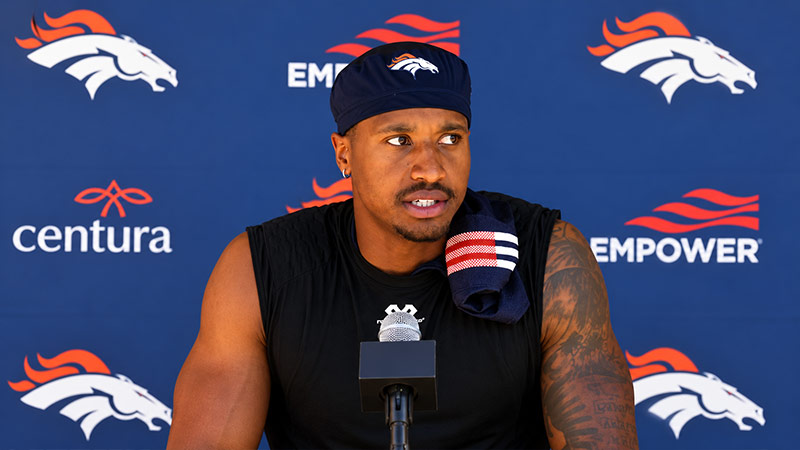
Across online forums, fantasy football leagues, and sports talk radio, a recurring question keeps surface-level observers up at night: Why do the Denver Broncos hate Courtland Sutton?
The frustration from fans and sports managers is understandable. When a proven receiver experiences quiet outings—such as logging just 11 receptions for 104 yards and a single touchdown across a five-game stretch—the immediate reaction is to suspect organizational friction, quarterback favoritism, or intentional benching.
Social media threads erupt with claims that head coach Sean Payton is ignoring his top target or that second-year quarterback Bo Nix refuses to look his way.
However, the narrative that the Denver Broncos hold personal animosity or institutional disregard toward Courtland Sutton is entirely false.
In reality, Sutton remains the undisputed emotional and physical anchor of the Denver offensive unit. He was voted a team captain for his sixth consecutive season, a honor bestowed directly by his teammates that reflects his standing as a leader in the locker room.
1. Tactical Breakdown: Unpacking the On-Field Production Decline
To understand why a star player’s target share dips, sports analysts must analyze film rather than emotion. Several interconnected tactical elements explain Sutton’s statistical lull.
Defensive Gravity and Bracket Coverage
Opposing defensive coordinators prepare for games by identifying the opponent’s primary threat and designing schemes to eliminate them. In Denver’s offense, Courtland Sutton stands out as the only fully proven, elite perimeter wideout on the roster.
Because surrounding receiving options consist of developing players and unproven depth, opposing defenses routinely dedicate their best defensive assets to Sutton. This involves:
- Shadow Coverage: Assigning the opponent’s number-one cornerback to follow Sutton across the formation.
- Safety Shells & Bracketing: Deploying safety help over the top, effectively double-teaming Sutton on intermediate and deep routes.
When a defense commits two defenders to cover one wideout, the quarterback’s pre-snap read dictates directing the ball elsewhere.
Sutton’s presence creates “coverage gravity,” drawing secondary focus away from the center of the field and opening up lighter coverage for secondary targets.
While this defensive attention limits Sutton’s individual targets, it serves as a foundational component of Denver’s broader offensive design.
Quarterback Development and Processing Mechanics
Bo Nix’s development can affect Sutton’s opportunities. Under pressure, the young quarterback may favor quick, safer throws over deeper routes.
His college connection with Troy Franklin may also influence his reads. Sutton’s boundary routes and contested catches require timing and protection, making his production more vulnerable when the passing game struggles.
Game Scripting and Game-Plan Conservatism
Sean Payton adjusts Denver’s offense to the opponent and game flow. When the defense controls the game, he favors running the ball, managing the clock, and limiting turnovers. That conservative approach can reduce Sutton’s downfield opportunities.
2. The Player Perspective: Leadership and High-Leverage Trust
While external observers interpret declining target numbers as a sign of internal discord, internal operations reveal a completely different story centered on mutual respect and professional alignment.
Sutton’s Team-First Philosophy
In an era where wide receivers often demand public attention regarding their target numbers, Courtland Sutton takes an entirely different approach. Sutton has explicitly voiced a willingness to sacrifice personal statistical goals and target volume if doing so supports the team’s victory strategy.
This selflessness is why his leadership remains unchallenged in the building. By occupying double-teams, executing perimeter run blocks, and drawing safety coverage away from the middle of the field without complaint, Sutton sets an example for the younger skill players on the roster.
The “Find 14” Rule in High-Stakes Moments
Coaching staff perspectives offer clear proof regarding Sutton’s actual status within the organization. Head Coach Sean Payton has publicly praised Sutton, emphasizing that he possesses all the physical and mental traits desired in a top-tier professional.
More importantly, when games reach critical junctures—such as third-and-long conversions, red-zone trips, or fourth-quarter comeback drives—Payton’s directive to his quarterback is explicit: “Find 14.”
As Payton has pointed out, even when Sutton appears covered by traditional defensive metrics, his size, catch radius, and body control mean he is rarely truly out of a play. The coaching staff views him not as a secondary option, but as their most dependable playmaker when the game is on the line.
3. Comparative Context: Historic Target Distribution in Payton’s Offense
To fully grasp why Sutton’s production comes in waves, it is helpful to analyze how Sean Payton’s offensive systems have operated over time.
Payton’s offensive philosophy is built on distributing the football according to defensive leverage rather than forcing targets to a single star player.
- The Spread Concept: In Payton’s systems, the ball goes wherever the defense leaves space. If an opponent plays single coverage on the boundary, the primary wideout receives high target volume. If the opponent rolls coverage toward the outside, the offense shifts focus to running backs out of the backfield, tight ends in the seam, or slot receivers underneath.
- Matchup Exploitation: Rather than asking a receiver to beat double coverage all game, Payton uses his primary receiver as a decoy to isolate favorable mismatches elsewhere on the field.
- Statistical Bouts: Throughout his career, Sutton has repeatedly shown the ability to string together highly dominant stretches—logging back-to-back double-digit target games, century-mark receiving totals, and multi-touchdown efforts once defenses are forced to loosen coverage.
Statistical lulls are not evidence of a fractured relationship; they are the natural product of a system designed to take what the defense gives.
4. Strategic Recommendations for Fans and Managers
For sports analysts, fantasy managers, and Broncos supporters trying to navigate Sutton’s fluctuating production, evaluation must be grounded in strategic indicators rather than emotional reactions.
Key Factors to Monitor
- Opposing Defensive Profiles: Track whether upcoming opponents deploy heavy zone schemes or man-to-man coverage. Sutton’s highest fantasy and real-world ceilings occur against aggressive defenses that play single-high man coverage, giving him isolated 1-on-1 matchups on the outside.
- Game-Script Trajectory: In games where Denver is projected to trail or engage in high-scoring contests, Payton is forced to open up the passing playbook, leading directly to higher target volume for Sutton. Conversely, in games against struggling offenses where Denver can rely on defense and ground play, expect lower passing volume.
- Quarterback Progression: As Bo Nix gains experience reading secondary coverages and trusting pocket protection, his willingness to throw into tight-window boundary coverage will increase, directly benefiting Sutton.
Strategic Action Plan
- Do Not Panic Drop: Claims that Sutton is “droppable” or completely phased out of the offense ignore his underlying role as the primary option in critical situations.
- Identify Buy-Low Opportunities: Statistical lulls caused by defensive attention create excellent acquisition windows for savvy managers who understand that target distribution naturally regresses to the mean over a full season.
- Matchup-Based Usage: Utilize Sutton strategically in lineups during weeks where Denver faces pass-heavy game scripts or secondary defenses lacking elite perimeter cornerbacks.
Strategic Summary
The narrative that the Denver Broncos “hate” or intentionally neglect Courtland Sutton is a total misconception born out of box-score watching and fantasy football frustration.
On film, Sutton remains the structural center of Denver’s passing attack. His lower statistical output during certain stretches is the direct result of drawing the opponent’s top defensive coverage, a developing young quarterback adapting to NFL defenses, and a head coach who tailors play-calling to game flow rather than individual stats.
Sutton’s six-year captaincy, combined with Sean Payton’s “Find 14” philosophy in critical moments, confirms his true standing in Denver.
As the offense matures and defenses are forced to respect emerging secondary options, expect target volume to balance out—reaffirming Courtland Sutton’s status as one of the premier boundary targets in the game.