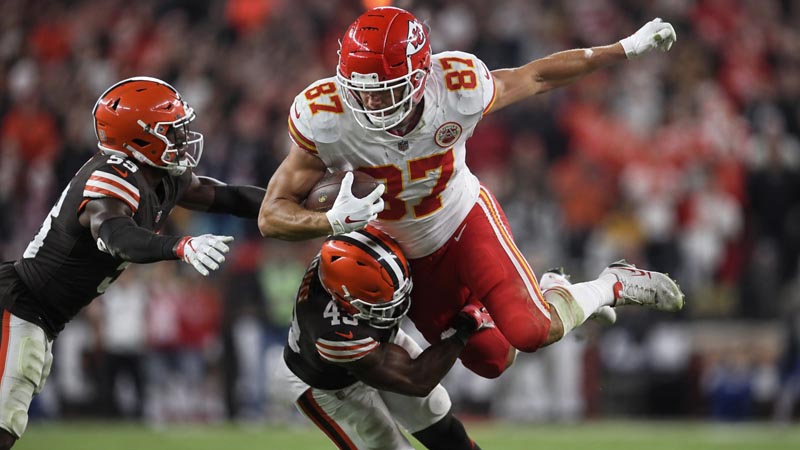
In the modern landscape of professional football, tactical innovation is driven by the search for match-up advantages. No single position on the gridiron embodies this quest more completely than the tight end.
Operating as football’s ultimate power-and-precision hybrid, a tight end combines the physical, gritty responsibilities of an offensive lineman with the dynamic, game-breaking catching capabilities of a wide receiver.
For casual observers and seasoned analysts alike, understanding what a tight end does in the NFL is essential to grasping how modern offenses operate.
The position has evolved from a quiet, blocking-first auxiliary role into a multi-faceted strategic weapon that dictates defensive alignments, opens up running lanes, and dominates the passing game.
The Hybrid Paradigm: Blending Protection and Playmaking
To fully comprehend the role of a tight end, one must look at how they bridge two entirely different worlds of football mechanics.
Traditionally, a tight end lines up directly adjacent to the offensive tackle on the line of scrimmage. Because of this alignment, they serve as the anchor of the “strong side” of the offensive formation, providing an immediate physical presence where the run or pass protection is concentrated.
1. The Core Blocking Mandate
When the play call dictates a run, the tight end effectively becomes a sixth offensive lineman. They are responsible for executing physical, straight-ahead blocks to push back heavy defensive linemen and physical linebackers.
Whether they are sealing the edge on an outside sweep or double-teaming a defensive end to clear a path for the running back, their blocking ability is a vital element of a successful running game.
In pass protection, the tight end’s blocking duties are equally critical. They must occasionally assist the offensive tackle in keeping pass rushers away from the quarterback.
This requires exceptional lower-body strength, precise hand placement, and a deep understanding of defensive blitz packages to prevent defenders from collapsing the pocket.
2. The Receiving Threat
Unlike offensive linemen, who are ineligible to catch forward passes, a tight end is an eligible receiver on every single play. This dual eligibility is what makes the position uniquely dangerous.
At any moment, a tight end can transition from a physical block to running a route into the flat, across the middle, or down the deep field.
By running short and intermediate routes, tight ends act as a vital safety valve for quarterbacks under pressure.
Because they run highly precise routes across the middle of the field—often in high-traffic zones populated by hard-hitting linebackers and safeties—they must possess the concentration and physical toughness to secure the ball in heavy traffic.
The Physical Blueprint: Size, Strength, and Athletic Mismatch
The physical demands of playing tight end in the NFL require a rare athletic profile that very few human beings possess.
To block a 270-pound defensive end on one play and run away from a 190-pound cornerback on the next requires a highly specific physical makeup.
In high-level Division I college football programs, the ideal recruiting profile for a tight end is typically 6-foot-4 and 230 pounds.
However, once these athletes reach the professional ranks of the NFL, the physical baseline expands significantly.
Active NFL tight ends generally range from 240 pounds to well over 300 pounds, standing as massive, muscular targets who can absorb heavy impacts.
To succeed with this massive frame, an NFL tight end must master a highly specialized set of physical skills:
- Exceptional Hands: First and foremost, tight ends must be highly reliable pass catchers. They must be capable of securing routine short passes as well as making difficult, contested catches while closely guarded by defenders who are actively pulling at their arms.
- Physical Strength and Height: One of the most inherent advantages a tight end has over standard wide receivers is sheer physical mass. While they lack the elite straight-line speed to consistently outrun defensive backs, they use their height and physical power to get into optimal position, essentially boxing out defenders to win jump balls.
- Lateral Elusiveness: Because they cannot rely on raw speed to create separation, tight ends must develop outstanding lateral quickness. This lateral agility allows them to run sharp, crisp routes, make sudden cuts, and shake defenders in tight spaces.
- Versatility in Blocking: An elite tight end cannot be a one-dimensional blocker. They must be comfortable blocking straight ahead on heavy running plays, executing pass protection assignments near the quarterback, and blocking downfield to spring running backs and wide receivers for extra yards.
- Yards After Catch (YAC) Physicality: Once a tight end catches the football, their job is far from over. They must be sturdy, aggressive runners who can move the ball downfield. Unlike wide receivers who try to outrun or juke defenders, tight ends typically gain their yards after the catch by running through, over, and physically punishing would-be tacklers.
Tactical Taxonomy: The Three Specialties of the Modern Position
As NFL coaching strategies have become more specialized, the tight end position has split into three distinct sub-roles.
While some elite players can perform all of these duties, most NFL rosters carry three different tight ends, each possessing a specific set of skills tailored to different game situations.
                ┌──────────────────────────────────┐
                │        THE NFL TIGHT END         │
                └────────────────┬─────────────────┘
                                 │
         ┌───────────────────────┼───────────────────────┐
         ▼                       ▼                       ▼
┌─────────────────┐     ┌─────────────────┐     ┌─────────────────┐
│     INLINE      │     │  FLEX / HYBRID  │     │     H-BACK      │
│  (Blocking-First│     │ (Receiver-First │     │ (Moveable Asset │
│   Sixth Lineman)│     │   Mismatch)     │     │   Back of line) │
└─────────────────┘     └─────────────────┘     └─────────────────┘
1. The Inline / Blocking Specialist
The inline tight end is the closest representative of the traditional, classic version of the position. These are heavy, exceptionally powerful players whose primary focus is hard-nosed blocking right next to the offensive tackle.
While they remain eligible receivers and will occasionally run routes to catch play-action passes, their main value is their ability to push the defensive line back.
In short-yardage situations—such as a third-and-one or a goal-line play—coaches will often deploy heavy packages featuring two or even three inline tight ends simultaneously, maximizing physical blocking power to secure a crucial first down.
2. The Flex / Hybrid Weapon
The flex or hybrid tight end is essentially an oversized wide receiver whose primary specialty is catching passes.
Because of their unique athletic gifts, these players are rarely asked to block inline with their hands in the dirt. Instead, they are “flexed” out wide or lined up in the slot as inside receivers.
The hybrid tight end is highly difficult to account for. Coaches will constantly put them in motion before the snap, shifting them across formations to force the defense to reveal its coverage scheme.
Even when they aren’t the primary target of a pass play, their presence on the field forces the defense to adjust, making them highly effective decoys for both running and passing schemes.
3. The Dynamic H-Back
The H-back represents a creative tactical blend of a traditional tight end and a fullback. Instead of lining up directly on the line of scrimmage, the H-back stands up and sets up a few yards behind the line of scrimmage.
This deep alignment gives them a head start and a wider angle of approach, allowing them to move dynamically before the snap.
From this versatile position, the H-back can act as a mobile lead blocker on running plays, protecting the running back as they cross the line of scrimmage, or they can quickly slip out into the flat to catch short check-down passes from the quarterback.
Strategic Domination: Creating the Ultimate Mismatch
The ultimate goal of any offensive scheme is to create a mismatch—a situation where a defender is physically or athletically incapable of covering an offensive player. The tight end is the premier mismatch tool in modern football.
The Coverage Dilemma
Because of their hybrid physical makeup, tight ends present an unsolvable problem for defensive coordinators.
- If a defense attempts to cover a hybrid tight end with a standard, physical linebacker, the tight end will typically use their superior speed, lateral quickness, and precise route running to get open.
- If the defensive coordinator tries to counter this by deploying a faster, more agile defensive back (such as a cornerback or safety), the tight end will simply use their massive height, weight, and strength advantage to physically box out the smaller defender and catch the ball over them.
The Art of the Chip Block
One of the most effective strategic tools in a tight end’s arsenal is the “chip block”. On a pass play, instead of immediately running a route downfield, the tight end will hold a block against an oncoming pass rusher for a second or two.
This initial block helps protect the quarterback and slows down the defender’s rush. Once the defender is engaged, the tight end suddenly releases the block and slips out into the flat to run a short pass route.
Because the defense assumed the tight end was staying in to block, they are often left completely uncovered, creating an easy completion and a big gain.
Red Zone and Short-Yardage Supremacy
As an offense approaches the opponent’s goal line, the playing field shrinks dramatically. In the red zone, deep speed and open space become non-existent, meaning wide receivers have very little room to run away from defenders.
This is where the tight end dominates. In these tight, condensed spaces, speed and separation are far less important than physical positioning and contested catching ability.
Tight ends excel at using their large bodies as shields, boxing out defenders like basketball players grabbing a rebound, and jumping high to pull down passes in heavy traffic.
The Historical Arc: From Forgotten Blocker to Center Stage
To appreciate the modern prominence of the tight end, it is helpful to look back at how the position was forged. The trajectory of the tight end mirrors the evolution of the game itself—shifting from a run-heavy, physical sport to a highly aerial, pass-first entertainment spectacle.
| Era | Key Development | Impact on the Tight End Position |
|---|---|---|
| 1906 | Forward Pass Introduced | The forward pass created new opportunities for receivers and helped establish the concept of the tight end. |
| 1940s | Two-Platoon System Begins | Greater player specialization allowed tight ends to develop more distinct blocking and receiving roles. |
| 1961 | Mike Ditka Redefines TE | Ditka helped transform the tight end into a major offensive weapon, recording 56 receptions as a rookie. |
| Modern Era | Dynamic Mismatch | Tight ends have become versatile matchup players, with 10 tight ends in the Pro Football Hall of Fame and the position now a roster staple. |
The Invention of the Position
In the early days of football, the forward pass did not exist; it was not officially integrated into the rules until 1906, which was 37 years after the first organized college football game was played in 1869. Consequently, the offense consisted entirely of running plays.
The player positioned at the very end of the offensive line was simply referred to as an “end”. As coaches began looking for ways to add physical power to their running attack, they squeezed an extra blocker tightly onto the end of the line. This physical alignment led to the coining of the term “tight end”.
The Post-War Specialization (1940s)
For the first half-century of football, rosters were comprised of two-way players who played on both offense and defense. A defensive end would double as an offensive end, and a fullback would play linebacker.
This changed in the 1940s when the NFL introduced the “two-platoon system,” which allowed teams to deploy completely separate units for offense and defense.
This rule change eliminated full-time two-way players and sparked an era of tactical specialization. Coaches finally had the freedom to experiment with unique, offense-only roles, laying the groundwork for the modern, multi-dimensional tight end.
The Mike Ditka Revolution
In 1961, Chicago Bears rookie tight end Mike Ditka forever changed how the position was played. Ditka became the league’s first true pass-first tight end, catching an incredible 56 passes in his rookie season alone.
As NFL teams slowly shifted their focus from running the ball to passing it, having a highly productive, pass-catching tight end became an absolute priority. The position grew from a gritty, blue-collar blocking role into a highly glamorous, heavily featured offensive weapon.
This historical transformation is reflected in the Pro Football Hall of Fame: before 1963, not a single tight end was enshrined in Canton. Today, there are 10 legendary tight ends immortalized in the Hall of Fame, celebrating the position’s massive impact on the history of the sport.
The Scarcity, Strategy, and Roster Dynamics of the NFL
Because of the diverse physical and mental demands of the position, finding an elite tight end is one of the hardest challenges an NFL front office can face.
The Severe Scarcity of Elite Talent
Truly elite tight ends are incredibly rare. An NFL team needs a player who is large and strong enough to block a 280-pound defensive end, yet fast and agile enough to run away from a 200-pound safety.
Athletes with this rare combination of size and movement skills are highly sought after. Often, by the time they reach college or professional drafts, these athletes are funneled into other high-profile positions, such as defensive end, or they pursue other sports like basketball entirely.
As a result, NFL teams struggle to find players who can seamlessly execute both blocking and receiving assignments at an elite level.
Roster Management and the Three-Tight-End Standard
To manage this talent scarcity and prepare for various tactical scenarios, almost every modern NFL team carries three tight ends on their active roster.
By holding three tight ends with different specializations—typically a hybrid receiver, a dedicated inline blocker, and a traditional dual-threat option—a coaching staff can remain highly flexible.
| Tight End Role | Primary Responsibility | Key Functions |
|---|---|---|
| TE 1: Hybrid | Receiving & versatility | Receiving mismatch, red-zone specialist |
| TE 2: Blocker | Blocking & protection | Inline run blocking, pass protection |
| TE 3: Utility | Depth & special teams | Special teams, backup/depth role |
They can rotate these players in and out depending on the game plan, the opponent’s defensive strengths, or the immediate down-and-distance situation.
The Fantasy Football Reality
This roster division explains why tight ends are notoriously inconsistent and difficult to predict for fantasy football players.
Except for a select few teams that actively game-plan around a tight end as a primary, heavily featured target, most NFL offenses use their tight ends primarily as blockers and situational check-down options.
For fantasy managers, identifying which tight ends play in schemes that prioritize them as primary targets is the key to finding consistent weekly production.
The Future of the Hybrid Position
The tight end remains one of the most intellectually and physically demanding positions in all of professional sports.
As NFL coaching staffs continue to push the boundaries of offensive design, the tight end will remain at the very center of strategic innovation.
Whether they are clearing a crucial path for a running back on a cold December afternoon or catching a game-winning touchdown pass in the back of the red zone, the tight end’s perfect blend of power and precision makes them the ultimate asset in modern football.