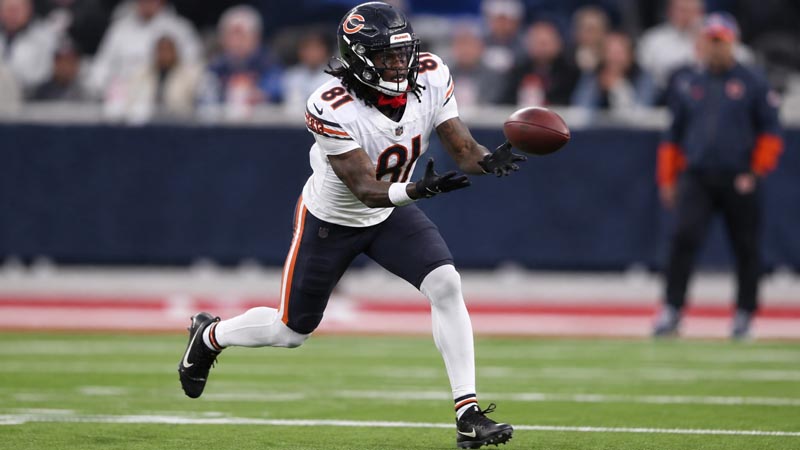
The modern National Football League is defined by the air game. While quarterbacks historically command the lion’s share of media attention and credit after an explosive play, an elite passing attack requires a highly skilled, specialized counterpart on the receiving end of those throws.
Enter the wide receiver: an offensive player positioned near the sidelines whose primary objective is to run pre-planned paths, separate from defenders, and secure passes to move the chains and score touchdowns.
Over the past few decades, the wide receiver position has transformed from a secondary offensive role into one of the most high-profile, glamorous, and heavily compensated positions in professional sports. On game days, NFL franchises typically dress five wide receivers.
Aside from quarterbacks, who average roughly $4.9 million annually, wide receivers have climbed the financial ladder to become the highest-paid offensive skilled players in the league, commanding an average salary of approximately $2.77 million per year.
This comprehensive guide analyzes the exact mechanics of what a wide receiver does, details their core physical and mental responsibilities, breaks down traditional alignments, and explores the tactical fluidity of the modern passing game.
1. Core Responsibilities: The Mechanics of an Elite Receiver
An elite wide receiver must combine world-class athleticism with rigorous mental discipline. To appreciate the position, one must look beyond the highlight-reel catches and analyze the specific duties a receiver must execute on every single snap.
Running Precise Routes
A “route” is the mathematically precise, pre-determined path a receiver runs after the ball is snapped. These paths are rarely straight lines; they require sharp cuts, stems, and double-moves designed to fool defenders. Mastery of route-running is a craft that requires years of intensive practice to perfect.
Receivers spend hours polishing their footwork and timing. This precision is critical because it directly influences the quarterback’s decision-making.
High-level offensive schemes rely on anticipation; the quarterback must often throw the ball to a specific spot on the turf before the wide receiver has even made their final cut. If a route is run even a fraction of a second too slow or a yard too wide, the pass will fall incomplete or be intercepted.
Classic Route Tree Concept (Simplified):
  9 (Fly/Go)      -------> Deep Vertical Route
  7 (Corner)      ---\     Outward Diagonal
  5 (Out)         ----|    90-Degree Outward Cut
  3 (Comeback)    <---|    Stop & Back Toward QB
  1 (Flat)        --|      Short Outward Cut
--------------------------------------------- Line of Scrimmage
  2 (Slant)       |--/     Quick Diagonal Inward Cut
  4 (In/Dig)      |----    90-Degree Inward Cut
  6 (Post)        |---/    Inward Diagonal Cut
  8 (Post-Corner) |---/\   Double-Cut Outward
Gaining Separation
Defensive backs—primarily cornerbacks—are tasked with matching a wide receiver’s movements stride for stride.
To counter this, a receiver must use exceptional quickness, agility, speed, and body positioning to create “separation” (physical distance between themselves and the defender).
A master class in separation relies heavily on deception. Elite receivers use head fakes, sudden changes of speed, and subtle shifts in body weight to make a defender believe they are running one route, only to snap in the opposite direction at the break point.
This split-second window of open space is all a quarterback needs to safely deliver the football.
Catching with the Hands
While it sounds simple, the mechanical process of catching an NFL-level pass is highly technical. Wide receivers are strictly taught to catch the football with their hands extended, rather than letting the ball strike their chest.
By securing the ball away from the body with “soft hands,” a receiver can smoothly transition into a running motion without losing speed. This technique is essential for making catches in stride and protecting the ball from defenders who are closely trailing.
A quality receiver is expected to secure any “catchable” pass—conventionally defined as any ball thrown within arm’s reach.
Yards After Catch (YAC)
Securing the catch is only the first phase of a wide receiver’s offensive contribution. Elite targets are judged heavily on their ability to accumulate Yards After Catch (YAC), also known as Run After Catch (RAC).
Once the ball is secured, the receiver instantly transitions into a ball-carrier, utilizing vision, physical stamina, and lateral agility to make defenders miss in open space.
By breaking tackles and executing sharp evasive cuts, they turn short, low-risk completions into explosive, chunk plays or touchdowns.
The Unsung Duty: Run and Pass Blocking
A common misconception is that wide receivers only impact the game when they are targeted. In reality, blocking is a crucial element of the position.
When a play call dictates a run or a quick perimeter screen to another player, receivers are expected to aggressively engage and block opposing cornerbacks, safeties, or linebackers.
Physicality in blocking is often what separates an average offense from an elite one; a well-executed block by an outside receiver is frequently the key block that springs a running back for a massive gain down the sideline.
2. Physical and Mental Attributes of the Position
According to long-time wide receiver evaluator and author Jay Norvell, the position demands an incredibly complex matrix of human capability. Norvell summarizes the elite receiver as a unique synthesis of:
- Physical Power: Agility, body control, quickness, soft hands, physical stamina, eye-hand coordination, and raw strength.
- Mental Acuity: Concentration, extreme focus, toughness, pride, situational vision, intelligence, and the cognitive ability to conceptualize complex structural concepts on the fly.
A receiver must possess the vision to locate a football flying through a crowded sky, often looking over or around defenders who are completely blocking their line of sight. Furthermore, they must possess the physical and mental toughness to withstand punishing hits from defensive players immediately after making a catch, maintaining their grip on the ball even under heavy impact.
3. The Traditional Blueprint: Understanding X, Z, and Slot Alignments
To understand how an NFL offense operates, one must understand the pre-snap alignment rules. By NFL rule, an offense must line up with at least seven players positioned directly on the line of scrimmage (an imaginary horizontal line spanning the width of the field where the ball is snapped).
Typically, five of these seven players are offensive linemen, leaving two eligible receiver positions on the line. The remaining four players in the eleven-man offense must align “off the line” of scrimmage (at least one yard back).
Usually, these four off-the-line players are the quarterback, a running back, and two additional receivers or tight ends.
Traditionally, wide receivers have been divided into three distinct roles based on these structural rules: the X, the Z, and the Slot (F) receiver.
Traditional Pre-Snap Offensive Alignment:

        [X]          [LT][LG][C][RG][RT]   [TE]
  (On Line of Scrimmage)                      (On Line)

                               [QB]                 [Z]
                                                 (Off Line)
                               [RB]
The X Receiver (Split End)
The X receiver lines up on the line of scrimmage, positioned wide on the far outside edge of the formation, opposite the tight end.
Because the X is positioned directly on the line of scrimmage, they are structurally restricted: they are not allowed to go into motion before the snap, and they cannot get a running start before facing the defender.
Consequently, the X receiver is highly susceptible to “the jam”—a five-yard zone stretching from the line of scrimmage where defensive backs are legally permitted to make heavy physical contact to disrupt the receiver’s path.
To succeed, an X receiver must be highly physical, tall, and strong, with the explosive power needed to fight through press-man coverage and initial contact.
Because they frequently match up against the defense’s premier cornerback without pre-snap help, the X is historically a team’s best all-around outside target, capable of running deep verticals, sideline comebacks, and physical over-the-middle routes.
The Z Receiver (Flanker)
The Z receiver, also known as the flanker, typically aligns on the opposite side of the field from the X, sharing the same side as the tight end. Unlike the X, the Z receiver is positioned off the line of scrimmage.
This small alignment shift provides a massive mechanical advantage:
- Running Starts: Being off the line allows the Z to get a running start, making it easier to slip past physical defenders at the snap.
- Pre-Snap Motion: Because they are off the line, the Z is legally eligible to go into pre-snap motion. Coaches frequently send the Z in motion across the field to identify whether the defense is playing man or zone coverage and to manufacture clean releases.
As a result, Z receivers can rely slightly more on pure speed, deep threat capabilities, and open-field quickness rather than the sheer physical strength required of the X.
The Slot Receiver (F Receiver)
The slot receiver aligns inside the outside receivers, occupying the “slot”—the pocket of space between the outermost receiver and the offensive tackle. Like the Z, the slot receiver aligns off the line of scrimmage.
Slot receivers run shorter, faster routes that cut across the middle of the field. While high speed is helpful, the slot position prioritizes elite lateral quickness, razor-sharp agility, and rapid change-of-direction.
Because they operate in the crowded middle of the field, slot receivers must have exceptional field awareness to spot empty zones between linebackers and safeties.
They must also possess the physical toughness to absorb hits from defenders who are waiting to defend the middle of the field.
4. The Modern Shift: Positional Fluidity and Matchup Hunting
While the classic definitions of X, Z, and Slot positions are excellent for teaching the fundamentals of football, the modern NFL has made rigid designations largely obsolete.
In the modern era, offenses are built on a philosophy of positional fluidity and mismatch hunting.
Coaches no longer leave their star receivers in a single static position. Instead, they move their best players across the entire formation to exploit defensive weaknesses.
- Creating Mismatches: If a team possesses a dominant, physically imposing “X” receiver, the offensive coordinator may deliberately line them up in the slot. This forces the defense to make a difficult choice: do they cover a massive, elite athlete with a smaller, less physical slot cornerback, or do they assign a slower linebacker to cover them over the middle?
- The Hybrid Approach: Top-tier wide receivers regularly play as an outside X in two-receiver packages, but shift inside to the slot when the offense switches to a three-receiver look. This keeps defenses guessing and prevents defensive coordinators from dedicating double-teams to a single area of the field.
Athletic Transitions to the Position
The high athletic demand of the modern wide receiver position has led to unique player development paths. It is common to see elite high school quarterbacks transition to wide receiver in college or the NFL.
Often, these players were the absolute best athletes on their high school teams, but lacked the specific mechanical traits to play quarterback at the professional level.
Their quarterback background gives them a deep, conceptual understanding of route timing, zone coverages, and defensive structures. Similarly, highly agile cornerbacks frequently transition to receiver to make a direct impact on the offensive side of the ball.
5. A Spectrum of Specialists: Modern Receiver Archetypes
To build a balanced “wide receiver room,” NFL front offices and coaching staffs look to combine players who fit different athletic archetypes. Rather than finding five identical players, teams assemble a puzzle of specialized skill sets.
| Receiver Archetype | Key Physical Traits | Core Tactical Role | Player Examples |
|---|---|---|---|
| Possession Master | Exceptional hands, strong frame, elite catch radius. | Reliably converts third downs; secures catches in tight windows. | Keyshawn Johnson |
| Jump Ball Specialist | Tall frame, exceptional vertical leap, superior body control. | Dominates contested situations, especially in the red zone. | Randy Moss, DeAndre Hopkins |
| Speedster / Deep Threat | Blazing vertical speed, explosive acceleration. | Stretches the defense deep; pulls safeties away from the line. | DeSean Jackson, Tyreek Hill |
| Route Tree Master | Flawless footwork, precise timing, highly deceptive cuts. | Creates quick separation on all routes; highly predictable for the QB. | Jerry Rice, Antonio Brown |
| RAC / YAC Merchant | Elite lateral quickness, strong balance, elusive running style. | Turns short, quick passes into major, explosive plays in space. | Odell Beckham Jr. (OBJ), Michael Thomas |
| Slot Technician | Quick cuts, high football IQ, fearless over the middle. | Exploits zone coverage gaps; acts as a reliable safety valve. | Wes Welker, Julian Edelman |
| Physical Blocker | Broad frame, physical toughness, aggressive playstyle. | Punishes defensive backs on outside runs and quick perimeter screens. | Larry Fitzgerald, Hines Ward |
6. Tactical Formations: Packaging the Passing Game
An NFL offensive coordinator’s playbook is built around personnel groupings. Wide receivers are deployed in specific formations designed to create strategic advantages. Three of the most common packages used in modern games include:
11 Personnel
This is a standard offensive grouping consisting of 1 running back, 1 tight end, and 3 wide receivers. It is widely considered a “neutral formation” because it maintains a perfect balance.
From 11 Personnel, an offense can run the ball or pass with equal effectiveness, keeping the defensive front from over-committing to either option. It is highly popular on first down and in medium-yardage situations.
Trips Formation
A trips formation occurs when an offense overloads three wide receivers on one side of the field.
This imbalance forces the defense to adjust its coverage scheme, often shifting safety help to the overloaded side. A skilled quarterback will analyze how the defense reacts to this grouping and look to exploit the resulting one-on-one matchups on the weak side of the formation.
5 Wide (Empty Backfield)
The 5 Wide formation aligns five receivers on or near the line of scrimmage, leaving the backfield empty of running backs. This is a pure passing formation.
- The Advantage: It spreads the defense across the entire width of the field, creating severe individual matchup advantages and leaving nowhere for defensive backs to hide.
- The Trade-off: With no running back in the backfield, the offense sacrifices pass-protection help. The quarterback has one less blocker to defend against oncoming blitzers, meaning the ball must be thrown incredibly fast.
Summary: The Evolution of an Offensive Weapon
The wide receiver has evolved from a simple split-end running basic routes into a versatile, high-impact offensive weapon.
Today’s elite receivers are among the most physically gifted and mentally sharp athletes in the world.
Success at the position requires a complex mix of explosive athletic ability, precise physical execution, and the cognitive intelligence to dissect defensive coverage systems in real time.
As NFL offenses continue to evolve, the wide receiver will remain at the very center of passing-game innovation.