In the highly structured, physical ecosystem of professional football, the placekicker exists as a fascinating paradox.
Often described as the “resident aliens” of a football team, kickers can resemble green, bug-eyed Martians living among Earthlings rather than traditional gridiron players.
Within a massive roster of up to 53 players, where specialized roles are the norm, the kicker stands out as the most isolated specialist of all.
While offensive and defensive players engage in the violent, physical collisions that define the sport, the kicker exists in a quiet world of technical precision, waiting on the sidelines for a few fleeting, high-pressure moments.
Understanding the role of the kicker requires looking past the standard imagery of block-and-tackle football. This analysis explores the specialized mechanics, strategic impact, psychological burdens, and historical legends of the placekicker position.
The Gridiron’s Martian: A Stature and Background Apart
The physical and cultural contrast between a kicker and the rest of an NFL roster is immediately apparent. Football players are typically celebrated as bulked-up behemoths wearing intimidating, scary-looking shields on their face masks. The kicker, by contrast, presents a far more modest physical profile.
The Physical Blueprint
Generally, professional kickers possess a much slimmer build than their teammates, typically fitting within the following physical estimates:
- Height: 5’10” to 6’2″
- Weight: 180 to 210 pounds
- Build: Slim and flexible
Rather than raw bulk, a kicker relies on extreme flexibility, consistent technique, and the ability to generate explosive power from the lower body.
An Alternative Path to the League
This physical departure is often mirrored by a completely different personal background. While most NFL players spend their youth climbing the ranks of Pee Wee football and starring as the premier athletes of their schools, kickers frequently enter the sport much later in life.
It is common for a professional kicker to have spent their childhood playing soccer or rugby, occasionally outside of the United States, before transitioning their kicking skills to the football field.
Because they do not hit, block, tackle, throw, or catch, they are often excluded from what fans and players consider the core activities of football. Yet, despite this physical and cultural isolation, their contribution to winning games is undeniably massive.
The Technical Mechanics of the Kick: Field Goals and Extra Points
The primary and most highly valued responsibility of a kicker is scoring points through field goals and extra points.
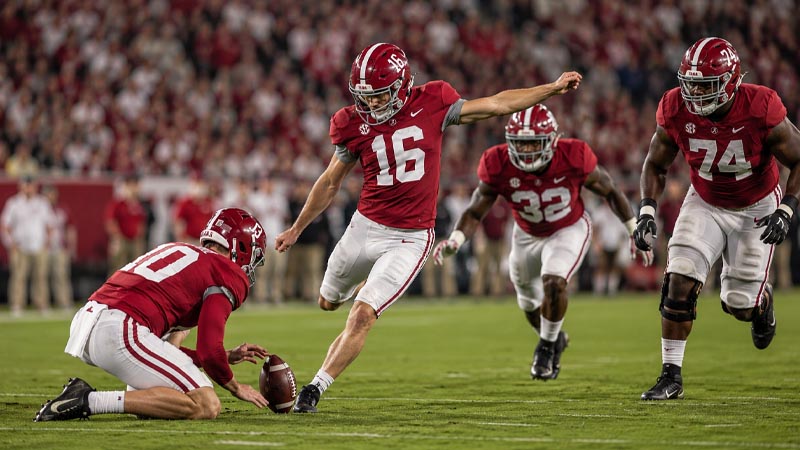
Though the physical act of kicking the ball through the goalposts appears straightforward, it is a highly choreographed operation that requires flawless timing and coordination among three distinct specialists: the long-snapper, the holder, and the kicker.
The Three-Point Play: Anatomy of a Field Goal
When an offense stalls on fourth down within striking distance of the opponent’s end zone, the head coach calls upon the field goal unit to salvage the drive and score 3 points.
The operation begins with the long-snapper, who must deliver a precise snap 7 yards backward. The holder catches the snap, places the football vertically on the ground, and spins the laces away from the incoming kicker.
The kicker then takes a measured approach and strikes the ball, aiming to send it flying through the U-shaped goalposts sits on top of an I-shaped base.
For a field goal to be ruled successful, the ball must fly within the boundaries of the upper U-portion of the posts.
The Probability of Distance
In the NFL, field goal attempts typically range from 25 to 60 yards depending on where the offense was stopped. The difficulty and expectations associated with these kicks scale dramatically with distance:
- Under 40 Yards: These are highly manageable attempts that a reliable NFL kicker is expected to make consistently.
- 40 to 50 Yards: These kicks are significantly more difficult due to the angle and power required, though modern kickers still usually make them.
- Over 50 Yards: These long-range attempts represent a true “crap-shoot” where wind, leg strength, and minor mechanical errors dictate success or failure.
Historically, NFL teams expect their kickers to convert approximately 80 percent of their total field goal attempts over the course of a season.
The Point After Touchdown (PAT)
Immediately following a touchdown, the kicker returns to the field for the extra point (or PAT) to tack on 1 additional point to the team’s score.
While historically viewed as a routine, near-automatic play, the NFL recently increased the difficulty by backing up the scrimmage line.
Today, the PAT is a 33-yard kick, raising the pressure on what was once a simple task. Despite the increased distance, elite professional kickers are still expected to convert roughly 90 percent of their extra point attempts.
Kickoffs and Lateral Duties: Controlling Field Position
While scoring points is the most celebrated aspect of the position, controlling field position through kickoffs and situational kicking is an equally vital part of the job.
    KICKOFF DUTIES (From the 35-Yard Line)
    ┌──────────────────────────────────────────────┐
    │                                              │
    │  [Touchback Goal]                            │
    │  Booting the ball out of the end zone        │
    │  to eliminate explosive returners.           │
    │                                              │
    ├──────────────────────────────────────────────┤
    │                                              │
    │  [Directional Kicking]                       │
    │  Locating the kick away from threats         │
    │  to match the coverage team's path.          │
    │                                              │
    ├──────────────────────────────────────────────┤
    │                                              │
    │  [Onside Kickoff]                            │
    │  Delicate, tactical ball placement           │
    │  traveling just past 10 yards.               │
    │                                              │
    └──────────────────────────────────────────────┘
The Kickoff Operation
The kicker initiates play at the start of each half, and resumes play immediately after their team scores by kicking off from the 35-yard line with the ball placed on a specialized tee.
The primary objective on a kickoff is to boot the ball deep into or out of the opponent’s end zone to secure a touchback, effectively keeping the ball out of the hands of the opposing team’s most dangerous and explosive return players.
When a touchback is not feasible or strategically desired, the kicker must employ directional kicking.
This involves placing the ball in specific zones to align with the coverage team’s run lanes, helping the special teams unit limit the returner’s space and pin the opponent deep in their own territory.
The Tactical Onside Kick
In desperate, late-game scenarios where a team needs to regain possession of the ball immediately after scoring, the kicker must execute an onside kick.
This requires delicate accuracy and touch to strike the ball so that it travels just past the mandatory 10-yard threshold, bouncing in a way that allows teammates to recover the football.
Successfully recovering an onside kick is an incredibly difficult, game-changing play that relies heavily on the kicker’s precision and a bit of luck.
The Luxury of Specialization
Because NFL active rosters are limited to 53 players, teams must manage their depth chart with extreme care.
Employing a separate kickoff specialist is an immense luxury that very few franchises choose to afford. On almost every NFL roster, the primary kicker is responsible for both placekicking and kickoffs.
Additionally, kickers serve as the primary emergency depth for special teams; if the team’s punter is injured during a game, the kicker is typically the first player called upon to fill in and handle punting duties.
The Mental Strain and the Compensation Discrepancy
The life of a professional kicker is defined by extreme psychological pressure and a glaring wage gap compared to the rest of the roster.
The Financial Discrepancy
As offensive schemes continue to evolve, NFL franchises have focused heavily on maximizing their scoring output, leading to skyrocketing salaries for quarterbacks and wide receivers. Kickers sit on the opposite end of this financial spectrum.
They are frequently undrafted coming out of college, and they are generally compensated minimally compared to the eye-popping contracts awarded to their teammates on offense and defense.
The Psychological Crucible
Despite this lower pay, the pressure placed on a kicker’s shoulders is uniquely intense. While quarterback mistakes can be hidden across dozens of plays, a kicker’s errors are magnified. In tight games, the outcome is frequently decided on the final play by a single field goal attempt.
This binary reality leaves no room for error. A kicker who nails a game-winning kick is instantly elevated to the status of a hero; a kicker who misses becomes the sole target of blame for fans and commentators alike.
Because of this brutal dynamic, the true value of an elite placekicker does not just lie in physical leg power, but in their mental discipline.
The difference between an average kicker and a great one is their ability to remain perfectly calm, clear-headed, and focused under extreme, game-defining pressure.
The Strategic Value: How Kickers Dictate Coaching Decisions
A head coach’s entire game plan can be altered by the reliability of their kicker’s leg. Having a high-performing specialist completely changes how a coaching staff approaches fourth-down decision-making.
               COACHING DECISION TREE ON 4TH DOWN

                    [4th Down Opportunity]
                              │
             Is the Kicker Elite and Reliable?
             ┌────────────────┴────────────────┐
            YES                                NO
             │                                 │
     [Peace of Mind]                  [High-Stress Choice]
  Coach confidently opts              Forced to attempt a risky
  for a long field goal to            4th-down conversion or punt,
  secure 3 points.               risking wasted possession.
If a coach knows their kicker can consistently hit long-range attempts, they gain immense peace of mind in tight games, choosing to secure 3 points rather than risking a failed fourth-down conversion.
Conversely, an unreliable kicker introduces severe strategic stress across the entire team:
- Offensive Strain: The offense is forced to take greater risks, knowing they must drive deeper into opponent territory to score, which can lead to wasted possessions.
- Defensive Strain: Missed field goals instantly award the opposing team excellent starting field position, putting immediate pressure on the defense to prevent a score.
Ultimately, a stable and accurate kicking game protects offensive drives, supports defensive starting position, and often serves as the thin margin between a close victory and a devastating loss.
Legends of the Uprights: Profiles in Kicking Excellence
To understand the absolute peak of the placekicker position, one must look at the careers of three legendary specialists who set the standards for accuracy, durability, and clutch performance.
1. Justin Tucker: The Pinnacle of Accuracy
Active since 2012, Justin Tucker has constructed a career that positions him as a lock for the Hall of Fame.
He stands as the most accurate kicker in NFL history, converting just over 91 percent of his career field goal attempts. Highlighting his immense leg strength, Tucker also holds the NFL record for the longest field goal ever converted, a breathtaking 66-yard kick.
2. Adam Vinatieri: The Standard of Clutch
Widely regarded as the most clutch kicker to ever play the game, Adam Vinatieri defined special teams excellence from 1996 to 2019. Over his career, Vinatieri secured multiple Super Bowl titles with dramatic, game-winning kicks in the final seconds.
He retired as the NFL’s all-time leading scorer with an astonishing 2,673 points, and he still holds the record for the most consecutive field goals made at 44.
3. Morten Andersen: The Durable Icon
Morten Andersen’s career is a testament to longevity and consistency, spanning 25 seasons from 1982 to 2007. Andersen retired holding the NFL record for career field goals with 565 conversions at an 80 percent success rate.
Inducted into the Pro Football Hall of Fame in 2017, Andersen retired as the league’s all-time leading scorer before his record was eventually surpassed by Vinatieri.
The Quiet Deciders of the Game
Though they may look like “aliens” standing alongside the heavily armored giants of the NFL, placekickers hold a unique and highly influential role in professional football.
Operating in a cutthroat, high-pressure environment with minimal margin for error, their accuracy and mental calmness dictate coaching strategies, protect team momentum, and ultimately decide the outcome of championship seasons.
They are the quiet deciders of the NFL, turning chaotic, physical games into a precise science of yards, angles, and ice-cold composure.