The modern NFL is a theater of extreme athletic specialization. While fans and commentators naturally gravitate toward the playmakers—the quarterbacks executing pinpoint throws, the wide receivers making acrobatic catches, and the running backs slicing through defenses—the true foundation of any successful franchise resides in the trenches.
The five players who comprise the offensive line are the steady, quiet force behind every successful offensive play. When an offense operates with flawless execution, the skill players are the ones who receive the glory.
Conversely, the offensive line unit is the first to receive blame when plays break down and the offense stalls.
Among the positions along the line, none face a more grueling mental and physical challenge than the offensive tackle.
Positioned at the absolute boundaries of the line of scrimmage, these players operate on a structural island, tasked with neutralizing some of the most explosive, physical, and relentless athletes on the planet.
To understand the mechanics of a professional offense, one must understand exactly what an offensive tackle does, how the position evolved, and why these players are considered the ultimate insurance policies for multi-million-dollar quarterbacks.
The Historical Enigma: Why is an Offensive Player Called a “Tackle”?
To a casual observer, the name “offensive tackle” can seem like a linguistic contradiction. In modern football, “tackling” is strictly a defensive action. Why, then, does an offensive player carry a title that describes a defensive maneuver?
The answer lies in the deep history and early development of the sport. During the formative years of American football, passing the ball was a rare novelty. Instead, the primary strategy of offenses was to run the ball heavily toward the outside boundaries of the field.
Because of this outside-heavy strategy, defensive coordinators positioned their primary edge defenders at the perimeter of the line, tasking them with tackling the ball carrier before they could turn the corner.
Because these defenders were located directly opposite the outermost offensive linemen, the verbiage used to describe the defensive objective—tackling the run at the edge—gradually crossed over to describe the offensive players responsible for blocking those defenders.
This terminology persisted through decades of tactical evolution. Today, the name remains, and offensive tackles make up two of the five starting offensive lineman spots on every team, lining up consistently as the outermost blockers on both sides of the formation.
Living on an Island: The Core Duties of the Tackle
The phrase “living on an island” is a standard football idiom used to describe the isolation that offensive tackles experience on every single snap.
While interior linemen—guards and centers—benefit from playing in tight spaces where they can easily assist one another, a tackle is isolated on the perimeter.
Except for occasional help from a tight end or a running back who might “chip” an oncoming defender, the tackle is entirely on their own to win individual, high-stakes matchups.
An offensive tackle’s job can be broken down into three primary, interconnected responsibilities:
1. Pass Protection: Building the Pocket
A tackle’s primary measure of success is winning their one-on-one pass-blocking responsibilities to create a clean, structurally sound pocket for the quarterback.
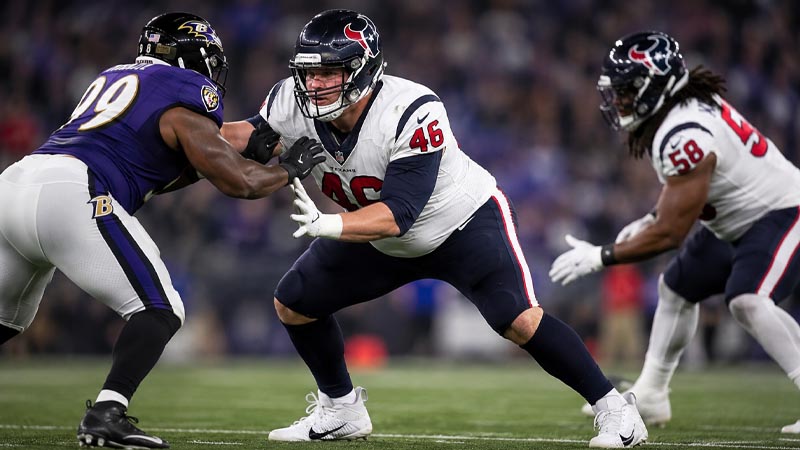
To do this, they must block fast, explosive defensive ends and rushing linebackers who are charging hard from the edge.
Pass protection is an art form of controlled retreat. The tackle must use a technique known as a “kick-slide” to move backward and outward, establishing a barrier between the quarterback and the rushing defender.
The goal is to run the defender past the “depth of the pocket” (behind the quarterback) or to anchor completely and stop their forward momentum.
If the tackle fails, the quarterback face-plants into the turf, which can lead to sacks, turnovers, or devastating injuries. For a quarterback, the peace of mind provided by an elite tackle is astronomically important.
2. Run Blocking: Clearing the Path
While pass protection is about holding ground, run blocking is about taking it. When an offensive play call dictates a run, the tackle must transform from a passive protector into an aggressive bulldozer.
Their job is to physically push back imposing, heavy defensive linemen to clear a defined path for the running back.
However, modern NFL running schemes are rarely straight-ahead power struggles. Run blocking demands a high level of athleticism. Tackles must have the agility and coordination to seal off their initial defender, disengage, and rapidly “climb” to the second level of the defense.
Once there, they are tasked with blocking linebackers who are much quicker, highly agile, and naturally lower to the ground than the tackle. Sealing these linebackers is what turns a modest four-yard run into a massive, game-changing gain.
3. Perimeter Defense: Controlling the Boundaries
NFL offenses frequently run plays that stretch horizontally across the field, such as sweeps, outside zones, and wide screen passes.
The offensive tackle serves as the primary perimeter defender, guarding the outer edges of the line of scrimmage where these plays develop.
If a tackle cannot quickly seal the edge and prevent defensive players from penetrating the perimeter, the entire play collapses before the running back or wide receiver can even turn upfield.
Left Tackle vs. Right Tackle: The Evolution of Edge Protection
Traditionally, NFL coaching staffs maintained a strict, rigid hierarchy between the left tackle and the right tackle. While both players line up at the ends of the line, their roles were historically viewed through vastly different lenses.
The Left Tackle (LT): Protecting the Blind Side
The left tackle has long been considered the premier, high-value position on the offensive line, and often one of the most talented athletes on the entire roster. This prestige is tied directly to the physiology of a right-handed quarterback.
When a right-handed quarterback drops back to pass, their body naturally rotates to the right so they can scan the field. This rotation means their back is turned completely to the left side of the defensive formation—creating a literal “blind side”.
A quarterback cannot protect himself from a threat he cannot see. A fast pass rusher coming from the left can strike the quarterback from behind, causing catastrophic fumbles or severe injuries.
Therefore, the left tackle is charged with the supreme responsibility of securing this blind side, requiring them to be the team’s absolute best pass blocker.
The Right Tackle (RT): The Traditional Run Anchor
Conversely, the right tackle was historically designated as the power anchor of the run game. Because most NFL teams historically favored running the ball to the right side of the formation, the right tackle was selected primarily for their brute strength, size, and run-blocking capabilities rather than elite lateral agility.
The Modern Paradigm Shift
In the modern NFL, the traditional division of labor between left and right tackles has largely evaporated. Defensive coordinators are masters of creating schematic mismatches.
Realizing that NFL franchises were investing their best resources into protecting the left side, defenses began moving their most athletic, elite edge rushers to the defensive left—which matches them up directly against the right tackle.
Today, right tackles face elite, speed-based pass rushers just as frequently as left tackles do. As a result, the right tackle position has undergone a dramatic evolution in value.
NFL front offices now recognize that they must possess elite pass-blocking capabilities on both edges of the line, making the right tackle position nearly equal in financial compensation and athletic requirements to the left tackle.
The Physical and Mental Blueprint of an NFL Tackle
Offensive tackles are often affectionately referred to by colorful nicknames in football circles, such as “Hogs,” “Bruisers,” “Bulldozers,” or “Big Uglies”.
While these names imply a slow, lumbering presence, the reality is that playing tackle at the professional level demands an astonishing level of functional athleticism.
The Prototypical Body Type
To survive the physical demands of the NFL, tackles must possess massive physical dimensions. A general estimate for starting NFL tackles includes:
- Height: 6’3″ to 6’8″
- Weight: 300 to 340 pounds
- Build: Thick, long-limbed, and heavily muscled
Their exceptional height and arm length are critical tools, allowing them to initiate contact with defensive players first and keep edge rushers at a distance.
The Required Athletic Skill Set
Lining up at over 315 pounds, a tackle must move with the fluid coordination of a much lighter athlete. Their athletic blueprint includes several core elements:
- Lateral Footwork: A tackle must have elite footwork to slide laterally, mirroring the rapid, erratic movements of defensive ends without crossing their feet or losing their base.
- Precise Hand Placement: Hand-to-hand combat in the trenches is won by inches. Tackles must master hand placement, striking the opponent’s chest plate to lock them in place and control their direction.
- Coordination and Agility: They must display excellent hand-eye coordination to redirect their weight instantly when defenders attempt sudden counter-moves.
- Functional Strength: Tackles must possess the core power to absorb a full-speed bull rush from a 275-pound defender and stop them dead in their tracks.
The Mental Chess Match (Football IQ)
Physical talent alone is insufficient to survive in the NFL. Defensive coordinators do not run simple, predictable schemes; they constantly attempt to confuse the offensive line by showing complex pre-snap alignments, sudden blitzes, and defensive line stunts where defenders loop and cross paths.
An offensive tackle must possess an incredibly high level of football IQ. In the fraction of a second between the pre-snap read and the snap of the ball, the tackle must process the movements of the defensive line, communicate adjustments with the guard next to them, and correctly execute either a run or pass-blocking scheme. A single mental error can lead directly to a free-rushing defender hitting the quarterback.
Titans of the Edge: Legends of the Position
To truly appreciate the art of playing offensive tackle, one can look to the historical standards set by the greatest players to ever play the game. These three individuals redefined the athletic and technical expectations of the position:
1. Anthony Muñoz (Cincinnati Bengals, 1980–1993)
Anthony Muñoz is widely regarded by football historians and players alike as the greatest offensive lineman in the history of the sport.
Spending 13 seasons as the anchor of the Cincinnati Bengals’ offensive line, Muñoz combined flawless technical precision with unprecedented athletic agility.
He set the standard for what a modern tackle should look like, proving that a player of his size could dominate both the run and pass games with equal elegance.
His legendary career earned him 11 Pro Bowl selections and a swift induction into the Pro Football Hall of Fame in 1998.
2. Jonathan Ogden (Baltimore Ravens, 1996–2007)
Standing at a towering 6’9″ and weighing over 340 pounds, Jonathan Ogden was a literal mountain of a man who possessed the light, nimble feet of a basketball player.
Drafted in the first round of the Ravens’ inaugural season, Ogden spent his entire 12-year career in Baltimore establishing absolute dominance on the left side of the line.
He was an 11-time Pro Bowl selection and a Super Bowl champion, showcasing a rare blend of massive size and elite lateral movement that made him nearly impossible for edge rushers to bypass.
3. Joe Thomas (Cleveland Browns, 2007–2017)
While Muñoz and Ogden played on highly competitive teams, Joe Thomas crafted a legendary career defined by individual perfection and unbelievable resilience.
Facing some of the toughest defensive divisions in football while playing for a struggling Cleveland Browns franchise, Thomas remained an absolute model of consistency.
He was selected to 10 consecutive Pro Bowls. Most impressively, Thomas set an all-time NFL record for durability, playing 10,363 consecutive snaps without missing a single play due to injury.
This incredible display of endurance cemented his status as one of the most technically perfect and reliable tackles in football history.
Conclusion: The Foundation of NFL Success
In the high-stakes world of professional football, the offensive tackle is the ultimate equalizer.
They are the players who absorb the physical punishment, navigate complex defensive schemes, and neutralize the defense’s most dangerous playmakers—all without expecting their names to be called on a broadcast or celebrated in fantasy leagues.
Behind every game-winning pass, every explosive touchdown run, and every championship-winning quarterback is an offensive tackle, quietly but effectively executing their job.
When building a championship-caliber roster, NFL front offices know that success does not start with the skill positions; it starts on the edge of the line, where these giant athletes protect the franchise on every single snap.