In the high-stakes chess match of professional football, public attention naturally gravitates toward the perimeter of the field.
The dazzling edge rushers, the speedy wide receivers, and the highly compensated offensive tackles who block them command prime-time highlights and record-breaking contracts.
Yet, beneath the glamour of the perimeter lies an equally critical, though frequently ignored, arena: the interior trenches.
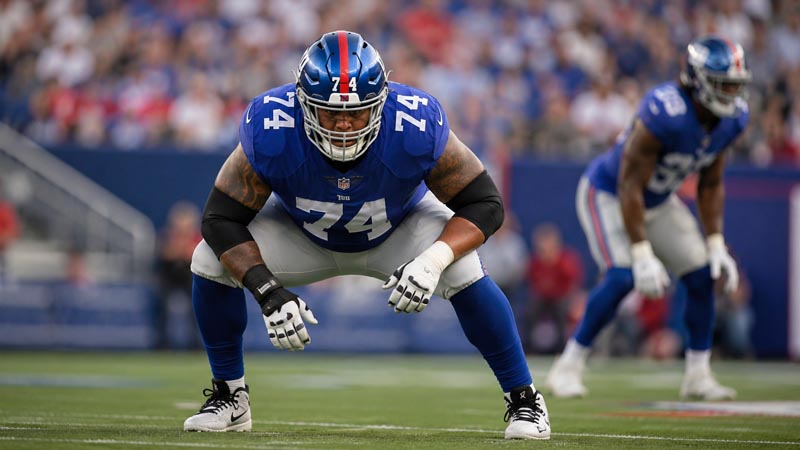
Here, the offensive guard operates away from the television cameras but right at the physical heart of the action.
Often affectionately referred to by traditional coaching nicknames such as the “Hogs,” “Bruisers,” “Bulldozers,” “Big Uglies,” or “Monsters,” these players represent the physical and strategic foundation of any successful offense.
To the casual observer, the work of an offensive lineman might look like a simple, chaotic display of pushing and shoving. However, the reality of the position is infinitely more complex.
Linemen do not merely push; they execute highly coordinated, technically demanding assignments that require a rare mixture of brute strength, deep cerebral intelligence, and precise, active footwork.
The offensive guard position requires a unique combination of strength and athleticism—demanding that a player match the size to combat 320-pound defensive tackles while maintaining the lateral quickness to run in open space as a lead blocker.
This comprehensive analysis explores the strategic importance, physical mechanics, and cognitive demands of the offensive guard in the NFL, demonstrating why this interior position is the true engine of offensive success.
1. Pocket Geometry: Defending the Front Door vs. The Perimeter
To understand an offensive guard’s value, picture the quarterback’s pocket as a protected space with two barriers: the perimeter and the front door.
Offensive tackles defend the perimeter, using quickness and length to push edge rushers wide and upfield while preserving the pocket’s width.
Guards and centers protect the front door by controlling its depth. Unlike tackles, interior linemen cannot afford to give ground backward.
They must prevent defenders from penetrating the A or B gaps, which can collapse the pocket, disrupt quarterback timing, and eliminate stepping-up space.
A strong guard anchors the interior and allows tackles to focus outside. A weak guard forces tackles inward, weakening the entire protection scheme.
2. The Physical Blueprint: Built as a Tactical Tank
Because interior blocking involves different matchups than the edge, offensive guards require a unique physical profile.
Defensive tackles are often the strongest and heaviest defenders, frequently weighing over 300 pounds and relying on powerful bull rushes. Guards counter this strength with a sturdy, compact build designed for leverage and stability.
A typical NFL guard stands around 6’3″ to 6’5″ and weighs roughly 300 to 320 pounds, making him slightly shorter and more compact than an offensive tackle.
This lower center of gravity helps guards absorb powerful interior contact. However, size alone is not enough.
Successful guards combine functional strength, strong hand placement, balance, and leverage with excellent lateral quickness and agility, allowing them to handle both protection and movement blocks.
3. Run Blocking Mastery: Power, Double Teams, and the Mechanics of the Pull
An offensive coordinator’s ultimate security blanket is a productive run game. When an offense can consistently hand the ball to a running back and gain four or more yards up the gut, it completely dictates the tempo of the game, tires out the opposing pass rush, and keeps the defense off balance. The offensive guard is the primary engine behind this physical dominance.
In run schemes, guards must combine sheer power with flawless blocking technique to move defenders off the line of scrimmage.
A standard run play often requires the guard to work in tandem with the center or tackle to establish a double team, driving a defensive tackle backward before one of the linemen releases to block a linebacker at the second level of the defense. This requires impeccable timing and physical coordination.
Furthermore, the guard is the primary “puller” in modern gap schemes, such as power and counter plays.
While tackles are generally required to stay home and protect the edges, guards must possess the agility and speed to step back, run parallel to the line of scrimmage, and lead block for the runner on the opposite side of the formation.
During these pulling plays, a guard must:
- Step back and clear the center: Execute a precise drop-step to run behind the line of scrimmage without colliding with adjacent players.
- Accelerate in space: Run laterally with enough speed to lead the running back to the outside edge.
- Deliver a physical kick-out block: Identify and physically neutralize a defensive end, linebacker, or defensive back in open space, establishing a clear running lane for the ball-carrier.
This requires an extraordinary athletic profile: the strength of a 315-pound anchor combined with the lateral quickness of a lead blocker.
4. Inside Pass Protection: Surviving on an Island Against the Bull Rush
Interior pass blocking is a brutal, close-quarters battle often compared to martial arts. Unlike tackles, guards have little space to retreat and must engage defenders almost immediately.
Guards are frequently challenged by powerful interior pass rushers using the bull rush, attempting to drive them backward into the quarterback.
To counter this, guards need excellent anchoring technique, combining lower-body strength, leverage, balance, and active hand placement to stop momentum.
Their compact surroundings leave little room for mistakes. A misplaced hand or poor footwork can quickly create a rushing lane.
Guards therefore require exceptional short-area reactions, strong hands, and precise technique to defeat moves such as swipes and swims while maintaining the pocket’s interior structure.
5. The Trench Ballet: Cognitive Complexity and Muscle Memory Specialization
Offensive line play is far more complex than five large players blocking independently. The unit must function as one synchronized group, with every lineman coordinating steps, hand placement, angles, and landmarks.
Even a small mistake can destroy a protection scheme or running lane. Guards also face major mental demands, reading defensive alignments, stunts, twists, blitzes, and simulated pressures while communicating assignments with teammates before the snap.
This complexity makes position changes difficult. Moving from tackle to guard or switching sides requires players to reverse deeply ingrained footwork, angles, and muscle memory.
Years of repetition create specialized habits, so even experienced linemen can struggle when asked to perform unfamiliar movements under pressure.
6. Titans of the Trenches: Learning From the Greats
To truly understand the ceiling of what the guard position can offer an NFL team, one must examine the careers of its greatest historical figures. These legends showcased the ultimate blend of the physical and technical traits required to dominate the interior trenches.
- Larry Allen (1994–2007): Widely regarded as one of the most physically powerful athletes in sports history, Larry Allen was a cornerstone of the Dallas Cowboys’ offensive dominance. Over a legendary career that also included a stint with the San Francisco 49ers, Allen earned 11 Pro Bowl selections and won a Super Bowl title. He was famous for his terrifying, bruising strength, which allowed him to single-handedly neutralize elite defensive tackles and dominate opponents in the run game.
- John Hannah (1973–1985): Spending his entire 13-season career with the New England Patriots, John Hannah established himself as one of the greatest offensive linemen of all time. Selected as an All-Pro seven times, Hannah was the absolute gold standard for run-blocking dominance. His combination of technical perfection, leverage, and physical toughness earned him inductions into both the College and Pro Football Hall of Fame.
Conclusion: The Foundation of Victory
While the NFL continues to celebrate its quarterbacks, wide receivers, and edge rushers, football games are ultimately won and lost in the unglamorous trenches.
The offensive guard position requires a unique, highly specialized blend of elite physical strength, lateral agility, and cognitive intelligence.
Whether they are anchoring against a massive 320-pound defensive tackle to preserve the pocket’s depth, or pulling out in space to lead block for a critical run, guards are the unsung heroes who make every offensive play possible.
For any championship-caliber organization, investing in elite guard play is not a luxury—it is the foundational requirement for long-term offensive success.