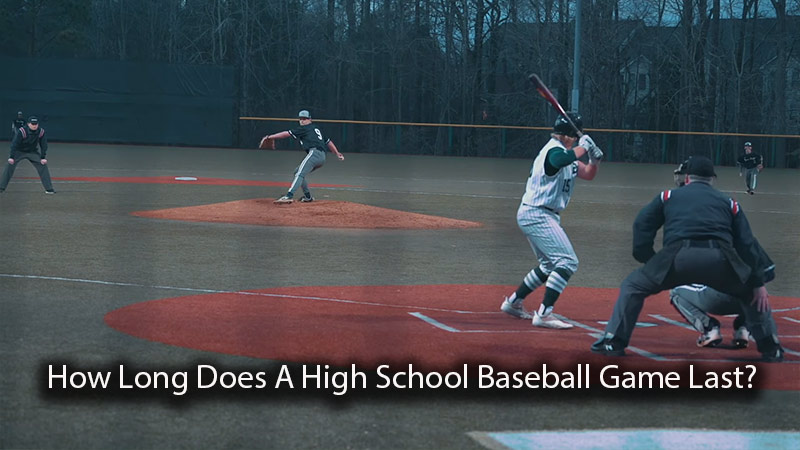
Unlike basketball, football, or soccer, baseball is defined by its clockless architecture. Victory is dictated not by a ticking countdown, but by the accumulation of outs across designated innings.
For student-athletes, coaches, parents, and athletic administrators, anticipating how long a contest will last requires an understanding of both foundational regulations and dynamic on-field variables.
While professional broadcasts showcase 9-inning marathons that often exceed three hours, varsity and junior varsity high school matchups operate on an accelerated framework tailored to youth development, academic schedules, and field availability.
On average, spectators can expect a varsity high school baseball game to span roughly two hours from the opening pitch to the final out.
However, depending on league guidelines, pitcher control, offensive volatility, and weather conditions, total time on the diamond can range from a swift 90 minutes to an extended 2.5 hours or more.
The Core Framework: Rules Dictating Game Length
The 7-Inning Standard
The primary distinction between amateur high school baseball and higher levels of play lies in inning allocation. High school games are scheduled for seven innings rather than nine.
Each inning consists of two halves: the top half (where the visiting team bats) and the bottom half (where the home team bats).
With three outs required per half-inning, a full 7-inning contest requires a total of 42 outs. If the home team leads after the top of the seventh inning, the bottom half is bypassed, and the game ends immediately after 39 outs.
| Level | Regulation Innings | Official Game Minimum | Average Duration |
|---|---|---|---|
| High School | 7 innings | 5 innings (or 4.5) | ~2.0 hours |
| College (NCAA) | 9 innings | 5 innings (or 4.5) | ~2.75 hours |
| MLB | 9 innings | 5 innings (or 4.5) | ~2.5 hours |
Official Game Status (Weather & Stoppage Protocols)
High school athletic facilities frequently lack turf drainage systems or stadium lighting, making matches vulnerable to darkness and sudden spring weather events. To account for unexpected disruptions, governing bodies enforce an official game rule.
A contest is declared an official game—allowing a definitive winner to be recorded without resuming play later—if it completes:
- 5 full innings of play.
- 4.5 innings if the home team is currently leading when play is terminated.
If a game is halted due to weather or darkness prior to reaching this threshold, it is generally deemed an incomplete contest and may be resumed from the exact point of interruption on a subsequent date.
Mandatory Speed-of-Play Regulations and Time Controls
To balance athletic competition with academic demands, high school state associations implement strict rules designed to eliminate unnecessary delays and preserve sportsmanship.
The Mercy Rule (Run Rule)
Lopsided scores not only tax pitching staffs but also unnecessarily extend game duration. To maintain competitive equity and respect, high school baseball utilizes a mercy rule (often called the run rule).
Under national standards, a game is terminated immediately if one team establishes a lead of 10 or more runs after 5 complete innings (or 4.5 innings if the home team leads).
- Regional Variations: Certain state associations enforce modified tiers, such as a 15-run rule after 3 innings or an 8-run rule after 6 innings. These adaptations streamline tournament schedules and protect young athletes from demoralizing non-competitive play.
Inning Transitions and Pitch Timers
Between half-innings, teams must execute field transitions swiftly. Rulebooks mandate a 90-second limit between the final out of one half-inning and the first pitch of the next. Pitchers are typically restricted to five warm-up throws during this window to ensure play resumes without friction.
Additionally, high school umpires enforce a 20-second pitch timer when no runners are on base. If a pitcher fails to deliver the ball within 20 seconds of receiving it from the catcher, a ball is automatically awarded to the batter.
Regular-Season and Junior Varsity Time Limits
While varsity games are generally played to a full resolution, sub-varsity levels (such as Freshmen and Junior Varsity) and regular-season showcase tournaments often impose a hard time limit.
- The 2-Hour Rule: A common standard prohibits a new inning from starting after 2 hours of elapsed play from the first pitch.
- Drop-Dead Caps: In select weekend exhibition tournaments, a strict “drop-dead” clock (e.g., 1 hour and 45 minutes) halts play immediately upon expiration, reverting the score to the end of the last fully completed inning if necessary.
Key Factors Influencing On-Field Game Duration
While regulations establish a baseline, the actual length of any individual high school game is dictated by on-field execution, tactical choices, and ambient conditions.
Pitching Control and Defensive Efficiency
The single greatest determinant of game duration is strike-throwing efficiency.
- Fast-Paced Games (~90 Minutes): When opposing starting pitchers command the strike zone and defenses record routine outs, innings progress rapidly. Games featuring few baserunners and quick groundouts can comfortably wrap up in 1 hour and 30 minutes.
- Slow-Paced Games (~2.5+ Hours): Conversely, games plagued by high walk rates, hit batters, defensive errors, and deep 3-2 count at-bats stall momentum dramatically. Accumulating baserunners prolongs half-innings, stretching total duration toward 2 hours and 30 minutes.
Pitching Changes and Arm-Care Protocols
Modern player safety standards require strict oversight regarding youth pitcher workload. High school pitch-count guidelines mandate specific rest periods based on total pitches thrown in an outing.
While essential for protecting player health, frequent pitching changes directly expand overall game time:
- A relief pitcher entering the game receives warm-up throws on the mound.
- The manager must make a formal trip to the umpire to declare the substitution.
- Mid-inning pitching changes disrupt offensive rhythm and add 3 to 5 minutes of real-time stoppage per substitution.
Weather Disruptions and Field Infrastructure
Spring weather presents operational challenges for high school athletic departments. Lacking subterranean drainage systems or tarp crews common in professional venues, high school diamonds are sensitive to sudden rain showers, field muddying, and temperature drops.
A passing thunderstorm can trigger mandatory 30-minute lightning delays, easily pushing a standard 2-hour window into a 3-hour afternoon event.
Extra Innings, Tiebreaker Dynamics, and Postseason Strategy
When a 7-inning varsity contest finishes with a tied score, the game proceeds into extra innings. However, extra-inning protocols in high school baseball differ significantly from Major League play.
           VISITOR  0 0 1  0 2 0  0 | 3
           HOME     1 0 0  0 0 2  0 | 3
           ------------------------------
           REGULATION ENDS TIED AT 3-3
           ------------------------------
           8TH INNING: International Tiebreaker Enforced
           • Runner automatically placed on 2nd Base
           • Batting team executes tactical sacrifice or hit
The International Tiebreaker Rule
To prevent player exhaustion, mitigate arm strain, and accommodate weeknight curfews, many high school conferences implement the International Tiebreaker Rule starting in the 8th inning (or 9th inning, depending on local policy).
- How It Works: At the start of each extra half-inning, the team on offense places the player who recorded the final out of the previous inning directly onto second base as a runner.
- Impact on Duration: Beginning an inning with a runner in scoring position dramatically increases the statistical probability of scoring, routinely resolving tied contests within 1 to 2 extra frames.
Tournament and Playoff Variations
During state championship series and win-or-go-home playoff matchups, the stakes elevate.
- No Time Limits: Postseason games generally eliminate regular-season time limits, requiring teams to play until a full, definitive victor emerges.
- Suspended Games: If a postseason game is tied or halted by weather/darkness after reaching official status, it is rarely left as a tie. Instead, rulebooks dictate that the game be suspended and completed from the exact stoppage point the following day.
Strategic Implications for Coaches, Players, and Parents
Understanding the mechanics of high school baseball duration enables stakeholders to better prepare physically, mentally, and strategically for game day.
Strategic Considerations Matrix
| Stakeholder | Key Focus Area | Tactical Adaptation |
|---|---|---|
| Coaches | Staff Allocation & Pacing | Managing pitch-count thresholds, scheduling warming relief pitchers early, and leveraging bench depth. |
| Players | Stamina & Mental Focus | Maintaining hydration through variable delays and sustaining plate discipline in high-tempo conditions. |
| Parents & Fans | Logistics & Expectations | Planning arrival times around 2-hour baselines and preparing for potential extra-inning or weather delays. |
Managing Pitching Depth
Because pitch count limits trigger mandatory rest days, coaches must calculate not just how to win the current 2-hour game, but how today’s pitching changes will impact bullpen availability three days later.
In-Game Offense vs. Fast-Paced Defense
In shortened 7-inning formats, early-inning runs carry disproportionate value. Teams that jump out to early leads can dictate tempo, forcing opponents to press offensively and frequently shortening overall game times through aggressive defensive play.
Conclusion
The structure of high school baseball reflects an ongoing balance between the traditional, clockless spirit of the game and modern athletic management.
By pairing a standard 7-inning format with strict safety protocols, pace-of-play clocks, and mercy rules, high school athletics provides student-athletes with a competitive environment that respects academic schedules and physical health.
Whether you are a coach structuring your pitching rotation, a player conditioning for extra-inning stamina, or a spectator heading to the ballpark, anticipating a 2-hour baseline ensures you are fully prepared for the dynamic rhythm of high school baseball.