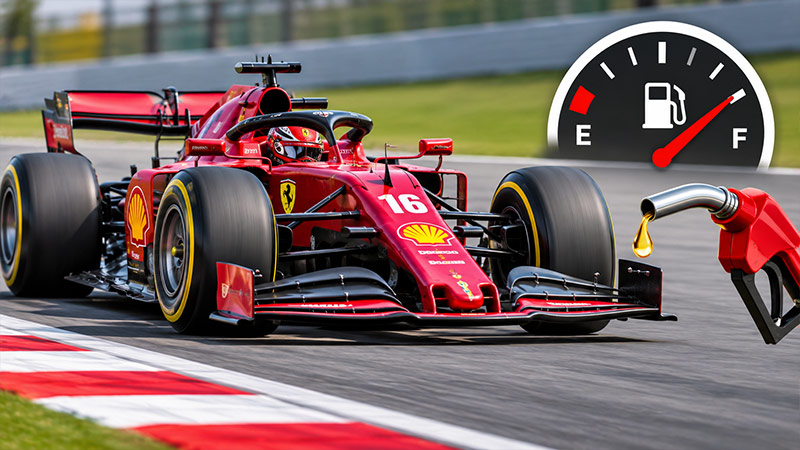
A Formula 1 car makes roughly 1,000 horsepower, tops 340 km/h (about 210 mph), and covers a full Grand Prix in around 90 minutes. So how far does it actually travel on a gallon of fuel?
The short answer surprises most people: about 5 miles per gallon. That sounds wasteful next to a family hatchback. Yet the full picture is far more interesting, because the same machine that returns single-digit mileage also runs one of the most efficient combustion engines ever built.
In this guide, you will learn the real MPG figure for a modern F1 car, how it is calculated from the sport’s fuel rules, why consumption changes from circuit to circuit, how it compares with road and race cars, and what the 2026 regulations mean for fuel use. Each figure is worked out step by step, so you can check the math yourself.
The Short Answer: Roughly 5 MPG
A modern hybrid-era F1 car averages roughly 4.9 to 5.4 US miles per gallon across a full Grand Prix. In the UK measure, that is about 6 to 6.5 mpg, because the imperial gallon is larger.
The range exists because cars do not burn exactly the same amount every race. Most use somewhere between 100 and 110 kg of fuel over a standard race distance of about 305 km (190 miles).
| Measure | Typical F1 race figure (approx.) |
|---|---|
| US miles per gallon | 4.9 to 5.4 |
| UK (imperial) miles per gallon | 5.9 to 6.5 |
| Litres per 100 km | 44 to 48 |
| Kilometres per litre | 2.1 to 2.3 |
These figures assume a fuel density of about 0.75 kg per litre, which is typical for high-performance petrol. Real density varies slightly by blend and temperature, so treat them as close estimates rather than official numbers.
The Rules That Shape F1 Fuel Use
F1 mileage is not left to chance. It is boxed in by three regulations that every team builds its race around.
A cap on total race fuel
From 2019 through 2025, each car could use a maximum of 110 kg of fuel per race. The limit started at 100 kg when hybrid engines arrived in 2014, then rose to 105 kg in 2017 as faster cars needed more. Refuelling during races has been banned since 2010, so every kilogram must be on board at the start.
A cap on fuel flow
An FIA-approved meter limits flow to 100 kg per hour above 10,500 rpm. This stops teams from burning fuel faster for short bursts of extra power, and it pushes engineers toward efficiency instead of sheer consumption.
A mandatory fuel sample
After the race, each car must hand over at least one litre of fuel for testing. In the 2021 Hungarian Grand Prix, Sebastian Vettel lost second place to disqualification after officials could recover only a fraction of that amount.
Notice that F1 measures fuel by mass, not volume. Mass tracks energy content more reliably, while volume shifts with temperature. That choice is also why converting to MPG takes a few extra steps.
Doing the Math: From Kilograms to Miles per Gallon
Turning F1’s kilogram limit into a familiar MPG figure takes four simple steps. Here is the calculation for a car that burns the full 110 kg.
- Convert mass to volume. 110 kg divided by 0.75 kg per litre gives about 146.7 litres.
- Convert litres to US gallons. 146.7 litres divided by 3.785 gives about 38.8 gallons.
- Convert race distance to miles. A standard 305 km race is about 189.5 miles.
- Divide distance by fuel. 189.5 miles divided by 38.8 gallons gives roughly 4.9 mpg.
Run the same steps for a car that uses 100 kg and the result climbs to about 5.4 mpg. The whole calculation fits in one line:
MPG = Race distance (miles) ÷ [Fuel mass (kg) ÷ Fuel density (kg/L) ÷ 3.785]
You can plug in any race. Monaco, for example, runs only about 260 km, so the same formula shows why teams need noticeably less fuel there.
Why a 1,000-Horsepower Car Drinks So Much Fuel
Low mileage is the price of extreme, sustained power. An F1 car is not cruising; it spends most of each lap working as hard as it can.
Power output
A hybrid power unit delivers roughly 1,000 hp combined: around 750 to 850 hp from the 1.6-litre V6 turbo engine, plus about 160 hp from the electric motor. At the 100 kg per hour flow limit, the engine receives fuel energy of roughly 1.2 megawatts.
Aerodynamic drag
F1 cars are built to generate huge downforce, which presses them into the track for faster cornering. At high speed, that downforce can exceed the car’s own weight. The trade-off is heavy drag, and the power needed to overcome drag rises sharply as speed climbs.
Time at full throttle
On many circuits, drivers are flat out for 60 to 80 percent of a lap. A road car on the motorway uses a small slice of its available power; an F1 car uses nearly all of it, lap after lap.
Constant acceleration
Every corner exit means pushing a car of around 800 kg, including the driver, from low speed back to more than 300 km/h. Repeated hard acceleration is one of the costliest things any vehicle can do.
Put simply, MPG measures how gently a vehicle can cover distance. F1 is designed to cover distance as fast as physics allows.
Not Every Track Is Equal: How Circuits Change Consumption
The 5 mpg figure is an average. Real mileage shifts from one Grand Prix to the next, sometimes by a noticeable margin.
| Circuit type | Example | Fuel demand | Why |
|---|---|---|---|
| Stop-start | Montreal | High | Long straights broken by slow corners mean repeated hard acceleration |
| High-speed | Monza | High per lap | The most time at full throttle, partly offset by low-drag setups |
| Tight street | Monaco | Lowest total | Shorter race distance (about 260 km) and low average speeds |
Race events matter as much as layout. A safety car period lets every driver cruise behind a slower car, saving fuel for the laps that remain. A wet race lowers speeds and throttle use, which also cuts consumption.
Teams model all of this before the weekend. They simulate each lap, add a margin for safety cars and battles, and decide exactly how much fuel the car will carry to the grid.
How F1 Mileage Compares With Road and Race Cars
An F1 car uses roughly five to ten times more fuel per mile than a typical road car. Against other top-level race cars, though, it holds its own, and it is far thriftier than the F1 cars that came before it.
| Vehicle | Approximate US mpg |
|---|---|
| Full hybrid hatchback | 50+ |
| Typical new passenger car | 25 to 35 |
| High-performance road supercar | 12 to 18 |
| F1 car, hybrid era (2014 to 2025) | 4.9 to 5.4 |
| NASCAR Cup car | 4 to 5 |
| F1 car, V8 era (2010 to 2013) | about 3.5 |
Figures are approximate and vary by model, track and driving style.
The historical comparison is the most revealing. Before 2014, cars without refuelling started races with roughly 150 to 160 kg of fuel. The move to hybrid power units cut race fuel by about a third while lap times eventually became faster than ever.
Remember, too, that the comparison is not like for like. A road car returning 30 mpg is travelling at legal speeds with a light foot. Asked to average over 200 km/h for 90 minutes, no road car could deliver that pace at all.
The Real Story: Some of the Most Efficient Engines on Earth
MPG tells you how far a car travels per gallon. Thermal efficiency tells you how much of the fuel’s energy becomes useful work. On that measure, F1 is a world leader.
A typical petrol road engine turns about 30 to 35 percent of its fuel energy into work, and the best production hybrids reach around 40 percent. The rest is lost as heat and friction. In 2017, Mercedes reported that its F1 power unit had passed 50 percent thermal efficiency on the test bench, a figure once thought out of reach for a petrol engine.
Three technologies make that possible:
- Energy recovery under braking. The MGU-K captures energy as the car slows and returns it as roughly 160 hp of electric boost.
- Energy recovery from exhaust heat. The MGU-H, fitted to the turbocharger, harvests energy from hot exhaust gas that a road engine simply throws away.
- Advanced combustion. Pre-chamber ignition and very lean fuel mixtures squeeze more work from every gram of fuel.
So the low MPG figure is not a sign of waste. It reflects a car using enormous power, with remarkable efficiency, for a very demanding job. Lessons from this work have already reached showrooms through turbocharged hybrid systems and the F1-derived engine in the Mercedes-AMG ONE hypercar.
Fuel Strategy: Why Teams Often Start Underfuelled
In F1, fuel is weight, and weight is lap time. That simple fact explains why teams rarely fill the car to the 110 kg limit.
A common rule of thumb is that every 10 kg of fuel costs around 0.3 seconds per lap, though the exact figure varies by circuit. A car starting with 100 kg on board can therefore be roughly three seconds per lap slower than the same car running nearly empty. Across a race, that penalty adds up quickly.
To cut it, strategists often load slightly less fuel than a flat-out race would need. They bet on safety car periods and on the driver saving fuel along the way. The main tool for that is lift and coast: the driver lifts off the throttle a fraction before the braking zone and coasts into the corner. It costs a few tenths per lap but saves a meaningful amount of fuel over a stint.
This is why you hear engineers on team radio asking drivers to hit a fuel target. It is also why an F1 car’s real-world mileage in any given race reflects strategy and driving style, not just engine design.
The 2026 Rules: Less Fuel, More Electric, Fully Sustainable
The 2026 regulations are the biggest shake-up to F1 fuel use since 2014, and they push mileage upward.
- Energy, not mass, is now capped: Instead of a 100 kg per hour limit, fuel flow is restricted to 3,000 megajoules of energy per hour. That is roughly 30 percent less fuel energy than before.
- Electric power nearly matches combustion: The MGU-K jumps to 350 kW (about 470 hp), close to an even split with the V6 engine’s output. The complex MGU-H has been dropped, which simplifies the power unit and makes it more relevant to road cars.
- Fuel is 100 percent sustainable: Teams now race on fuel made from non-food biomass, captured carbon or waste, rather than fossil crude.
The FIA’s own expectations pointed to race fuel loads of around 70 kg. If cars land near that mark, mileage would rise to roughly 7 to 8 US mpg, a striking gain for cars that remain among the fastest on the planet.
Exact figures depend on how teams run their cars across the season, so expect real numbers to settle as more races are completed.
Conclusion: Low MPG, High Efficiency
So, what is the real mileage of an F1 car? Across a full Grand Prix, a modern hybrid-era car returns roughly 4.9 to 5.4 US mpg, or about 44 to 48 litres per 100 km.
That number looks thirsty, yet it hides a remarkable engineering story. These cars produce around 1,000 hp from engines that turn around half their fuel energy into work, a level few road engines approach.
Strict fuel caps, smart strategy and energy recovery keep every kilogram working hard. With the 2026 rules cutting fuel energy and running on fully sustainable fuel, mileage is set to climb further.