A Formula 1 car can pass 340 km/h, corner at more than 5g and cover a full race distance of roughly 305 km in under two hours. Behind every one of those numbers sits a carefully engineered liquid most fans never think about: the fuel.
The F1 car fuel type has changed more than almost any other part of the sport. It has travelled from potent alcohol cocktails in the 1950s, through aviation petrol and turbo-era chemistry, to the E10 blend of 2022 and the 100% advanced sustainable fuel that arrived with the 2026 regulations.
This guide explains what goes into an F1 fuel tank today, how it compares with the petrol in your own car, how the FIA keeps it fair, and why the work happening in F1 fuel labs matters far beyond the racetrack.
The Short Answer
Since the start of the 2026 season, F1 cars have run on 100% advanced sustainable fuel. It behaves like high-grade unleaded petrol, but its carbon comes from non-food biomass, municipal waste or carbon captured from the air rather than from crude oil.
From 2022 to 2025, the cars used E10: a blend of roughly 90% conventional petrol and 10% sustainable ethanol. Before that, F1 fuel was a tightly regulated, high-performance relative of road-going unleaded with a small bio-derived share.
What Fuel Do F1 Cars Use Today?
Today’s F1 fuel is a “drop-in” fuel. It is chemically designed to work in a conventional petrol engine without hardware changes, exactly like the fuel at a roadside pump.
The difference lies in where its molecules start life. Instead of drilling for oil, producers build the fuel from feedstocks such as agricultural residues, non-food plants, household waste, or carbon dioxide pulled from the atmosphere and combined with hydrogen. The result is then refined and blended to meet the FIA’s strict technical specification.
That fuel feeds a 1.6-litre turbocharged V6 hybrid power unit. Under the 2026 rules, the electrical side delivers up to around 350 kW, close to half of the car’s total output, and the MGU-H (the heat-recovery motor on the turbo) has been removed. The combustion engine still supplies roughly 400 kW, so every gram of fuel has to work harder than ever.
How F1 Fuel Differs From Pump Petrol
Many fans are surprised by how close F1 fuel is to the petrol in a family car. The FIA requires it to be made almost entirely of compounds normally found in commercial fuel, and exotic power-boosting additives are banned.
The similarities end with the ingredient list. This is where a race fuel separates itself:
- Precision blending. Fuel partners test hundreds of candidate blends to suit one specific engine’s combustion chamber, injection system and turbocharger.
- Knock resistance. Octane is held within a regulated window of 95 to 102 RON, and engineers exploit every point of it to run aggressive ignition timing without engine damage.
- Burn rate and energy content. Small gains in how quickly and completely the fuel burns translate directly into lap time.
- Batch consistency. Every delivery must match an approved reference sample almost exactly, a tolerance no road fuel faces.
- Cost. A litre of F1 fuel costs many times more than pump petrol, reflecting the research, testing and small production runs behind it.
In short, F1 fuel is pump petrol’s elite cousin: familiar chemistry, taken to an extreme level of refinement.
A Brief History of Formula 1 Fuel
F1 fuel rules have swung from near-total freedom to tight control, and each shift has shaped how the cars sound, perform and race. These milestones trace that journey.
| Era | Fuel type | What changed |
|---|---|---|
| 1950s | Alcohol-based blends | Methanol-rich mixtures fed supercharged engines with few restrictions |
| 1958 | Aviation petrol (avgas) | Commercial aviation fuel became mandatory, ending the alcohol era |
| 1980s | Exotic turbo blends | Toluene-heavy fuels helped turbo engines pass 1,000 hp in qualifying trim |
| 1990s | Pump-style unleaded | Fuel had to resemble road petrol, and FIA fingerprint testing became routine |
| 2008 | Bio-component blend | A minimum 5.75% bio-derived share was introduced |
| 2014 | Hybrid-era petrol | A 100 kg per hour flow cap and a 100 kg race limit arrived with V6 hybrids |
| 2022 | E10 | Sustainable ethanol rose to 10% of the blend |
| 2026 | 100% advanced sustainable fuel | Fossil carbon removed entirely; an energy-flow limit replaced the mass-flow cap |
The turbo era remains the most extreme chapter. Fuel allowances were cut repeatedly through the mid-1980s to rein in power, and turbocharged engines were banned outright from 1989. That pattern of rules chasing ingenuity still defines F1 fuel development today.
The E10 Era: 2022 to 2025
The 2022 regulations raised the sustainable share of F1 fuel from 5.75% to 10%, creating E10. The “E” stands for ethanol, and the rules required it to be advanced ethanol, made from waste or non-food biomass rather than food crops.
Ethanol carries less energy per kilogram than conventional petrol, so the switch initially cost power. Engine manufacturers and their fuel partners answered with revised combustion strategies and new blend chemistry, recovering much of the lost performance within the first seasons.
E10 also served as a proving ground. It gave suppliers four years of race data on sustainable components under extreme conditions, laying the groundwork for the far bigger step that followed in 2026.
The 2026 Revolution: 100% Advanced Sustainable Fuel
The 2026 rules completed the transition: every drop in an F1 tank must now be advanced sustainable fuel, with no fossil carbon at all. Three ideas sit at the heart of the change.
What “advanced sustainable” means
To qualify, the carbon in the fuel must come from one of three routes: non-food biomass, municipal waste, or carbon captured directly from the atmosphere. Fuel made from food crops is not permitted.
Suppliers must prove the origin of their feedstocks through an FIA certification process that tracks the full supply chain. Sustainability claims are therefore verified, not assumed.
Energy flow replaces mass flow
From 2014 to 2025, the rules capped fuel flow at 100 kg per hour. In 2026, the FIA switched to an energy-based limit of 3,000 megajoules per hour.
Sustainable fuels can differ in energy content per kilogram. Measuring energy rather than mass keeps the competition fair and rewards genuine efficiency instead of fuel density.
A near 50/50 power split
With electrical output raised to around 350 kW and combustion power trimmed to roughly 400 kW, the fuel’s job has changed.
It must deliver maximum energy from a smaller allowance, burn cleanly enough to protect a highly stressed engine, and support strategies where drivers constantly balance fuel use against battery harvesting.
For fuel chemists, this is the toughest brief in the sport’s history. Sustainable molecules can ignite, vaporise and form deposits differently from fossil fuel, so every blend is co-developed with the engine it powers.
Who Makes F1 Fuel?
Every power unit manufacturer works with a dedicated fuel and lubricant partner, and these are among the deepest technical collaborations in motorsport. Well-known pairings include:
- Shell with Ferrari, one of the longest-running relationships in the sport
- Petronas with Mercedes, a partnership dating back to the team’s 2010 return
- ExxonMobil with Red Bull Ford Powertrains
- Aramco with the Aston Martin Honda project, which began with the 2026 regulations
Partners typically place engineers trackside, run mobile laboratories at races and test fuel and oil samples throughout each weekend. Their research teams work years ahead of every rule change, which is why fuel is often described as a hidden performance factor.
How the FIA Polices F1 Fuel
Because fuel can be worth tenths of a second per lap, the FIA treats it as one of the most closely controlled parts of the car.
- Reference approval. Each supplier submits a sample before a fuel can race. The FIA analyses it with gas chromatography to create a chemical “fingerprint”.
- Trackside sampling. Officials draw fuel from cars during race weekends and compare it with the approved fingerprint. Any mismatch is a breach.
- The one-litre rule. After a race, each car must hold at least one litre of fuel for testing. Sebastian Vettel lost his second place at the 2021 Hungarian Grand Prix when his car could not provide enough.
- Temperature control. Fuel in the car cannot be more than 10°C below ambient temperature. Chilling fuel would make it denser and offer an unfair advantage.
Enforcement has teeth. At the 1995 Brazilian Grand Prix, Michael Schumacher and David Coulthard were initially disqualified over fuel irregularities. Their drivers’ points were later restored, but their teams lost the constructors’ points.
Fuel and Race-Day Strategy
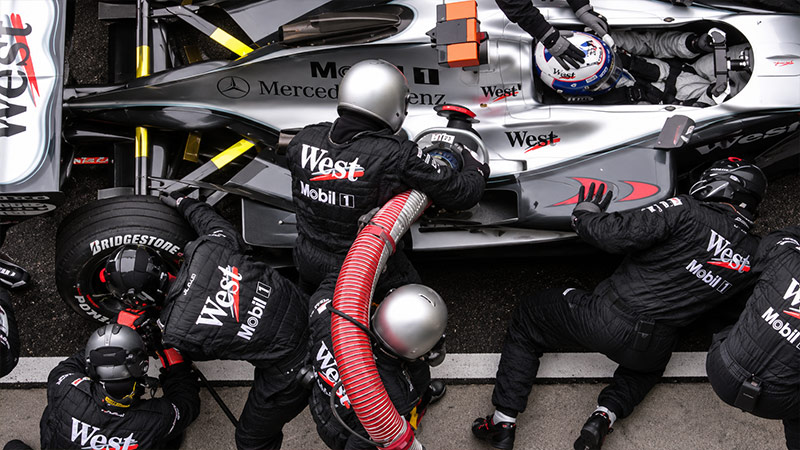
Refuelling has been banned in F1 since 2010, so every car starts the race carrying all the fuel it needs. That single rule turns fuel into a strategic weapon.
A full tank is heavy, and weight costs time. A common rule of thumb puts the penalty at around three tenths of a second per lap for every 10 kg, though the figure varies by circuit.
Teams therefore load only what the race demands, sometimes slightly less, and recover the gap through lift-and-coast: easing off the throttle before braking zones to save fuel.
The 2026 rules sharpen this further. With so much power now electrical, drivers juggle fuel burn, battery deployment and energy recovery on every lap.
When a driver’s pace improves late in a stint, a lighter car and smarter energy use are often the reason.
Why F1 Fuel Matters Beyond the Track
Formula 1 has long served as a high-speed laboratory, and fuel is one of its clearest links to everyday driving. Well over a billion combustion-engine vehicles are on the world’s roads, and many will stay in use for decades.
Drop-in sustainable fuels could cut the lifecycle carbon footprint of those vehicles without forcing owners to replace them. The F1 programme shows these fuels can survive the harshest conditions imaginable, giving producers, regulators and carmakers real-world confidence.
Efficiency gains travel too. Modern F1 hybrid power units have exceeded 50% thermal efficiency, far above the roughly 30 to 40% typical of road engines, and lessons in combustion and energy recovery steadily filter into production cars. The sport’s target of net zero carbon by 2030 keeps this work firmly in focus.
Key Numbers at a Glance
| Item | Figure |
|---|---|
| Engine | 1.6-litre turbocharged V6 hybrid |
| Fuel type, 2026 onward | 100% advanced sustainable fuel |
| Fuel type, 2022 to 2025 | E10 (10% sustainable ethanol) |
| Energy-flow limit, 2026 | 3,000 MJ per hour |
| Fuel-flow limit, 2014 to 2025 | 100 kg per hour |
| Maximum race fuel, 2019 to 2025 | 110 kg |
| Electrical power, 2026 | Around 350 kW |
| Octane window | 95 to 102 RON |
| Post-race fuel sample | At least 1 litre |
| Refuelling | Banned since 2010 |
Conclusion
The F1 car fuel type tells the story of the sport itself: relentless innovation shaped by tighter rules and bigger responsibilities.
From alcohol blends and turbo-era chemistry to E10 and today’s fully sustainable fuel, every change has pushed engineers to extract more performance from every molecule.
The 2026 switch proves that speed and responsibility can share the same tank, and the lessons learned on track are already shaping fuels that could one day power the cars in your driveway.
Understanding fuel also helps you read a race better, from early-stint pace to late-race energy management.