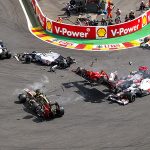
Formula 1’s biggest crashes are some of the most replayed moments in motorsport, but their true significance lies in what came after.
Nearly every major accident in the sport’s 76-year history has pushed F1 to build safer cars, write smarter rules, and redesign its circuits.
A modern F1 car can top 350 km/h (about 217 mph), and a heavy impact can generate more than 50G, the equivalent of over 50 times the driver’s body weight.
Today, drivers regularly walk away from accidents that would have killed their predecessors. That progress was earned through hard lessons, some of them paid for with lives.
In this guide, we break down the 10 crashes that shaped Formula 1, from Niki Lauda’s fiery accident in 1976 to Zhou Guanyu’s upside-down slide at Silverstone in 2022.
For each one, you will learn what happened, the key numbers behind the impact, and the safety change it inspired.
The Biggest F1 Crashes at a Glance
These 10 accidents rank among the most significant in Formula 1 history, listed in the order covered below.
| # | Crash | Year | Outcome | Lasting impact |
|---|---|---|---|---|
| 1 | Romain Grosjean, Bahrain | 2020 | Burns to hands | Proved the value of the Halo |
| 2 | Ayrton Senna and Roland Ratzenberger, Imola | 1994 | Both fatal | Sweeping safety reforms |
| 3 | Niki Lauda, Nürburgring | 1976 | Severe burns | F1 left the Nordschleife |
| 4 | Gilles Villeneuve, Zolder | 1982 | Fatal | Added urgency to ground-effect limits |
| 5 | Jules Bianchi, Suzuka | 2014 | Fatal (died 2015) | Virtual Safety Car introduced |
| 6 | Robert Kubica, Montreal | 2007 | Concussion, sprained ankle | Showcased survival cell strength |
| 7 | Zhou Guanyu, Silverstone | 2022 | Unhurt | Stronger roll-hoop rules |
| 8 | Fernando Alonso, Melbourne | 2016 | Rib fractures | Highlighted crash structure gains |
| 9 | Mark Webber, Valencia | 2010 | Unhurt | Spotlight on closing speeds |
| 10 | Spa first-corner pile-up | 2012 | No serious injuries | Strengthened the case for head protection |
How These Crashes Were Selected
A crash earns its place on this list through three measures: its physical severity, its human consequences, and the safety change that followed. Severity covers impact speed and G-force, where official data exists.
Consequences cover injuries, careers, and championships. Legacy covers the rules, technology, and circuit changes each accident triggered.
Several of these accidents cost drivers their lives. They are included with respect, because their legacy lives on in every car on today’s grid.
1. Romain Grosjean, Bahrain Grand Prix (2020)
Key numbers: 67G impact · about 221 km/h (137 mph) · roughly 28 seconds in the fire
On the opening lap of the 2020 Bahrain Grand Prix, Romain Grosjean’s Haas clipped Daniil Kvyat’s AlphaTauri and veered into the steel barrier. The car pierced the barrier, split in two, and erupted into a fireball. For a few long seconds, the world feared the worst.
Then Grosjean emerged from the flames, climbing over the barrier with help from FIA medical delegate Dr Ian Roberts and medical car driver Alan van der Merwe. He suffered burns to his hands but was otherwise remarkably unhurt.
Why it mattered: The Halo, the titanium head-protection device made mandatory in 2018, took the force of the barrier and shielded Grosjean’s head.
Grosjean had once been sceptical of the Halo, but afterwards credited it with saving his life. The FIA’s investigation led to further work on barrier design, fire-resistant gloves, and fuel system safety.
2. Ayrton Senna and Roland Ratzenberger, San Marino Grand Prix (1994)
Key numbers: two fatalities in two days · Senna’s impact at roughly 211 km/h (131 mph) · Ratzenberger’s at over 300 km/h
The 1994 San Marino Grand Prix weekend remains the darkest in modern Formula 1. On Friday, Rubens Barrichello was launched into a tyre barrier and knocked unconscious, though he escaped serious injury.
On Saturday, Austrian rookie Roland Ratzenberger was killed in qualifying when his Simtek’s front wing failed at over 300 km/h, sending him into the wall at Villeneuve corner.
On Sunday, 1 May, three-time world champion Ayrton Senna left the track at the high-speed Tamburello curve and struck a concrete wall.
A suspension component penetrated his helmet, and he died later that day. The loss of the sport’s most celebrated driver shocked fans around the world.
Why it mattered: Imola triggered the most sweeping safety overhaul in F1 history. The FIA created an expert safety group led by Professor Sid Watkins, raised cockpit sides, toughened crash tests, cut engine size from 3.5 to 3.0 litres, and reshaped dangerous corners, including Tamburello itself. No driver would lose their life from a Grand Prix accident for another 20 years.
3. Niki Lauda, German Grand Prix (1976)
Key numbers: 22.8 km (14.2 mi) Nordschleife lap · back in the car 42 days later · lost the title by a single point
On 1 August 1976, reigning world champion Niki Lauda lost control of his Ferrari on the Nordschleife, the old Nürburgring circuit.
The car struck an embankment, burst into flames, and was hit by other cars. Lauda was trapped in the burning wreck until fellow drivers Arturo Merzario, Guy Edwards, Brett Lunger, and Harald Ertl pulled him free.
Lauda suffered severe burns and inhaled toxic fumes, and he was given the last rites in hospital. Astonishingly, he returned just 42 days later at Monza and finished fourth. He lost the championship to James Hunt by one point, a rivalry later retold in the film Rush.
Why it mattered: Lauda had urged drivers to boycott the Nordschleife before the race, arguing that its length made marshalling and rescue impossible.
Formula 1 never raced on the full Nordschleife again. His crash became a lasting symbol of the need for fast, well-equipped medical response at every circuit.
4. Gilles Villeneuve, Belgian Grand Prix Qualifying (1982)
Key numbers: estimated speed above 200 km/h · car launched into the air · one of three major accidents in a single season
During final qualifying at Zolder on 8 May 1982, Gilles Villeneuve came up behind Jochen Mass’s slower March. Both drivers moved the same way, and the Ferrari’s front wheel struck the March’s rear.
Villeneuve’s car was launched into the air and broke apart as it landed, throwing him from the cockpit.
The Canadian, one of the most admired drivers of his era, died that evening. His fearless style had made him a fan favourite, and his loss is still felt in Formula 1 today. The circuit in Montreal now carries his name.
Why it mattered: The 1982 season also saw Riccardo Paletti killed in Canada and Didier Pironi’s career ended by a crash at Hockenheim.
Those accidents exposed the dangers of the extreme cornering speeds produced by ground-effect aerodynamics. For 1983, the governing body required flat car floors, sharply cutting downforce and cornering speeds.
5. Jules Bianchi, Japanese Grand Prix (2014)
Key numbers: impact at about 126 km/h · peak deceleration reported at 254G · first driver to die from a Grand Prix accident since 1994
The 2014 Japanese Grand Prix was run in heavy rain from an approaching typhoon, with light fading late in the race.
Adrian Sutil’s Sauber aquaplaned off at the Dunlop curve, and a recovery vehicle came out to remove it under yellow flags. A lap later, Jules Bianchi’s Marussia left the track at the same spot and struck the recovery vehicle.
Bianchi suffered a severe brain injury and never regained consciousness. He died in July 2015, aged 25. The highly rated Frenchman had been widely tipped for a future seat at Ferrari.
Why it mattered: The FIA’s accident panel led to the Virtual Safety Car, introduced in 2015, which forces every driver to slow to a set pace across the whole circuit.
Rules on recovery vehicles and race start times where rain or fading light is likely were also reviewed. Bianchi’s crash added momentum to the research that produced the Halo.
6. Robert Kubica, Canadian Grand Prix (2007)
Key numbers: peak deceleration of about 75G · impact at roughly 230 km/h (143 mph) · missed just one race
Midway through the 2007 Canadian Grand Prix, Robert Kubica’s BMW Sauber touched Jarno Trulli’s Toyota on the approach to the hairpin.
With a damaged front wing, the car ran onto the grass, hit a bump, and was launched into a concrete wall. It then barrel-rolled back across the track before coming to rest on its side, the front of the car torn away and the driver’s legs exposed.
Many watching feared a fatal outcome. Instead, Kubica escaped with a concussion and a sprained ankle. He sat out the next race, where a young Sebastian Vettel made his debut in his place and scored a point.
Why it mattered: Kubica’s escape became the clearest proof of how far car safety had advanced since 1994.
The carbon-fibre survival cell held firm, the raised cockpit sides protected his head, and the HANS device, mandatory since 2003, limited neck injuries. He returned at the next race but one, the French Grand Prix.
7. Zhou Guanyu, British Grand Prix (2022)
Key numbers: slid upside down across track and gravel · cleared by doctors the same day · roll-hoop rules rewritten for 2023
Seconds after the start of the 2022 British Grand Prix, Pierre Gasly’s AlphaTauri squeezed George Russell’s Mercedes, which in turn struck Zhou Guanyu’s Alfa Romeo.
Zhou’s car flipped and slid upside down along the track and through the gravel. It then vaulted the tyre barrier and became wedged between the barrier and the catch fence.
Russell jumped from his own car and ran to help as marshals reached the wreck. Zhou was extracted and, remarkably, cleared after medical checks. Alex Albon, caught up in the same first-lap chaos, was taken to hospital as a precaution.
Why it mattered: The car’s roll hoop, the structure above the driver’s head, failed when it first struck the ground. The Halo then carried the load and protected Zhou’s head during the long slide.
The FIA responded with tougher roll-hoop strength tests and a rounded hoop design to stop it digging into the ground.
8. Fernando Alonso, Australian Grand Prix (2016)
Key numbers: peak impact of 46G · approach speed above 300 km/h · one race missed
At the 2016 season opener in Melbourne, Fernando Alonso’s McLaren closed rapidly on Esteban Gutiérrez’s Haas on the run to Turn 3. Alonso clipped the Haas’s rear wheel, slammed into the wall, and barrel-rolled through the gravel before stopping upside down against the barrier.
The two-time world champion crawled out through a small gap in the wreckage and walked away. Scans later revealed rib fractures and a partially collapsed lung, and doctors ruled him out of the next race in Bahrain. His replacement, Stoffel Vandoorne, scored a point on debut.
Why it mattered: Alonso’s crash showed how well modern crash structures absorb energy, even when a car tumbles through multiple impacts. It also became a reference point in the debate over cockpit protection, which reached its conclusion with the Halo two years later.
9. Mark Webber, European Grand Prix (2010)
Key numbers: approach speed above 300 km/h · full somersault in mid-air · driver unhurt
At the Valencia street circuit in 2010, Mark Webber’s Red Bull was charging back through the field after an early pit stop.
On a long straight, he moved to pass Heikki Kovalainen’s much slower Lotus just as Kovalainen braked earlier than Webber expected.
Webber’s front wheel hit the Lotus’s rear, launching the Red Bull into the air. The car flipped, landed upside down, rolled back onto its wheels, and slammed into a tyre barrier. Webber climbed out without injury.
Why it mattered: The crash highlighted the danger of large speed gaps between front-running teams and the new teams that joined F1 that year. It also showed, once again, how wheel-to-wheel contact can turn a car into a projectile, a risk that later shaped thinking on head protection.
10. Spa First-Corner Pile-Up, Belgian Grand Prix (2012)
Key numbers: five cars eliminated or damaged at the first corner · a car passing within centimetres of a driver’s head · first race ban since 1994
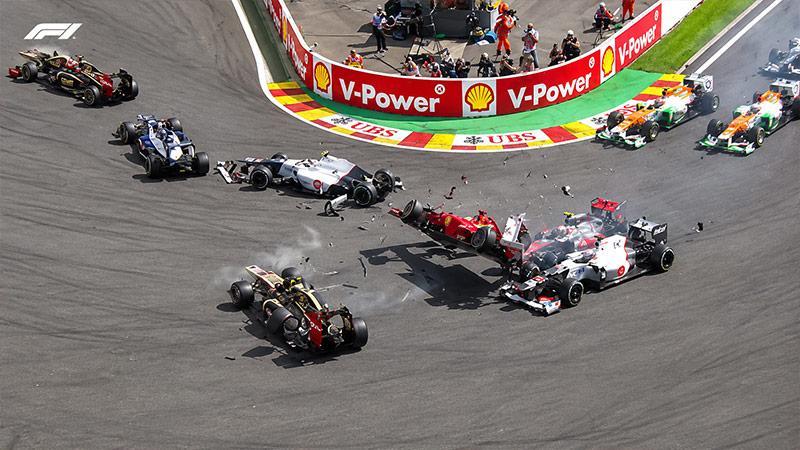
At the start of the 2012 Belgian Grand Prix, Romain Grosjean’s Lotus moved across on Lewis Hamilton’s McLaren on the run to La Source.
The two cars touched, and both were thrown into the braking zone, collecting Sergio Pérez, Kamui Kobayashi, and championship leader Fernando Alonso.
Grosjean’s car flew directly over Alonso’s Ferrari, passing just above his head. Alonso was unhurt but out of the race, a costly blow to his title hopes. Grosjean received a one-race ban, the first handed to a driver since 1994.
Why it mattered: The image of a car skimming over an exposed cockpit became one of the strongest arguments for frontal head protection. Eight years later, Grosjean himself would owe his life to the Halo that this incident helped bring about.
Honourable Mentions
Several other crashes deserve a place in any history of Formula 1’s most dramatic accidents.
- David Purley, Silverstone (1977): Purley survived an estimated 179.8G deceleration in pre-qualifying, one of the highest G-forces ever recorded in a human survivor.
- Gerhard Berger, Imola (1989): Berger’s Ferrari caught fire after hitting the wall at Tamburello. Rapid action by marshals freed him in under 30 seconds, and he missed only one race.
- Mika Häkkinen, Adelaide (1995): A tyre failure in practice left Häkkinen with a fractured skull. An emergency tracheotomy at the trackside saved his life, and he went on to win the 1998 and 1999 world titles.
- Martin Brundle, Melbourne (1996): Brundle’s Jordan was launched over other cars and broke in half, yet he sprinted back to the pits to take the restart in the spare car.
- Michael Schumacher, Silverstone (1999): A rear brake failure sent Schumacher’s Ferrari into the tyre wall at Stowe, breaking his leg and ending his title challenge that year.
- Max Verstappen, Silverstone (2021): Verstappen’s Red Bull hit the barrier at Copse with a force of 51G after contact with Lewis Hamilton.
- Verstappen and Hamilton, Monza (2021): Verstappen’s car landed on top of Hamilton’s Mercedes, and the Halo shielded Hamilton’s head from a rear wheel.
The Safety Legacy: How Crashes Shaped Modern F1
Almost every major safety feature in today’s Formula 1 can be traced back to a specific accident or a run of them. The table below links the key changes to the crashes that prompted them, newest first.
| Year | Safety change | What prompted it |
|---|---|---|
| 2023 | Stronger, rounded roll hoops | Zhou Guanyu, Silverstone 2022 |
| 2018 | Halo head protection made mandatory | Spa 2012, Bianchi 2014, and other head-impact risks |
| 2015 | Virtual Safety Car introduced | Jules Bianchi, Suzuka 2014 |
| 2003 | HANS head and neck support mandatory | Research into head and neck injuries |
| 1996 | Raised cockpit sides and headrests | Imola 1994 |
| 1995 | Engine size cut from 3.5 to 3.0 litres | Imola 1994 |
| 1983 | Flat car floors required | Villeneuve, Paletti, and Pironi crashes in 1982 |
The changes go beyond the cars. Medical cars now follow the field on the opening lap, trackside medical teams train for rapid extraction, and circuits use energy-absorbing barriers and wider run-off areas. Together, these layers explain why drivers like Kubica, Alonso, Grosjean, and Zhou could walk away from crashes that once would have been fatal.
Conclusion
Formula 1’s biggest crashes are woven into the sport’s identity. Some, like Grosjean’s escape from the flames in Bahrain, are stories of survival.
Others, like Imola in 1994 and Suzuka in 2014, are tragedies that the sport still mourns. Together they form a clear pattern: each major accident exposed a weakness, and the sport responded with stronger cars, smarter rules, and safer circuits.
The Halo, the HANS device, the Virtual Safety Car, and far tougher crash tests all trace back to lessons learned the hard way.
Today’s drivers race faster than ever, yet they are better protected than any generation before them.
That progress is the true legacy of every driver featured here, and it continues with every new season.