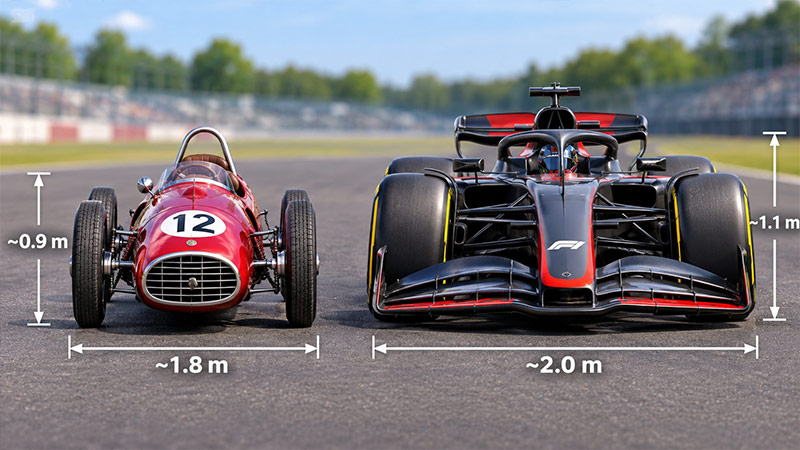
A modern Formula 1 car is longer than a Mercedes-Benz S-Class limousine. That fact surprises most fans, because on television these cars look low, compact and almost fragile. Park a 2024 grid car beside a 1960s Lotus, though, and the gap is impossible to miss.
The modern machine is well over a metre longer, noticeably wider and more than 250 kilograms heavier, even before the driver climbs in. Size in Formula 1 is never an accident. Every centimetre is written into the technical regulations, then exploited by engineers hunting for lap time.
Safety rules, hybrid power, fuel strategy and aerodynamics have all pushed the cars outward for decades. In 2026, the sport finally pushed back with smaller, lighter cars.
This guide compares F1 car size past vs present, era by era, from the front-engined racers of 1950 to the slimmer 2026 generation.
You will see how length, width and weight changed, why they changed, how an F1 car stacks up against everyday road cars, and what it all means for the racing you watch on Sunday.
Key Takeaways
- Peak length: The 2022–2025 cars stretched to roughly 5.6 metres, with the wheelbase capped at 3.6 metres.
- Heaviest cars ever: Minimum weight peaked at 798 kg, car plus driver, from 2022 to 2025.
- Lightest era: From 1961 to 1965, the minimum weight was just 450 kg, not counting the driver.
- Width has swung both ways: 2.15 m in the 1980s, 2.0 m from 1993, 1.8 m from 1998, 2.0 m again from 2017 and 1.9 m in 2026.
- 2026 reversed the trend: The current cars have a 200 mm shorter wheelbase, 100 mm less width and a 768 kg minimum weight.
F1 Car Size by Era: Comparison Table
An F1 car has grown from about 4 metres long in the 1950s to roughly 5.6 metres in 2025, before shrinking for 2026. The table shows how length, width and minimum weight moved across nine eras.
| Era | Representative car | Length (approx.) | Width | Minimum weight | Defining trait |
|---|---|---|---|---|---|
| 2026 | Current grid | ~5.4 m (est.) | 1.9 m max | 768 kg | Active aero, 3.4 m wheelbase cap |
| 2022–2025 | Red Bull RB19 | ~5.6 m | 2.0 m max | 798 kg | Ground effect, 18-inch wheels |
| 2017–2021 | Mercedes W08 | ~5.5 m | 2.0 m max | 728–752 kg | Wider bodies, no wheelbase cap |
| 2014–2016 | Mercedes W05 | ~5.0 m | 1.8 m max | 691 kg | Hybrid V6 turbo power units |
| 1998–2008 | Ferrari F2004 | ~4.5 m | 1.8 m max | 600–605 kg | Narrow track, grooved tyres, V10 |
| Late 1980s | McLaren MP4/4 | ~4.4 m | 2.15 m max | 540 kg (turbo) | Turbo power, flat floors |
| 1970s | Lotus 79 | ~4.4 m | 2.15 m max | 575 kg | Wings, slicks, ground effect |
| 1961–1965 | Lotus 25 | Under 4.0 m | ~1.5 m (typical) | 450 kg | Rear engine, monocoque chassis |
| 1950s | Alfa Romeo 158 | ~4.3 m | ~1.5 m (typical) | None (~700 kg dry) | Front engine, upright driver |
Figures are rounded. Teams rarely publish exact dimensions, so lengths are estimates, while widths and weights are the regulatory limits of each era. Minimum weight has included the driver only since 1995, and it has never included fuel.
The 1950s: Front Engines and Upright Drivers
The first championship cars of 1950 were about 4.3 metres long, close to a modern family hatchback. They looked like narrow cigars on tall, skinny tyres, with the engine mounted in front of the driver.
The dominant Alfa Romeo 158 set the template. Its driveshaft ran beneath the seat, which forced the driver to sit high and bolt upright, elbows out, with almost nothing around his shoulders. Drivers raced in cloth or leather helmets, and many chose not to wear seatbelts at all.
The rulebook controlled engines, not bodies. There was no minimum weight, so cars weighed whatever their builders made them, typically around 700 kg dry. Size was a by-product of the mechanical layout: a long engine bay up front, a big fuel tank behind the driver and very little else.
The 1960s: The Rear-Engine Revolution and the Smallest F1 Cars
The early 1960s produced the smallest, lightest cars in championship history. From 1961 to 1965, the rules limited engines to 1.5 litres and set the minimum weight at just 450 kg.
Cooper had already moved the engine behind the driver, and Jack Brabham won the 1959 and 1960 titles to prove the idea. Rivals copied it almost overnight. With no driveshaft under the seat, drivers could lie back, so the cars became far lower and slimmer.
In 1962, the Lotus 25 introduced a stressed monocoque chassis, a single rigid tub instead of a tube frame. It was under 4 metres long, barely wider than the driver’s shoulders at the cockpit, and it carried Jim Clark to the 1963 title.
The 3-litre formula arrived in 1966, raising the minimum weight to 500 kg. By 1968, teams were bolting wings onto tall struts, a sign that aerodynamics was about to reshape the car.
The 1970s and 1980s: Wings, Ground Effect and Turbo Power
Aerodynamics, not engines, began to dictate an F1 car’s shape in the 1970s. Wings moved from tall struts onto the bodywork, radiators shifted into side pods, and slick tyres grew enormously wide at the rear.
Width became the key battleground. The overall limit settled at 2.15 metres, and designers used every millimetre. The Tyrrell P34 of 1976 even ran six wheels, using four small front wheels to cut frontal area and drag.
The biggest leap came from the floor. The Lotus 79 of 1978 shaped its underbody like an upside-down wing, sealed at the sides by sliding skirts. This ground effect sucked the car to the track and dominated the season. Flat floors became mandatory in 1983 to rein in cornering speeds.
The 1980s turbo era brought qualifying engines well beyond 1,000 horsepower, yet the cars stayed around 4.4 metres long. In 1981, McLaren’s MP4/1 introduced the carbon-fibre monocoque, a huge safety gain that added strength without adding size.
The 1990s and 2000s: Narrower Cars and the V10 Era
The 1990s made F1 cars narrower on purpose. The width limit dropped from 2.15 to 2.0 metres in 1993, then to 1.8 metres in 1998, when grooved tyres also replaced slicks to cut cornering grip.
Safety reshaped the cockpit after the tragic 1994 San Marino Grand Prix weekend. Cockpit sides rose around the driver’s head, crash structures grew, and impact tests became far tougher. From 1995, the minimum weight of 595 kg included the driver for the first time.
Refuelling, reintroduced in 1994, kept fuel tanks small and wheelbases short. The result was a generation of compact, agile cars.
The Ferrari F2004, for example, was about 4.5 metres long and 1.8 metres wide, with a screaming 3-litre V10 behind the driver.
Slick tyres returned in 2009, alongside a wider front wing, a narrower rear wing and the first energy-recovery systems. The car’s footprint, however, stayed close to its 1998 shape.
2014 to 2025: The Growth Spurt
Between 2014 and 2022, F1 cars grew longer and heavier faster than in any period before. The minimum weight climbed from 691 kg to 798 kg, and typical length rose from about 5 metres to around 5.6 metres.
The groundwork was laid in 2010, when refuelling was banned. Cars had to start with a full race load of fuel, so tanks became larger and wheelbases stretched to fit them.
In 2014, hybrid power units arrived. A 1.6-litre V6 turbo now worked with two motor-generators, a battery and control electronics, all needing extra space and cooling. Bigger side pods and longer bodies followed.
The 2017 rules widened the cars back to 2.0 metres and fitted tyres about 25 per cent wider. With no limit on wheelbase, some teams pushed beyond 3.7 metres to gain floor area and downforce. The halo, added in 2018, brought roughly 7 kg of titanium protection above the cockpit.
The 2022 regulations completed the growth spurt. Ground-effect floors returned, 18-inch wheels replaced 13-inch rims, and the wheelbase was capped at 3.6 metres. At 798 kg, these were the heaviest F1 cars ever raced.
2026: Smaller, Lighter and Nimbler
The 2026 regulations are the first planned shrink of the F1 car in more than a decade. The maximum wheelbase falls by 200 mm to 3.4 metres, overall width drops by 100 mm to 1.9 metres, and the minimum weight is cut by 30 kg to 768 kg.
The floor is about 150 mm narrower, and the 18-inch tyres are slimmer too, by 25 mm at the front and 30 mm at the rear. Together, these changes aim for a car that changes direction faster and fits better on tight circuits.
Aerodynamics are now active. Movable front and rear wings switch between a high-downforce setting for corners and a low-drag setting for straights. The FIA targeted roughly 30 per cent less downforce and about 55 per cent less drag than the 2025 cars.
The power units changed just as dramatically. Electrical power now supplies close to half of the total output, the MGU-H has been removed, and the cars run on fully sustainable fuel.
Fitting a stronger hybrid system into a smaller, lighter car was one of the toughest engineering briefs in the sport’s history.
One detail keeps the story in perspective: at 768 kg, a 2026 car is still heavier than any F1 car raced before 2022.
Why F1 Cars Got So Big
Five forces explain nearly all of the growth in F1 car size since the 1990s. Each one added length, width or weight, and most were introduced for good reasons.
- Safety structures. Survival cells, front, side and rear crash structures, anti-intrusion panels, wheel tethers and the halo all need space and mass. Every new crash test has made the car stronger and, almost always, larger.
- Hybrid hardware. Since 2014, the power unit has included a battery, motor-generators and complex electronics. These parts generate heat, so the car needs larger radiators, bigger side pods and more internal packaging room.
- Fuel load. The 2010 refuelling ban forced every car to carry its full race fuel from the start. A bigger tank behind the driver meant a longer chassis and a longer wheelbase.
- Aerodynamics. A longer car offers more floor area, and more floor means more downforce. When the wheelbase was unrestricted from 2017 to 2021, teams stretched their cars voluntarily to gain grip and stability.
- Tyres and wheels. Wider tyres in 2017 and larger 18-inch wheels in 2022 added weight at every corner. Heavier wheels also demanded stronger suspension and brakes, adding more mass.
None of these forces is likely to disappear. That is why the 2026 shrink required trade-offs across the whole car rather than one simple rule change.
How an F1 Car Compares With Road Cars
A 2022–2025 F1 car is longer than a luxury limousine but weighs less than half as much. The comparison below puts F1 car dimensions next to familiar road cars.
| Vehicle | Length (approx.) | Width (approx.) | Weight (approx.) |
|---|---|---|---|
| F1 car, 2022–2025 | 5.6 m | 2.0 m | 798 kg (with driver) |
| F1 car, 2026 | 5.4 m (est.) | 1.9 m | 768 kg (with driver) |
| Mercedes-Benz S-Class (long wheelbase) | 5.3 m | 1.95 m | 2,100 kg |
| Range Rover | 5.0 m | 2.0 m | 2,500 kg |
| Mazda MX-5 | 3.9 m | 1.7 m | 1,050 kg |
Height tells the other half of the story. An F1 car is limited to 950 mm tall, roughly hip height on an adult, while even a low sports car like the MX-5 stands well over 1.2 metres.
This mix of limousine length, sports-car width and featherweight mass explains the extraordinary performance. With close to 1,000 horsepower and well under a tonne of weight, an F1 car has a power-to-weight ratio that only a handful of road-legal hypercars even approach.
What Car Size Means for the Racing
Bigger cars have made F1 safer but harder to race wheel to wheel, especially on narrow circuits. Size shapes almost every part of the on-track product.
- Overtaking on tight tracks. Two 2-metre-wide cars side by side need more than 4 metres of road. On street circuits such as Monaco, that leaves almost no room to attack, which is why qualifying position matters so much there.
- Agility in slow corners. A long wheelbase gives stability at high speed but resists quick direction changes. Many drivers described the 2022–2025 cars as heavy and reluctant through chicanes and hairpins.
- Tyre and brake wear. Extra mass loads the tyres harder and makes brakes work longer. Heavier cars often have less freedom to push for a full stint.
- Driver protection. The payoff has been dramatic. Romain Grosjean escaped a fiery crash in Bahrain in 2020, and Zhou Guanyu survived a violent rollover at Silverstone in 2022, both protected by the halo and a strong survival cell.
The 2026 rules try to keep that protection while giving drivers lighter, more responsive cars that can race closer together.
Conclusion
The F1 car has travelled a remarkable path. It began as a 4.3-metre, front-engined machine with no weight limit, shrank into the tiny, featherweight rear-engined cars of the 1960s, then grew steadily as wings, safety structures, fuel tanks and hybrid power demanded more room.
By 2022, it had become a 5.6-metre, 798-kilogram giant, the heaviest F1 car in history. The 2026 regulations mark a deliberate turn, with a shorter wheelbase, narrower body and lower weight.
Even so, today’s cars remain far bigger than their ancestors, because safety and efficiency will always need space.
Understanding F1 car size past vs present reveals how the sport balances speed, protection and spectacle, and why every centimetre on the grid is fiercely fought over.