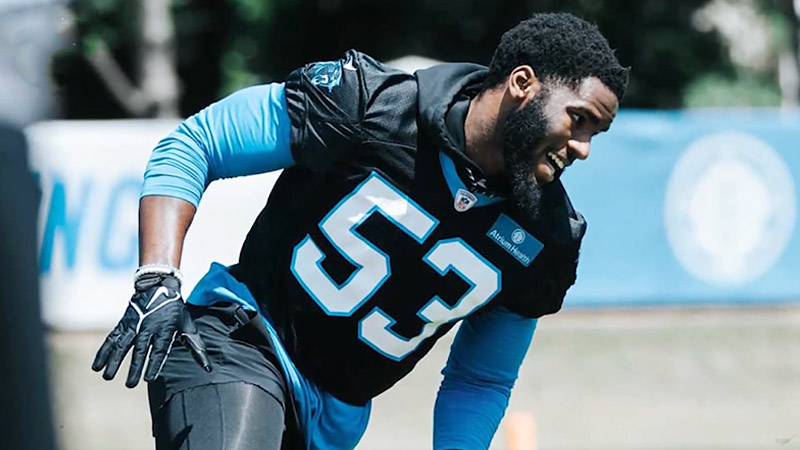
The landscape of professional football is often defined by high-stakes decisions that balance immediate athletic impact against long-term organizational health.
In March 2024, the Carolina Panthers executed one of the most discussed transactions of the off-season, sending star pass rusher Brian Burns to the New York Giants.
This move was not merely a change of scenery for a premier defender; it was a definitive statement on the Panthers’ new direction under General Manager Dan Morgan and a reflection of the evolving economics of the modern defensive line.
To understand why a franchise would part ways with an elite talent in his prime, one must look beyond the stat sheet and into the intricate world of salary cap management, draft capital valuation, and the cold logic of a comprehensive rebuilding phase.
The Mechanics of the Transaction
The trade that finalized Burns’ departure from Carolina was the culmination of months of uncertainty.
After negotiations for a long-term contract extension reached a stalemate, the Panthers utilized a $24 million franchise tag to maintain control over Burns’ immediate future and prevent him from entering the open market as a free agent.
This move provided the front office with the necessary leverage to facilitate a trade rather than losing a high-value asset for nothing more than a compensatory pick.
The New York Giants emerged as the primary partner in this exchange. In return for the two-time Pro Bowler, the Panthers received a second-round pick, a fifth-round pick, and a late-round pick swap.
While the compensation was significant, it sparked immediate debate among analysts, particularly because the Panthers had previously declined a substantially larger trade offer from the Los Angeles Rams in a prior season.
This historical context added a layer of complexity to the deal, highlighting the challenges of timing in professional sports management.
The Financial Pivot: Roster Reshaping vs. Star Retention
At the heart of the decision to move Burns was a fundamental disagreement on valuation and team-building philosophy. As contract talks stalled, it became clear that Burns sought a deal reflective of the top-tier edge rusher market.
Upon arriving in New York, he promptly signed a five-year, $150 million contract extension, solidifying his place as one of the highest-paid defensive players in league history.
For the Panthers, the prospect of committing approximately $30 million per year to a single non-quarterback presented a significant hurdle.
The organization’s leadership identified several key factors that made this investment untenable:
- Salary Cap Constraints: With multiple positions requiring upgrades, locking a massive percentage of the cap into one player was viewed as a risk to overall roster depth.
- The Rebuilding Phase: The Panthers are currently in a transition period aimed at establishing a sustainable winning culture. In this phase, the front office prioritized the acquisition of draft capital and the preservation of financial flexibility over the retention of expensive veteran stars.
- Addressing Structural Gaps: By clearing the cap space that would have been occupied by Burns and gaining additional draft picks, the Panthers empowered themselves to address “multiple holes on the roster” rather than over-leveraging their future on a single defensive pillar.
The Management Shift: The Dan Morgan Era
The trade also serves as a landmark move for General Manager Dan Morgan, signaling a shift in how the Panthers evaluate talent and manage their assets.
By choosing to move on from Burns, Morgan demonstrated a willingness to make difficult, often unpopular decisions to facilitate a broader roster reshaping.
This approach emphasizes the collective strength of the 53-man roster over individual star power. In an era where the “salary cap floor” and “roster churn” are constant pressures, the Panthers opted for a strategy that favors long-term versatility.
The decision to accept the Giants’ offer—despite it being lower than previous proposals from other teams—suggests a desire to finalize the team’s direction and move forward without the lingering distraction of a contract dispute.
The Giants’ Calculus: Why They Paid the Premium
While the Panthers focused on flexibility, the New York Giants viewed the acquisition of Burns as a necessary move to solidify their defensive identity.
By pairing Burns with their existing front, the Giants are betting on the “premium position” philosophy—the belief that elite pass rushers are worth the high financial cost because of their ability to disrupt the most important player on the field: the opposing quarterback.
Burns’ $150 million extension is a testament to the Giants’ belief that he is a “force multiplier”. In their defensive scheme, his speed and agility are expected to create opportunities for the rest of the unit, justifying the loss of draft picks and the significant cap hit.
The Long-Term Impact on Carolina’s Roster
For the Panthers, the success of this trade will not be measured by the performance of the players they lost, but by the performance of the players they gain.
The second-round and fifth-round picks acquired in the deal represent more than just prospects; they represent cost-controlled assets that can help fill the “holes” identified by the front office.
The “roster reshaping” strategy relies on the ability of the scouting department to turn these picks into contributing starters.
If the Panthers can find two or three reliable players with the capital gained from Burns, the trade will be viewed as a masterstroke of organizational efficiency.
Conversely, if those picks fail to develop, the loss of a proven elite defender will be felt deeply on the field.
The Road Ahead: Building Through Discipline
The Brian Burns trade is a reminder that in the NFL, talent is often secondary to the business of the game. The Panthers’ decision was a calculated move designed to prioritize the long-term health of the franchise over the short-term benefit of keeping a star player.
As the organization continues its rebuilding efforts, the focus remains on disciplined spending and the intelligent acquisition of draft assets.
This transaction marks the end of one era in Carolina and the beginning of another—one defined by a rigorous commitment to roster balance and financial sustainability.
Key Takeaways for Stakeholders
- Strategic Realignment: The trade was driven by a need to address multiple roster deficiencies rather than over-investing in one area.
- Market Dynamics: Burns’ new $150 million contract reflects the high value of edge rushers in today’s NFL, a price the Panthers were unwilling to pay during a rebuild.
- Asset Management: The use of the franchise tag was critical in ensuring the team received draft picks in exchange for their departing star.
Final Perspective
Success in the NFL is rarely about a single player; it is about the synergy of the entire organization. By moving Brian Burns, the Carolina Panthers have taken a bold step toward a more balanced future.
Whether this gamble pays off will depend on how effectively they utilize the newfound resources to build a team capable of competing at the highest level.
For fans and analysts alike, this trade remains a defining moment of the 2024 off-season—a clear example of how team-building philosophies can diverge when faced with the realities of a $150 million price tag.