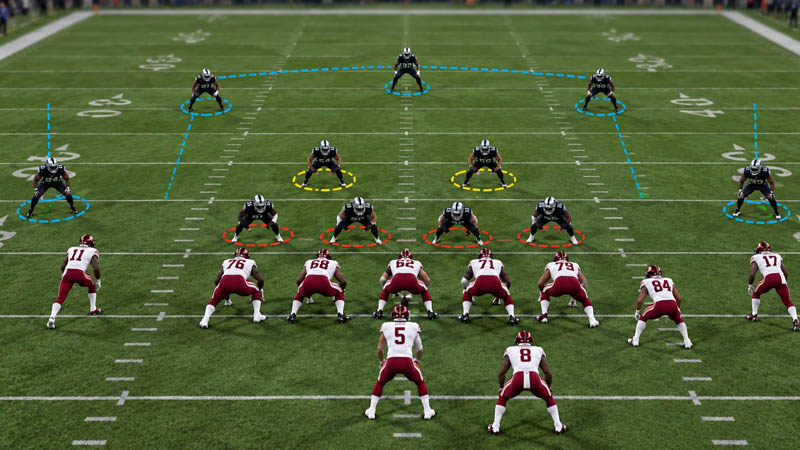
In the contemporary landscape of professional and collegiate football, the traditional terminology of “base defense” has undergone a radical transformation.
For decades, the sport was defined by the 4-3 and 3-4 alignments—structures prioritizing a balanced front to neutralize the run while providing adequate pass coverage.
However, as offensive coordinators transitioned to pass-heavy “11 personnel” groupings, defensive architects were forced to evolve.
The result is the ascendancy of the nickel defense. Once considered a situational sub-package reserved for third-and-long, the nickel has effectively become the primary defensive identity for the majority of teams.
Understanding this alignment is no longer just for the defensive coordinator; it is essential for anyone seeking to comprehend the high-stakes chess match of modern gridiron strategy.
Defining the Nickel: The Personnel Mathematics
At its core, a nickel defense is defined by the presence of five defensive backs on the field. The name is derived from the American five-cent coin, signifying the five secondary players utilized in the formation.
In a standard base defense, a team typically employs four defensive backs: two cornerbacks and two safeties.
Transitioning to a nickel package involves removing one “big” defender—typically a linebacker or, less frequently, a defensive lineman—and replacing them with a fifth defensive back, known as the nickelback or slot corner.
Common Structural Variations
The nickel defense is not a singular play-call but a personnel grouping that can be organized into several distinct fronts:
- The 4-2-5 Formation: This is the most prevalent iteration in the professional ranks. It utilizes four defensive linemen, two linebackers, and five defensive backs. It maintains a strong pass rush while providing enough coverage speed to match three-receiver sets.
- The 3-3-5 Formation: Frequently seen in the college game and increasingly in the professional ranks, this version uses three linemen, three linebackers, and five defensive backs. This structure offers greater pre-snap disguise and blitzing versatility.
- The 2-4-5 Formation: Often used by 3-4 base teams, this alignment features two interior linemen, four “linebackers” (often including two edge rushers), and five defensive backs.
Regardless of the front, the goal remains the same: trading physical mass for lateral speed and coverage flexibility.
Historical Context: From Gimmick to Global Standard
The nickel defense did not emerge overnight; its rise mirrors the professionalization of the passing game.
One of the earliest recorded uses of a specialized fifth defensive back occurred in 1960, when the Philadelphia Eagles utilized the alignment to neutralize Chicago Bears’ legendary tight end, Mike Ditka.
Throughout the 1970s and 1980s, the package remained a “gimmick” or a situational adjustment for obvious passing downs.
However, the 1990s marked a turning point as offensive schemes became increasingly sophisticated, spreading the field and forcing defenses to adapt or be exploited in space.
By the 2023 season, the data indicated a complete shift in philosophy: NFL teams employed a nickel defense on more than 60% of their total defensive snaps.
Today, even if a team does not start a game in a nickel look, it serves as their functional “base” for the majority of the afternoon.
The Anatomy of the Nickelback: Football’s Most Demanding Role
The player designated as the “nickel” or slot corner occupies one of the most intellectually and physically demanding positions on the field.
While early iterations of the nickel package often utilized a backup player off the bench, modern defenses treat the nickelback as a core starter who must be among the team’s most versatile athletes.
The Challenges of the Slot
Unlike outside cornerbacks, who can use the sideline as an “extra defender” to limit a receiver’s options, the nickelback operates in the slot—the area between the offensive tackle and the outside wide receiver.
- Two-Way Leverage: Inside receivers have two-way releases, meaning they can break their routes toward the middle of the field or toward the sideline. The nickelback must possess exceptional footwork and “leverage awareness” to defend this open space.
- Hybrid Responsibilities: The modern nickelback must play like a hybrid between a linebacker and a defensive back. They are expected to cover elite wideouts in man coverage while also possessing the physicality to “fit the run” and tackle larger running backs.
- The Blitzing Threat: Because they line up closer to the offensive line, nickelbacks provide a short, devastating path to the quarterback. Slot pressure is considered one of the most efficient blitzing strategies because offenses often struggle to account for it in their protection schemes.
Strategic Objectives: Disguise and Response
The primary catalyst for the nickel defense’s ubiquity is the offensive trend toward 11 personnel (one running back, one tight end, and three wide receivers).
If a defense remains in a traditional 4-3 base against three receivers, they are essentially asking a slower linebacker to cover a fast receiver in open grass—a mismatch that modern quarterbacks are trained to exploit immediately.
The Power of Disguise
A significant advantage of the nickel package is its ability to create “offensive confusion” through disguise:
- The Robber Concept: In this scheme, a defensive back (often a safety or the nickelback) abandons their apparent assignment to “rob” or jump a route in the middle of the field. This creates an illusion of an open receiver, baiting the quarterback into a turnover.
- Pressure vs. Simulation: The nickel alignment allows coordinators to show a blitz but only rush the standard four linemen, dropping the nickelback into a “zone shell”. Conversely, they can “simulate pressure” by dropping a defensive lineman and sending the nickelback, maintaining coverage integrity while changing the angle of attack.
- Variable Coverages: From a 4-2-5 look, a defense can seamlessly transition between Cover 1 (man-to-man), Cover 2, or Cover 3 (zone) without changing personnel, making it difficult for the offense to diagnose the scheme pre-snap.
Strategic Variants: The Rise of “Big Nickel”
As offenses began countering nickel defenses by running the ball against smaller defensive backs, a new variation emerged: the Big Nickel.
In a Big Nickel package, the defense utilizes a third safety as the fifth defensive back rather than a third cornerback. This adjustment offers a specific set of benefits:
- Size and Physicality: Safeties are typically larger and better tacklers than cornerbacks, making the defense more resilient against early-down runs and “power” schemes.
- Tight End Neutralization: With the evolution of “move” tight ends who possess wide-receiver speed, the Big Nickel safety provides the necessary size and range to match up physically in the red zone and over the middle.
- Run-Support Flexibility: A safety in the slot can effectively play as a “third linebacker,” allowing the defense to maintain coverage speed without surrendering the “box” to a heavy rushing attack.
Vulnerabilities: How Offenses Counter the Nickel
Despite its flexibility, the nickel defense is not invincible. Savvy offensive coordinators look for specific “gaps” in the alignment to regain the advantage.
Exploiting the “Light Box”
The most direct counter to a nickel defense is a commitment to the run game. By replacing a 240-pound linebacker with a 190-pound cornerback, the defense becomes inherently “lighter” in the interior.
Offenses often respond with “inside zone” or “power” runs, forcing the smaller nickelback to take on blocks from 300-pound offensive linemen.
The Substitution Trap and Tempo
Offenses also use personnel tempo to punish nickel-heavy teams. If an offense breaks the huddle with “heavy” personnel (two tight ends or a fullback), the defense will often try to substitute their nickelback for a linebacker.
To counter this, offenses will:
- Sprint to the Line: Line up and snap the ball before the defensive substitutions can be completed, often leading to “too many men on the field” penalties or massive coverage busts.
- Force Mismatches: Use “no-huddle” tempo to trap a nickel defense on the field against a run-heavy formation, essentially daring the smaller defenders to stop a power rushing attack over multiple plays.
Roster Building in the Nickel Era
The dominance of the nickel defense has fundamentally changed how front offices evaluate talent. The “third cornerback” is no longer a luxury; they are a high-priced starter.
Furthermore, this era has placed a premium on versatile interior linemen. Because the nickel removes a linebacker, the remaining two interior linemen must be “stout” enough to hold multiple gaps against the run while also possessing the quickness to pressure the passer on every down.
Teams are increasingly investing in edge rushers who can win one-on-one battles, allowing the back end to remain in a “two-high” safety shell to prevent big plays.
Conclusion
The transition of the nickel defense from a situational tool to a foundational strategy represents one of the most significant shifts in football history.
It is a direct response to an era of high-flying offenses and specialized athletes who thrive in space.
For the modern defender, the nickel package demands a rare blend of speed, intelligence, and raw physicality.
For the fan or analyst, recognizing the “fifth man” in the secondary provides the ultimate clue into a team’s defensive philosophy, their fear of the pass, and their willingness to gamble on speed to secure a victory.
As offenses continue to innovate, the nickel—and its various hybrid evolutions—will remain at the heart of the battle for field position and scoreboard dominance.