In the modern NFL, evaluating quarterback performance requires balancing raw physical ceiling against operational efficiency and consistency.
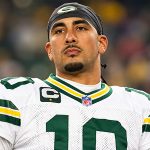
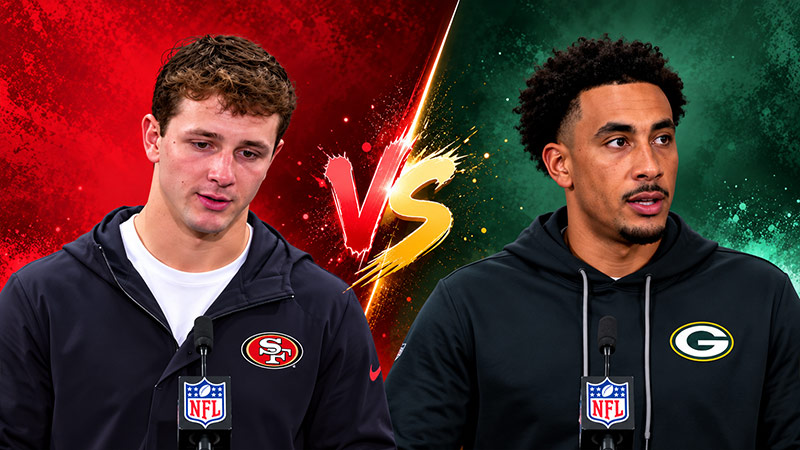
Few positional debates capture this strategic dilemma better than the ongoing comparison between San Francisco 49ers quarterback Brock Purdy and Green Bay Packers quarterback Jordan Love.
Both signal-callers lead premier NFC franchises operating within sophisticated variations of the Shanahan offensive system. However, their career arcs, physical profiles, and play styles present two distinct philosophies for franchise building.
While Love represents the quintessential high-ceiling arm talent with off-schedule playmaking capabilities, Purdy delivers elite processing, laser accuracy, and historical efficiency metrics.
Statistical Breakdown: 2026 Performance and Career Metrics
To make an objective assessment, franchise leaders and analysts evaluate raw production alongside down-by-down efficiency metrics.
Looking at the initial five-game stretch of the 2026 season, the contrast between Purdy’s supreme surgical efficiency and Love’s high-volume aggression becomes immediately clear.
2026 Head-to-Head Metric Comparison (Through 5 Games)
| Metric | Brock Purdy (SF) | Jordan Love (GB) | Performance Advantage |
|---|---|---|---|
| Games Played | 5 | 5 | Tied |
| Passing Yards | 1,196 | 1,408 | Jordan Love (+212 Yards) |
| Passing Touchdowns | 13 | 10 | Brock Purdy (+3 TDs) |
| Interceptions | 2 | 3 | Brock Purdy (-1 INT) |
| Completion Percentage | 69.0% | 60.5% | Brock Purdy (+8.5%) |
| Passer Rating | 119.3 | 95.5 | Brock Purdy (+23.8 Points) |
An analysis of these numbers demonstrates that while Jordan Love generates higher overall passing volume (1,408 yards), Brock Purdy operates with far higher efficiency across almost every qualitative category.
Purdy’s 69.0% completion rate and 119.3 passer rating reflect a quarterback commanding total control over his offense’s passing rhythm.
Conversely, Love’s 60.5% completion rate highlights ongoing struggles with down-by-down consistency, despite generating big plays downfield.
Career metrics tell a consistent story across multiple seasons. Purdy generally holds a firm edge over Love in efficiency, completion percentage, yards-per-attempt, and overall career passer rating.
While Love posted a slightly higher ESPN QBR in 2025 (73.8 vs. Purdy’s 72.9), Purdy’s full body of work reflects superior sustained performance.
Brock Purdy: Master of Field Reading, Accuracy, and Decision-Making
Elite Processing Speed and Precision
Brock Purdy’s rise from the final pick of the NFL Draft to an elite NFL distributor relies heavily on his elite cognitive processing.
Purdy reads coverages before and post-snap as intelligently as any signal-caller in the league today. He operates Kyle Shanahan’s complex offense with precision, consistently delivering the ball on time to maximize post-catch yards.
Purdy routinely ranks near the top of the league in completion percentage and yards-per-attempt because he consistently identifies the soft spots in defensive coverage structures and hits his receivers in stride.
Analysts who dissect game film note that Purdy’s mental processing is significantly ahead of most young quarterbacks in his peer group.
Underrated Athleticism and Pocket Mobility
A frequent misconception surrounding Purdy is that he lacks functional physical mobility. On film, Purdy displays sneaky athleticism and quick pocket footwork, enabling him to escape pressure, break the pocket, and make plays with his legs.
His mobility is not merely defensive; he uses pocket movement to create throwing lanes and extend plays downfield without breaking structure unnecessarily.
The Turnover Profile: Hero Ball vs. Errant Decisional Errors
Every quarterback commits turnovers, but the nature of those turnovers differentiates precise decision-makers from volatile ones.
When Purdy throws interceptions, the film generally shows a calculated risk—either placing excessive trust in his receiving core or attempting to make a play in late-clock situations.
Importantly, Purdy’s mistakes rarely stem from reading the coverage incorrectly. His calculated aggression does not derail his team’s ability to win, ensuring he rarely serves as the primary reason for a 49ers loss.
High-Stakes Experience and Winning Pedigree
Purdy has consistently validated his skill set in high-pressure environments. He has captured NFC Offensive Player of the Month honors and propelled San Francisco to a Super Bowl appearance early in his career.
His ability to sustain high-level performance across playoff runs separates him from talent profiles that have yet to translate physical traits into championship appearances.
Jordan Love: Arm Talent, Off-Schedule Potential, and Volatility
The High-Ceiling Gunslinger Dynamic
Jordan Love presents the classic physical upside profile that NFL talent evaluators covet. Operating in Matt LaFleur’s offensive system, Love is granted considerable pre-snap autonomy to tweak protection schemes and adjust route concepts.
His physical arm strength enables him to make throws across the field from off-balance platforms, making him a dynamic threat when plays break down.
Love’s raw talent allows him to push the ball into tight windows downfield that conventional system quarterbacks cannot attempt. When operating at his absolute peak, Love matches any top-tier quarterback in pure off-schedule playmaking ability.
The Realization Gap: Inconsistency and Unforced Errors
The fundamental challenge with Love’s evaluation is the gap between his maximum potential and his week-to-week execution.
Evaluators frequently observe that while Love possesses elite arm talent, he fails to actualize it on a consistent basis.
Unlike Purdy, whose turnover profile involves calculated downfield aggression, Love experiences unforced decisional lapses.
Film breakdown reveals instances where Love throws mind-boggling interceptions into heavy coverage without clear structural rationale.
These erratic turnovers can single-handedly alter game momentum, making his high-ceiling style a double-edged sword for Green Bay.
Because of these persistent accuracy lapses and turnover spikes, some sports analysts view Love as underachieving relative to his physical toolset.
Scheme Architecture, Surrounding Talent, and Technical Validation
Shanahan vs. LaFleur: Structural Context
A central debate when evaluating both quarterbacks involves the influence of their offensive systems. Both the San Francisco 49ers and Green Bay Packers utilize wide-zone running schemes paired with heavy play-action passing concepts designed to create clear throwing lanes.
- Kyle Shanahan’s System (San Francisco): Demands absolute timing, rapid diagnostic speed, and pinpoint ball placement. Purdy excels here because he operates with anticipation, throwing receivers open before they break in their routes.
- Matt LaFleur’s System (Green Bay): Grants additional pre-snap autonomy while relying heavily on vertical concepts and off-schedule extensions. Love fits this architecture due to his raw arm strength, though his lower completion metrics suggest difficulty sustaining drives when rhythm breaks down.
The “System QB” Fallacy and Legendary Endorsements
Detractors often attempt to diminish Purdy’s statistical achievements by framing him as a product of elite surrounding playmakers. However, evaluating film demonstrates that Purdy elevates the system through quick decision-making under heavy pressure.
This reality has been validated by Hall of Fame evaluators. Seven-time Super Bowl champion Tom Brady publicly praised Purdy’s game, stating:
“Brock Purdy is playing as well as anybody. He should be considered in the tier 1 QB discussions. At least he is in my eyes.”
When legendary quarterbacks recognize Purdy’s processing speed and execution as elite, the argument that he is merely a passive system manager loses its foundational merit.
Public Perception, Draft Pedigree Bias, and Market Valuation
First-Round Pedigree vs. “Mr. Irrelevant”
Public evaluation of quarterbacks remains heavily biased by draft position. Jordan Love was selected in the first round of the NFL Draft (#26 overall), bringing immediate prestige and an expectation of greatness based on physical traits.
Brock Purdy was selected with the final pick of the draft (“Mr. Irrelevant”), causing critics to constantly look for regression in his play.
If Purdy had been drafted in the first round with his current statistical profile—leading his team to a Super Bowl and maintaining top-tier efficiency metrics—he would be universally accepted as a franchise cornerstone without hesitation.
Fan and Analyst Consensus
Across NFL fan communities and neutral team observers, opinion has shifted firmly toward Purdy’s side. Even rival fans acknowledge that while Love displays flashes of brilliance, Purdy operates at his maximum level far more consistently.
The general consensus among analytical observers summarizes the dynamic clearly: Love holds the edge in raw physical arm talent, but Purdy commands a clear advantage in mental processing, accuracy, decision-making, and overall impact on winning.
Final Verdict
When choosing between Brock Purdy and Jordan Love, franchise leadership must decide what matters more: speculative physical potential or proven operational efficiency.
Jordan Love will always draw interest from talent evaluators due to his raw arm talent and off-schedule playmaking flashes.
However, physical traits alone do not guarantee sustained franchise success if they are accompanied by low completion rates and game-altering turnovers.
Brock Purdy has repeatedly proven that elite mental processing, precise ball placement, pocket mobility, and decision-making under pressure are the true determinants of winning in the modern NFL.
With superior statistical efficiency across multiple seasons, higher consistency, and proven championship experience, Brock Purdy is unequivocally the better quarterback.