The strategic landscape of American football is defined by a constant battle for leverage, timing, and psychological advantage.
Among the most enduring concepts in the offensive playbook is the counter run. As a gap-scheme rushing play, the counter is designed to send the ball carrier in the opposite direction of the initial backfield action, essentially using the defense’s own aggression as a weapon against them.
While the play has evolved from the rigid structures of the Wing-T to the high-tempo spread offenses of the modern era, its core identity remains unchanged: it is the art of controlled misdirection.
The Strategic Foundation: Why Misdirection Works
At its most fundamental level, the counter run exploits the “keys” that defensive players are trained to read.
Linebackers and safeties do not watch the ball in a vacuum; they track the movement of the offensive line and the backfield flow to determine their pursuit angles. The counter run provides these defenders with conflicting information.
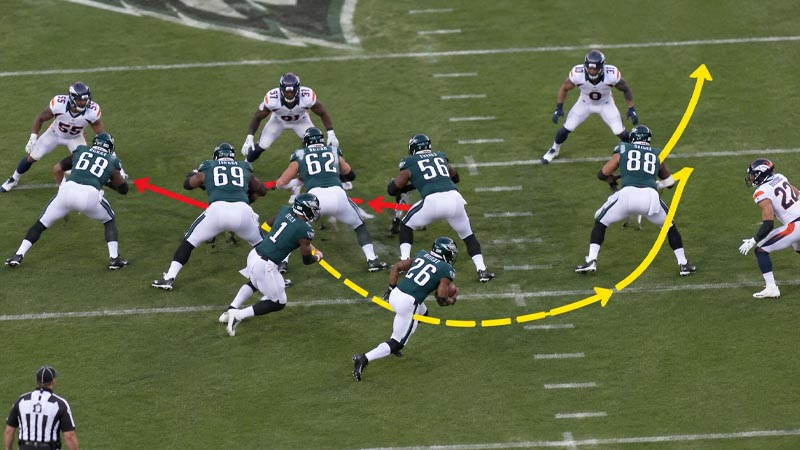
While the running back may take a preliminary step or “fake flow” in one direction, the actual point of attack develops on the opposite side, paved by pulling linemen who have crossed the formation.
This creates a “chess match” on the field. If a defense is “fast-flowing”—meaning they react decisively and quickly to the initial movement—the counter run punishes them by opening cutback lanes and creating superior blocking angles in the space they just vacated.
The Anatomy of the Block: Building the “Wall”
The success of a counter run is not determined by the ball carrier alone, but by the precise execution of a gap-blocking scheme.
Unlike zone blocking, where linemen step toward an assigned area, a gap scheme creates specific angles and lanes around the line of scrimmage.
The Front-Side Down Blocks
The offensive linemen on the side where the play is actually going execute “down blocks.” They block toward the back side of the formation, essentially creating a physical wall that closes interior space.
This wall is designed to pin defensive tackles and interior linebackers inside, preventing them from flowing toward the perimeter.
By blocking down, the offense intentionally leaves certain defenders near the point of attack unblocked, setting them up for the “pullers”.
The Pulling Linemen
The signature of the counter is the movement of the backside blockers—usually a guard and a tackle or tight end—who leave their side of the line and run across the formation to lead the play. These pullers have two distinct roles: the Kick-out and the Wrap.
- The Kick-out Block: The first pulling lineman (often the backside guard) is responsible for the edge defender on the line of scrimmage. If that defender stays wide to contain the play, the guard drives him further outside to widen the hole. If the defender “crashes” inside to stop the run, the guard may “log” him, sealing him inside and allowing the runner to bounce to the outside.
- The Wrap Block: The second puller (often the backside tackle or an H-back) follows the first puller through the hole. Their objective is to “wrap” around the initial blocks and engage the first linebacker who appears in the lane.
The Role of the Counter Step: Timing vs. Deception
One of the most debated aspects of the play is the counter step—the initial false step taken by the running back. While common wisdom suggests this step is designed to “trick” linebackers into moving the wrong way, the technical reality is often more nuanced.
- The Timing Mechanism: For many coaching staffs, the counter step is primarily a timing tool. Pulling two heavy linemen across a formation takes time. If the running back received the ball and headed immediately for the gap, he would often outrun his blockers. The counter step provides the necessary delay, allowing the guard and tackle to reach their targets before the back enters the crease.
- Manipulating the “Pointer System”: Many defensive units teach linebackers to read a “triangle” between the guards and the deepest back, often called a pointer system. Linebackers are coached to step in unison with the running back’s first step. By taking that false step, the back forces the linebacker to commit his weight or his positioning to the wrong gap. Even if the linebacker realizes the mistake, the momentary hesitation creates the “superior blocking angle” the offense needs to seal him off.
Technical Distinctions: Counter vs. Power
In the hierarchy of gap-scheme runs, Power and Counter are closely related, often leading to confusion among observers. Both utilize down blocks and pulling linemen, but their execution differs in backfield action and blocking assignments.
On a Power play, the runner typically attacks the called side directly. A fullback or H-back is usually responsible for kicking out the edge defender, while a single backside guard pulls through the hole to lead on a linebacker.
In contrast, the Counter utilizes misdirection in the backfield and often involves two pullers. A common technical distinction is that in Power, the guard wraps while another player kicks out; in Counter, the guard often handles the kick-out block while a second player (tackle or tight end) wraps through the gap. Essentially, Power and Counter are mirrors of the same concept with the blocking assignments switched.
Modern Evolutions: The GT Counter and Beyond
As offenses have migrated toward the spread and shotgun formations, the counter has adapted to remain a primary weapon.
The GT Counter (Guard-Tackle)
Perhaps the most recognizable modern variation is the GT counter. In this version, both the backside guard and the backside tackle pull.
The guard kicks out the edge, and the tackle leads through. This version is particularly effective because it brings significant mass and power to the point of attack, often overwhelming smaller, modern defensive fronts.
The Counter Bash and RPO Integration
Modern coordinators like Lincoln Riley have further refined the concept by removing the counter step and replacing it with a “read”.
In Counter Bash, the offense might run the counter blocking scheme in one direction while the running back “bashes” (runs a sweep) in the opposite direction.
The quarterback reads a specific defender: if that defender chases the pullers, the QB hands off the sweep. If the defender stays home for the sweep, the QB keeps the ball and follows the counter pullers.
Furthermore, the counter is frequently paired with Run-Pass Options (RPOs). If linebackers stay disciplined to stop the counter run, they may leave a void in the passing lane, allowing the quarterback to pull the ball and throw a quick slant or hitch to a receiver.
Defensive Counter-Strategies: Neutralizing the Misdirection
Defending the counter run requires discipline, physical penetration, and specific techniques designed to disrupt the timing of the pullers.
- Interior Penetration: The biggest enemy of any pulling scheme is penetration. If a defensive tackle can beat a down block and get into the backfield, he can collide with the pulling linemen before they even cross the formation. This “clogs” the lane and forces the runner to stop or change course before the play can develop.
- The “Spill” Technique: Edge defenders are often coached to “spill” the kick-out block. Instead of trying to maintain outside contain, the defender attacks the inside shoulder of the pulling guard. This forces the ball carrier to “bounce” the run further outside, where pursuit from safeties and backside linebackers can track him down.
- Scrape Exchange: This is a coordinated movement between a defensive end and a linebacker. The end crashes inside to “wrong-arm” the puller, while the linebacker “scrapes” over the top to handle the outside gap. This effectively swaps their responsibilities and can confuse the pulling blockers’ reads.
Historical Context: From Wing-T to Today
The counter has deep roots in football history, particularly within the Wing-T and Single Wing offenses. In the traditional Wing-T, the counter was often the primary misdirection play off the “fullback dive.”
As the defense keyed on the fullback moving in one direction, the halfback would take a “rock step” (a version of the counter step) and follow a pulling guard in the opposite direction.
This historical lineage highlights the play’s fundamental effectiveness: whether in 1950 or 2024, the goal remains to “freeze” the defense for a split second.
How to Identify the Counter on Television?
For the analytical viewer, recognizing the counter run requires moving eyes away from the ball carrier and focusing on the interior line.
- Watch the Pullers: Look for one or two offensive linemen (usually the guard and tackle) vacating their positions and running parallel to the line of scrimmage toward the other side of the formation.
- Identify the Down Blocks: Notice if the linemen on the side the pullers are heading toward are blocking “down” (away from the perimeter).
- Track the Backfield Step: Observe the running back. Does he take a quick step in one direction before pivoting and following the pulling linemen?.
If these three elements align, you are witnessing the counter run in action. The leverage of the pullers will ultimately dictate the runner’s path; their success in kicking out the edge and wrapping to the linebacker determines whether the play is a short gain or a breakaway touchdown.
Conclusion
The counter run remains a staple of football at every level because it addresses the fundamental truth of the sport: defenses must react to movement.
By providing false keys and then overwhelming a specific point with pulling blockers, the offense dictates the terms of the engagement.
Whether it is a “Counter Trey” in the NFL or a “GT Counter” in a high school spread system, the concept’s ability to punish aggression and create leverage ensures it will remain a cornerstone of offensive strategy for decades to come.
To truly understand the game is to understand the pull of the guard, the wrap of the tackle, and the patient, decisive cut of the runner following behind them.