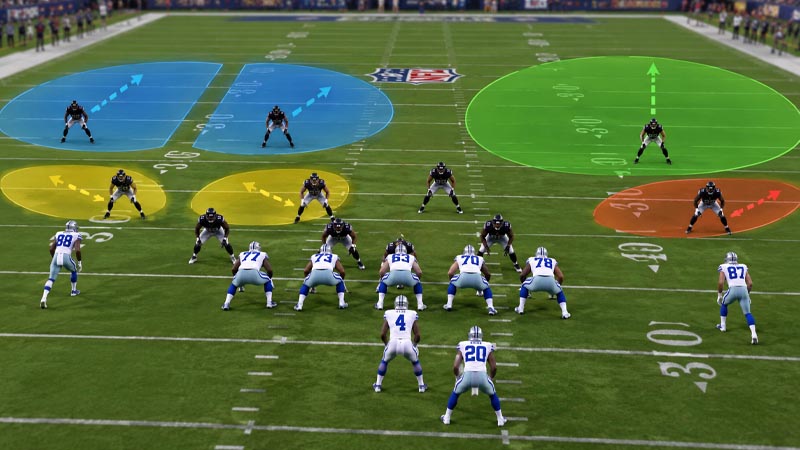
In the chess match of modern football, defensive coordinators are no longer content with static, one-size-fits-all shells. As passing attacks become more sophisticated, defenses have evolved into high-functioning hybrids.
At the center of this evolution is Cover 6, a split-field defensive scheme that has redefined how teams handle various passing strengths.
Often referred to as “Quarter-Quarter-Half,” Cover 6 isn’t just a play call; it is a strategic philosophy that combines the best elements of multiple coverages to create a sophisticated, shape-shifting wall.
Whether you are a seasoned coach looking to tighten your red zone defense or a dedicated fan trying to understand why a quarterback looks hesitant post-snap, understanding Cover 6 is essential. This deep dive will break down the mechanics, the strategic advantages, and the modern NFL context of this hybrid powerhouse.
The Anatomy of Cover 6: Quarter-Quarter-Half
The most intuitive way to understand Cover 6 is through simple defensive mathematics. The name “Cover 6” is derived by adding the deep zones of the two coverages being merged: Cover 4 (Quarters) on one side and Cover 2 (Half) on the other. When you take two deep quarters (2/4) and add one deep half (2/2), you get 6.
1. The Split-Field Logic
Unlike traditional “whole-field” coverages like Cover 3, where every player follows a unified rule set, Cover 6 operates on a split-field principle. This means the defense essentially plays two different coverage styles simultaneously on either side of the center.
This asymmetrical approach allows the defense to tailor its response based on the “field” (wide side) and the “boundary” (short side).
- The Cover 4 Side (Field Side): Generally played toward the strong side or the wide side of the formation. On this side, a cornerback and a safety each take responsibility for a deep quarter of the field. This “box” coverage is designed to handle multiple-receiver sets or “trips” formations where the offense has a numbers advantage.
- The Cover 2 Side (Boundary Side): Usually played toward the short side or the “weak” side of the formation. Here, the cornerback stays low to protect the flat, while the safety covers the entire deep half of that side. This setup provides a “hard” corner who can disrupt quick passes and support the run.
2. Player Responsibilities and Landmarks
Cover 6 typically features three deep defenders and four underneath defenders. This distribution creates a unique geometry that can be difficult for quarterbacks to read pre-snap.
Because the safeties have asymmetrical roles—one playing a deep quarter and the other a deep half—the landmarks they must reach are different, which can bait a quarterback into making a throw based on a false assumption of symmetry.
Strategic Advantages: Why Coaches Love the Hybrid
The popularity of Cover 6 at the collegiate and professional levels isn’t accidental. It solves several problems that traditional coverages leave open.
1. The “Zone Double” on Star Receivers
One of the most effective modern uses of Cover 6 is to create a “zone double” on an offense’s premier threat.
By placing the Cover 2 side toward a specific receiver, the defense ensures a cornerback is underneath, and a safety is over the top, effectively bracketing the player without committing a pure man-to-man double team.
2. Disguise and Confusion
The hallmark of elite defensive play today is the ability to hide intentions until the ball is snapped. Cover 6 is a master of disguise.
Because it presents as a “two-high” shell (two safeties deep) pre-snap, it can look identical to a standard Cover 2 or Cover 4.
It is only after the snap, when one safety rolls to a half and the other stays in a quarter, that the quarterback realizes the field is split. This split-second hesitation is often the difference between a completion and a sack or interception.
3. Superior Run Support
In many defensive schemes, you sacrifice run defense for pass coverage. Cover 6 attempts to bridge that gap.
- Safety Run Fits: On the Cover 4 side, the safety has a primary run fit, meaning he can be aggressive in coming downhill to stop the ball carrier.
- The Force Player: On the Cover 2 side, the cornerback sits in the flats, making him the “force player” for outside runs or tosses. This allows the defense to maintain an “8-man box” feel while still keeping three defenders in deep zones.
Cover 6 vs. Cover 3: Choosing the Right Tool
While both Cover 6 and Cover 3 utilize three deep defenders, they are fundamentally different in their geometry and leverage.
- Middle of the Field Open (MOFO) vs. Closed (MOFC): Cover 6 is a MOFO coverage, meaning there is no single defender standing in the “high hole” or deep middle. Cover 3 is a MOFC coverage, with a free safety patrolling the deep center.
- Hash Spacing: Strategic insight suggests that Cover 6 is often the superior choice when the ball is placed on a hash mark. Because 80-85% of football is played on a hash, the asymmetrical nature of Cover 6 fits the field’s natural dimensions better than the even 1/3 splits of Cover 3.
- Weaknesses to Attack: Cover 3 is notoriously vulnerable in the seams and the flats. Cover 6 is designed to “bait” these exact throws, using the non-bailing corner on the Cover 2 side to jump a flat route that would be open against Cover 3.
The “Sister” Scheme: Understanding Cover 8
In the world of defensive terminology, especially within the influential Vic Fangio coaching tree, Cover 6 has a sister coverage known as Cover 8. While the numbering can vary between coaching systems (like Nick Saban’s vs. Vic Fangio’s), the concept remains consistent.
- Cover 8 is essentially Cover 6 flipped. In Cover 8, the “Half” side (Cover 2) is played toward the passing strength or the field side, while the “Quarters” side (Cover 4) is played toward the boundary.
- This variation allows defenses to be even more targeted, choosing whether to put the “hard” corner on the side with more receivers (Cover 8) or the side with the isolated threat (Cover 6).
Vulnerabilities: How Offenses Attack the Hybrid
No coverage is perfect. The complexity that makes Cover 6 a strength also creates specific “cracks” that savvy offensive coordinators look to exploit.
1. The Deep Middle Stress
Because Cover 6 is a Middle of the Field Open (MOFO) defense, it can be susceptible to “bomb” shots right down the center.
If the two safeties do not communicate their depth correctly, a fast receiver on a post route can find the gap between the quarter safety and the half safety.
2. Underneath Gaps
The effectiveness of Cover 6 relies heavily on the “underneath” defenders reaching their landmarks quickly. If the linebackers or nickels are slow to get outside, the flat areas can become vulnerable—especially on the Quarters side where the corner is bailing deep.
3. Complexity of Installation
At the high school level and below, Cover 6 can be difficult to implement. Unlike the “simple rules” of Cover 3, Cover 6 requires every defender to understand the formation’s strength and their specific split-field rules.
Miscommunication in a split-field shell often leads to “blown” coverages where a receiver is left entirely uncovered.
Personnel: Who Thrives in Cover 6?
To run Cover 6 at a high level, you need specific types of athletes. This isn’t just about speed; it’s about football IQ and physical toughness.
- The “Mini-Linebacker” Corner: The cornerback on the Cover 2 side needs to be a physical player who isn’t afraid of run support. Think of players like Richard Sherman or Ty Law—corners who excel at re-routing receivers with their hands and “forcing” the run back inside.
- The Versatile Safeties: Both safeties must be comfortable with varying roles. One must have the range to cover a deep half, while the other must have the “downhill” mentality to fit the run from a deep quarter position.
The Modern Verdict: The Two-High Revolution
Since roughly 2020, the NFL has undergone what experts call the “Two-High Revolution,” led in large part by the defensive philosophy of Vic Fangio.
This movement prioritized limiting explosive plays by keeping two safeties deep and using split-field coverages like Cover 6 to stay flexible.
In an era where quarterbacks like Patrick Mahomes and Josh Allen can score from anywhere on the field, Cover 6 provides the “safety net” coaches crave without completely surrendering the short game or the run. It is the ultimate compromise—a defense that is as multiple and complex as the offenses it seeks to stop.
For teams that can master the communication and personnel requirements, Cover 6 remains the gold standard for high-level, adaptive football. It is proof that in the game of football, the smartest team on the field often has the best chance to win.