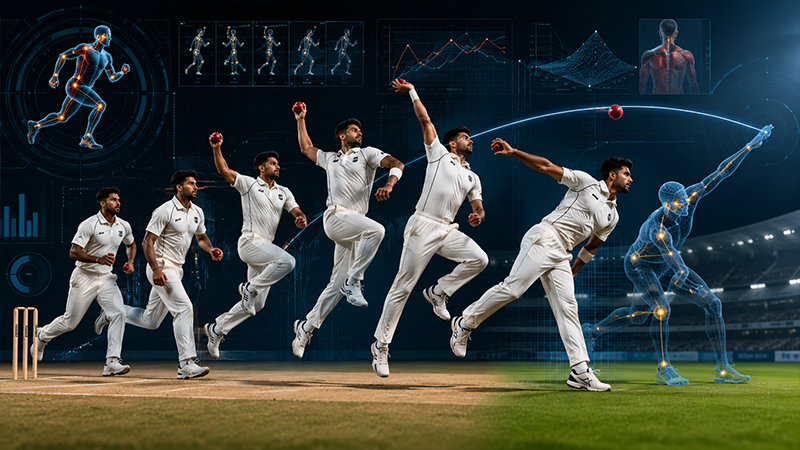
In the modern landscape of professional cricket, technical precision is the primary differentiator between consistent performance and athletic stagnation.
The bowling action is a complex sequence of kinetic movements that requires perfect synchronization to achieve optimal velocity, accuracy, and longevity.
For players and coaches aiming to reach the highest standards of the sport, understanding the mechanics of this action is not merely a preference but a fundamental requirement for competitive success.
Developing a repeatable and efficient bowling action involves a rigorous commitment to diagnostic analysis and incremental refinement.
This framework outlines the essential principles of bowling mechanics, drawing on established protocols to correct technical flaws and maximize output through bio-efficient movements.
Step 1: Diagnostic Analysis and Technical Auditing
The first step in any technical intervention is a comprehensive audit of the current movement patterns. Without objective data, attempts to modify a bowling action are often based on subjective feeling rather than mechanical reality.
The most effective method for technical assessment is the use of high-frame-rate video analysis.
To gain a complete understanding of the mechanics, a bowler must be recorded from multiple angles—typically from the side and from directly behind the arm—capturing the run-up, the delivery stride, the release point, and the follow-through.
Slow-motion playback allows for the identification of subtle inefficiencies that are invisible to the naked eye, such as a dropping shoulder or a “lazy” front arm.
By analyzing these recordings, coaches can pinpoint exactly where the kinetic chain is breaking down. For example, if a bowler is losing velocity, the video might reveal a lack of hip-shoulder separation or an incomplete rotation of the torso.
This data-driven approach ensures that adjustments are targeted and effective, reducing the risk of introducing new errors during the remodeling process.
Step 2: Fundamental Alignment and Body Positioning
Alignment is the foundation of accuracy and power in fast bowling. When the body’s segments are misaligned, the force generated during the run-up and delivery stride is dissipated, leading to inconsistent release points and increased stress on the joints.
Effective correction of a bowling action requires a primary focus on ensuring the body moves in a straight line toward the target.
This begins with the alignment of the hips and shoulders; if these key markers are not directed toward the target at the point of release, the bowler will struggle to maintain a consistent line.
A common technical error is tilting the head or body excessively toward the off-side, a movement that often causes the ball to be released too far to the left for a right-arm bowler.
Such inconsistencies make it difficult to maintain pressure on the batter and often lead to an increased number of wides or stray deliveries.
Maintaining a vertical orientation throughout the delivery stride is essential for balance. If the head falls away from the line of the delivery, the rest of the body will naturally follow, leading to a loss of control and a reduction in the effective height of the release point.
Alignment must be maintained from the start of the run-up through to the completion of the follow-through to ensure maximum efficiency.
Step 3: The Front Arm as a Kinetic Catalyst
One of the most overlooked components of the bowling action is the non-bowling arm, often referred to as the “front arm.” In elite mechanics, the front arm acts as a lever that initiates the rotational speed of the upper body.
A frequent technical flaw among developing bowlers is a “lazy” front arm that drops prematurely or fails to reach its full height.
To maximize rotational velocity, the front arm must be driven up firmly toward the target and then pulled down aggressively toward the hip.
This “pulling” motion creates a counter-balance that helps whip the bowling arm through the arc of the delivery, significantly increasing the speed of the ball at release.
Strengthening the front arm is not just about muscular endurance; it is about technical discipline. By keeping the front arm firm and active, the bowler prevents the torso from “falling away,” which is a common cause of injury and technical breakdown.
An active front arm ensures that the shoulders remain square to the target for as long as possible, allowing for a more efficient transfer of energy through the back and into the bowling arm.
Step 4: Release Mechanics, Wrist Position, and Grip
The point of release is the final opportunity for the bowler to influence the trajectory and movement of the ball.
At this stage, the stability of the wrist and the position of the fingers are the determining factors in whether the ball will swing, seam, or remain inert.
To achieve maximum control and upright seam position, the bowler must maintain a firm wrist throughout the delivery.
The fingers should remain directly behind the ball, ensuring that the seam is perfectly vertical as it leaves the hand.
This positioning is critical for bowlers who rely on late movement in the air or off the pitch. If the wrist is weak or the fingers are placed to the side of the ball, the seam will wobble, making the ball’s behavior unpredictable even for the bowler.
Consistent grip and wrist stability are built through repetitive practice and muscle memory. By focusing on the “feel” of the seam at the point of release, bowlers can develop the fine motor skills required to manipulate the ball under pressure.
Step 5: The Follow-Through and Completion
A bowling action does not end when the ball leaves the hand. The follow-through is a vital component of both performance and injury prevention, serving as the decelerating phase of the movement.
Many bowlers make the mistake of stopping abruptly after release or “falling away” to the side of the pitch. An effective follow-through requires the bowler to complete the full rotation of the shoulders and continue moving straight down the wicket in the direction of the target.
This ensures that all the momentum generated during the run-up is channeled forward rather than being diverted laterally.
A complete and straight follow-through also protects the bowler’s lower back and knees by allowing the body to slow down naturally over several strides.
When a bowler cuts their follow-through short, the impact forces of the delivery stride are absorbed entirely by the joints, significantly increasing the risk of stress fractures and soft tissue injuries.
Step 6: Strategic Drills for Technical Refinement
Translating mechanical theory into repeatable habits requires the use of specific drills designed to isolate and reinforce correct movement patterns.
These exercises remove the distractions of a full match environment, allowing the athlete to focus on specific technical goals.
The Tunnel Drill
This drill is specifically designed to address alignment issues. By setting up two rows of cones or nets to create a narrow “tunnel,” the bowler is forced to keep their run-up and delivery stride within a restricted corridor.
This trains the body to stay aligned with the target and prevents lateral deviations that lead to inconsistent bowling.
The No-Run-Up Action
To isolate the mechanics of the upper body, bowlers should perform the delivery stride from a stationary position without a run-up.
This exercise allows the athlete to focus exclusively on the synchronization of the front arm pull, the rotation of the hips and shoulders, and the verticality of the bowling arm. It is an essential tool for building muscle memory in the final phases of the action.
Open-Side Net Practice
Traditional net practice can sometimes mask technical flaws, as bowlers may subconsciously rely on the side nets for physical guidance.
Practicing in an open area or a net without a side screen encourages the bowler to drive straight through the crease using their own balance and alignment rather than external boundaries. This promotes a more robust and independent technique.
Step 7: Biomechanical Compliance and Professional Oversight
While technical refinement is often an internal process between a player and a coach, there are certain mechanical boundaries defined by the governing bodies of the sport.
The International Cricket Council (ICC) maintains strict regulations regarding the legality of a bowling action to ensure fair play.
An illegal action, commonly known as “throwing,” is defined by an elbow extension of more than 15 degrees during the delivery phase.
If a bowler suspects their action may be nearing this limit, or if they have been officially cited, it is imperative to seek the assistance of a qualified professional coach.
Remodeling an action to ensure compliance with the 15-degree rule is a complex process that requires expert biomechanical feedback and consistent monitoring.
Professional intervention ensures that the new action is not only legal but also efficient and safe for long-term use.
Technical FAQ: Optimizing Bowling Mechanics
How can I identify if my bowling shoulder is dropping during delivery?
The most reliable method is to use slow-motion video analysis from a side-on perspective. If your bowling shoulder is significantly lower than your front shoulder at the point of release, or if your head is tilting away from the target, it is an indication that your shoulder is dropping, which often leads to a loss of height and bounce.
What is the primary cause of “falling away” in the follow-through?
Falling away is usually caused by a lack of alignment in the delivery stride or a “lazy” front arm. If the front arm drops to the side rather than being pulled down toward the hip, it pulls the torso off-balance, forcing the bowler to step to the side to regain stability.
Why is it important to keep the fingers behind the ball?
Keeping the fingers directly behind the ball ensures that the force is applied through the center of the ball, which keeps the seam upright.
An upright seam is essential for achieving consistent movement and control, as it allows the ball to interact with the air and the pitch in a predictable manner.
What should I do if I feel my bowling action is becoming inconsistent?
The first step is to return to basics by analyzing your action via video to identify any new flaws.
Focus on your alignment and the consistency of your run-up to rebuild muscle memory. Utilizing drills like the “No-Run-Up Action” can help reset your mechanics without the added complexity of a full run-up.
Implementation Strategy for Technical Excellence
Achieving a world-class bowling action is a continuous process of refinement. It requires a disciplined approach to training, where every delivery is an opportunity to reinforce correct mechanics.
By prioritizing alignment, strengthening the front arm, and ensuring a complete follow-through, bowlers can unlock new levels of performance while minimizing the risk of injury.
The transition from a talented amateur to an elite professional is defined by the ability to execute these fundamental principles with unwavering consistency under the highest levels of pressure.
The data is clear: technical efficiency leads to measurable results. Whether you are correcting a minor flaw or remodeling an entire action, the path to success begins with a commitment to the mechanics of the game.