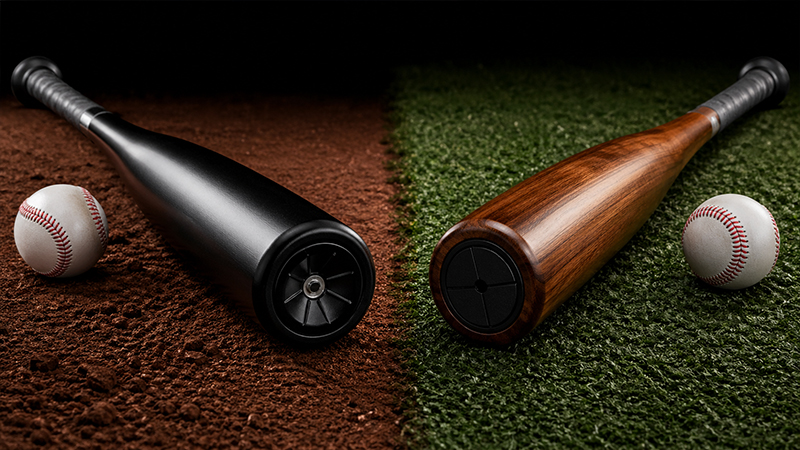
In the high-stakes world of elite baseball and softball development, the margin between a warning-track flyout and a game-winning home run is measured in milliseconds and millimeters.
For the modern athlete, player development is no longer about “getting swings in”; it is about purposeful training intervention. Two brands have emerged as the dominant forces in the weighted-training market: Victus and Camwood.
While both brands aim to optimize the kinetic chain of a hitter, they approach the problem from different physiological angles.
One focuses on the neurological feedback of the swing path, while the other prioritizes the biometric development of strength and hand speed.
This comprehensive analysis serves as the definitive guide for coaches, professional organizations, and elite athletes looking to maximize their “Return on Training” (ROT).
The Core Philosophy: Mechanical Correction vs. Power Generation
The fundamental difference between Victus and Camwood lies in their primary design objective.
Victus: The Precision Feedback Loop
The Victus training philosophy is rooted in the belief that the shortest path to the ball is the most efficient. Their trainers are engineered to provide instant mechanical feedback.
If a hitter’s swing is inefficient, the bat tells them immediately through weight distribution shifts. It is a tool designed to refine the “mental map” of the swing path, ensuring that the hitter remains “short to and long through” the hitting zone.
Camwood: The Biomechanical Engine
Camwood, widely regarded as the industry standard for knob-weighted training, operates on a philosophy of overload training.
Their focus is on developing the specific muscle groups—the forearms and wrists—that translate directly into bat speed and barrel control.
By placing the weight near the hands, Camwood allows the athlete to maintain a natural swing plane while simultaneously building the “engine” that powers the swing.
Deep Dive: The Victus Two-Hand Trainer
Interestingly, the market has seen a convergence of these two titans. Victus now offers a “Two-Hand Trainer,” which is a licensed design or collaboration closely mirroring the Camwood architecture. However, Victus infuses this design with unique feedback characteristics.
Dynamic Weight Feedback
One of the most innovative features of the Victus trainer is its dynamic feel. The bat is engineered to feel like a standard -3 drop bat—the standard for high school and collegiate play—provided the swing path is mechanically sound.
However, if a hitter “casts” their hands (a common flaw where the barrel sweeps out too early), the bat’s physics shift, making it feel significantly heavier, up to a +5 “heavy” bat. This immediate consequence forces the athlete to keep their hands “inside” the ball to maintain control.
Versatility in the Lab
Unlike traditional heavy bats that are restricted to tee work, the Victus Two-Hand Trainer is designed for a full spectrum of high-intensity drills.
- Tee Work: For isolated path correction.
- Soft Toss: For timing and hand-eye coordination.
- Live Batting Practice: For real-time mechanical reinforcement against high-velocity pitching.
Deep Dive: The Camwood Training System
Camwood has built a legacy on its knob-weighted design, a departure from the traditional “donut” weights that can often ruin a hitter’s swing plane by making the bat end-heavy.
Strategic Weight Distribution
By locating the weight right above the hands, Camwood ensures the bat remains balanced. This prevents the “barrel drop” that often plagues youth hitters using heavy bats.
Because the weight is concentrated near the fulcrum (the hands), the body’s large muscle groups are forced to handle the load. This creates a synergistic effect where the athlete gets stronger without sacrificing the integrity of their swing path.
The Science of Hand Speed
The primary goal of the Camwood system is the development of forearm and wrist strength. In the “Statcast era,” exit velocity is king.
Camwood’s training philosophy suggests that by overloading the hands, the athlete’s “unloaded” swing with a game bat becomes significantly faster, leading to higher exit velocities and greater distance.
Feature Comparison Matrix
| Feature | Victus Two-Hand Trainer | Camwood Training Bat |
|---|---|---|
| Primary Objective | Correcting swing path & mechanics | Building strength & hand speed |
| Feeling/Feedback | Dynamic (varies by swing path) | Consistently weighted near hands |
| Mechanical Focus | Eliminating “casting” / loopy swings | Overload training for large muscles |
| Drill Capability | Tees, Soft Toss, Live BP | Tees, Soft Toss, Live BP |
| Price Point | Often ~$20 more affordable | Premium industry-standard pricing |
Economic Analysis and Value Proposition
For organizations managing a large roster or parents looking for the best “bang for their buck,” the Victus version presents a compelling economic case.
Market insights, including user reports from platforms like Reddit, indicate that the Victus Two-Hand Trainer is frequently priced approximately $20 lower than the original Camwood brand.
While Camwood remains the “classic choice” with a long-standing reputation as the industry standard, the Victus model offers a high-performance alternative that may allow teams to purchase more units for their budget.
Strategic Selection: Which Tool for Which Player?
Choosing between these two systems requires an audit of the player’s current developmental stage.
The Case for Victus
The Victus Two-Hand Trainer is the superior choice for players struggling with mechanical efficiency. If a coach observes a “loopy” swing or a player who consistently gets beat by inside fastballs due to casting their hands, the Victus provides the tactile feedback necessary to “self-correct”. It is a teacher as much as it is a weight.
The Case for Camwood
The original Camwood is the preferred tool for the athlete who has already mastered their mechanics but has reached a plateau in their power output.
If the swing path is “clean” but the exit velocity is lacking, Camwood’s focus on hand speed and strength building through large muscle group integration is the logical next step.
Demographic Considerations
It is also vital to consider the player’s age and league. Both brands offer different weight profiles tailored for youth versus adult use. A youth player using a bat that is too heavy, even if knob-weighted, can lead to compensations that damage their natural swing.
Enhanced FAQ: Expert Insights
Q: Can I use these bats with real baseballs?
A: Yes. Both the Victus and Camwood trainers are built to withstand the rigors of live batting practice, soft toss, and tee work using standard baseballs or softballs.
Q: How does the Victus “dynamic weight” actually feel?
A: When you keep your hands tight to your body (the “inside path”), the bat feels balanced and manageable, similar to a -3 BBCOR bat. If your hands move away from your body too early, the centrifugal force makes the bat feel significantly heavier (+5), effectively “punishing” the poor mechanic.
Q: Is Camwood better for building “bat speed”?
A: Camwood is specifically designed for this purpose by targeting the wrists and forearms through balanced overload training. By making the hands stronger, the “game-day” swing feels lighter and faster.
Q: Which one is better for a youth player just starting?
A: Generally, the Victus may be better for younger players who are still developing their swing path, as it helps prevent the development of bad habits like casting. However, ensure you select the appropriate youth-weighted model.
Conclusion: The Path to Elite Performance
In the pursuit of excellence, there is no “one size fits all” solution. The decision between Victus and Camwood should be data-driven, based on an honest assessment of the hitter’s needs.
- Prioritize Victus if the goal is to fix a “casting” motion or a loopy swing through immediate path feedback.
- Prioritize Camwood if the goal is to increase power and hand speed through a proven strength-training philosophy.
Regardless of the choice, integrating a knob-weighted trainer into a daily routine is one of the most effective ways to bridge the gap between “good” and “elite” at the plate.