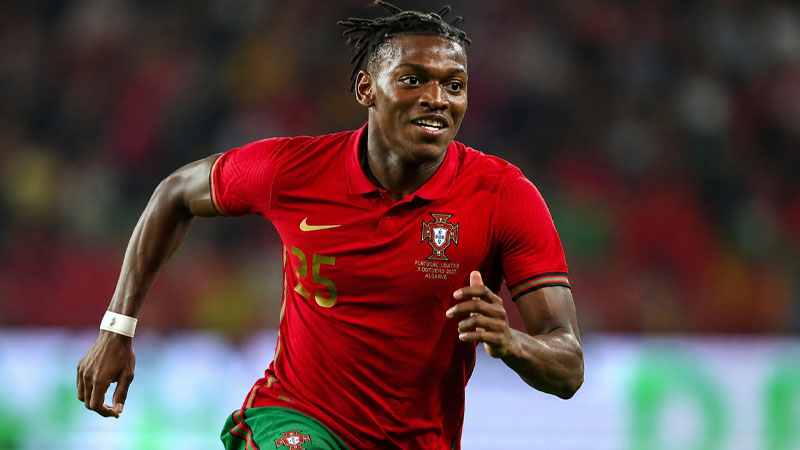
In the high-stakes arena of elite European football, where every movement is scrutinized and the pressure to perform is immense, AC Milan’s Rafael Leão stands out as a unique anomaly.
While most players maintain a mask of intense concentration or physical strain, Leão is frequently seen gliding past defenders with a wide, unmistakable grin. This characteristic has become his professional trademark, captivating fans and puzzling analysts alike.
Far from a sign of distraction, this smile represents a deeply rooted personal and spiritual philosophy that redefines the relationship between professional excellence and pure, unadulterated joy.
The Core Meaning Behind Rafael Leão’s Signature Smile
To understand why Rafael Leão smiles, one must first recognize that he does not view football through the traditional lens of a grueling profession.
Instead, he has cultivated a mental framework that preserves the innocence of the game, even at the highest levels of competition. This mindset is not a byproduct of his success but rather the engine that drives it.
By maintaining a connection to the early days of his career, he manages to bypass the paralyzing effects of match-day anxiety that often plague his peers.
Pure Enjoyment: Transitioning from Hobby to Career
Leão has explicitly stated that football was his primary hobby long before it became his professional calling. This distinction is critical to his performance psychology.
By viewing the pitch as a space for play rather than a workplace, he retains a level of creative freedom that allows for high-risk, high-reward maneuvers.
He views the stadium not as a pressure cooker, but as a place to have fun, even during the most intense match situations. This perspective allows him to maintain technical composure when other players might succumb to the tension of a critical moment.
The “Natural Tic”: An Involuntary Expression of Flow
Interestingly, Leão has described his smile as an unconscious physical mechanism, comparing it to a “tic”.
Just as other athletes might display specific hand gestures or facial contortions when they are “in the zone,” showing his teeth is his body’s involuntary response to the act of doing what he loves.
Some observers have compared this to Michael Jordan’s habit of sticking out his tongue during play—a physical manifestation of deep focus and the “flow state”. It is a sign that the athlete is fully present and operating at the peak of his intuitive powers.
A Deep Sense of Radical Gratitude
The smile is also a reflection of Leão’s profound appreciation for his position in life. He often grounds his professional experience in a global context, noting that many people around the world lack basic necessities like clean water.
By contrast, having a loving family, food, and the opportunity to play a sport for a living is, in his view, a massive blessing that demands a positive response.
This radical gratitude prevents him from becoming jaded by the industry’s demands and keeps his focus on the privilege of his career.
The Spiritual and Philosophical Roots of the Grin
Beyond the psychological benefits of a positive demeanor, Leão’s smile is anchored in a spiritual foundation. He does not claim sole credit for his talents or his upbeat attitude, instead pointing toward a higher power as the origin of his joy.
This spiritual grounding provides him with a sense of security that transcends the fluctuations of match results or transfer rumors.
It allows him to play with a sense of purpose that is larger than the game itself, making his performance on the pitch a form of worship and celebration.
“I Think It’s God”: The Role of Faith
In several interviews, when pressed about the origin of his infectious happiness, Leão has simply stated, “I think it’s God”. He believes that his creator understands his deep love for the game and has provided him with the platform to express that love.
This belief system removes the weight of personal ego from his performance. If his talent is a gift, then his smile is the appropriate way to acknowledge the giver.
Interestingly, when he shared this sentiment, some teammates like Zlatan Ibrahimović—known for his own “god-like” persona in football—undoubtedly took notice of the young winger’s humble spiritual conviction.
Perspective on Global Struggles and Blessings
Leão’s philosophy is further reinforced by his awareness of the world outside the stadium walls. He has questioned how he could possibly not smile when he has been given everything, especially in a world where so many struggle.
This perspective acts as a shield against the negativity often found in sports media or from aggressive opposition fans.
By maintaining a constant awareness of his blessings, he ensures that the “draining” aspects of the sport do not extinguish his inner light. His smile is a conscious choice to prioritize positivity in a complex world.
Impact on Performance and the “Terrifying” Confidence
| Aspect of Influence | Impact on Performance and Brand |
|---|---|
| Psychological Edge | His smile can be “terrifying” to opponents because it signals a lack of fear and total confidence in his abilities. |
| Fan Engagement | He has won the hearts of supporters through humble acts, such as wearing a handmade armband from a child during club games. |
| Team Morale | He is known for spreading positivity to his teammates, acting as a social anchor during difficult matches. |
| Record-Breaking Focus | This relaxed state contributed to him scoring the fastest goal in the history of Europe’s top five leagues—just 6 seconds after kickoff. |
The visual of Leão smiling while dribbling past players has become iconic, with some fans comparing the image to Usain Bolt looking back at his competitors during a record-breaking sprint.
This level of calm in high-velocity situations is a hallmark of elite performers who have mastered their emotional state.
The “Smile” Brand: From the Pitch to the Page
Rafael Leão has successfully translated his personal philosophy into a broader brand identity that resonates with fans globally. This is not merely a marketing tactic but a genuine attempt to inspire others.
By codifying his approach to life and sports, he has created a roadmap for younger athletes who may struggle with the pressures of the modern game. His brand is built on the idea that success and happiness are not mutually exclusive, but rather mutually reinforcing.
The Autobiography: A Deeper Look into Positivity
To provide a more comprehensive understanding of his worldview, Leão published an autobiography titled Smile. The book serves as a manifesto for his positive philosophy, offering fans a deeper look into his life both on and off the pitch.
Through this medium, he aims to inspire and make others happy, demonstrating that his smile is not a mask of simplicity but the result of a deliberate, thoughtful approach to living.
It covers his journey from Portugal to the heights of Serie A, emphasizing that joy was the constant through every challenge.
Cultural Iconography and Comparisons
Leão’s approach has drawn frequent comparisons to footballing legends like Ronaldinho Gaúcho, who was similarly famous for his permanent grin and “Joga Bonito” (play beautifully) style.
Like Ronaldinho, Leão represents a brand of football that prioritizes flair and entertainment. This connection to the greats of the past helps establish his authority as a modern-day icon of the “joyous” style of play.
Fans on social media platforms often celebrate this, noting that he looks like he is having a blast every time he steps onto the field.
Challenges and the Reality Behind the Teeth
Despite the outward appearance of constant happiness, Leão’s career has not been without its dark periods. The theology of the smile is not about the absence of pain, but the persistence of joy in spite of it.
Understanding the moments when the smile wavered provides a more complete and trustworthy picture of his character.
It shows that his positivity is a resilient trait, not a superficial one, and that he is capable of navigating the “grimace-inducing” aspects of professional sports with maturity.
Playing Through Pain: The Pubalgia Struggle
There have been times when the physical demands of the sport took a significant toll. Leão has revealed that he played for several months while suffering from pubalgia, a painful and lingering injury.
During this period, he was also forced into tactical positions that did not suit his strengths, which he described as “draining”.
The fact that he continued to contribute to the team while navigating these obstacles demonstrates a level of grit that his smiling exterior might otherwise hide. His resilience during these “difficult times” is what makes his eventual return to joy so compelling.
Addressing Criticism and the “Disconnected” Narrative
As with any high-profile athlete, Leão has faced his share of criticism. At times, analysts and fans have misinterpreted his relaxed demeanor as a lack of focus or being “disconnected” from his club.
During periods of poor team form, some have suggested he is looking for a “safe haven” elsewhere. However, Leão has consistently reaffirmed his commitment to his growth, noting that AC Milan helped him through his most difficult moments.
By deactivating his social media at times, he has shown a willingness to protect his mental peace from external negativity to maintain his internal joy.
Frequently Asked Questions About Rafael Leão’s Smile
Does Rafael Leão smile even when he loses or gets fouled?
Yes, Leão is frequently observed smiling even after being fouled or during moments of high tension. For him, the smile is a reaction to the game itself, not just the positive outcomes within it. It represents his ongoing enjoyment of the “dream” he is living.
Is his smile a sign that he doesn’t take the game seriously?
On the contrary, his performance statistics—including his record-breaking 6-second goal—suggest that his relaxed state actually enhances his focus.
His smile is a sign of “flow,” not a lack of seriousness. It allows him to perform with a level of confidence that can be intimidating to opponents.
What is the significance of the “Smile” book?
The autobiography is intended to inspire others and spread the positivity that has defined Leão’s career. It serves as a formal explanation of his “Theology of the Smile,” ensuring that his message of gratitude and joy reaches a wider audience beyond just football fans.
Has he ever talked about leaving AC Milan?
Leão has expressed deep gratitude for AC Milan, stating that the club helped him grow and supported him during difficult times.
While he has mentioned the possibility of seeking new challenges in other leagues like the Premier League, his focus remains on giving his best to his current team while he is there.
The Legacy of the Joyful Winger
Rafael Leão’s “Theology of the Smile” is a refreshing departure from the hyper-serious, often joyless nature of modern professional sports.
By grounding his performance in gratitude, faith, and the simple pleasure of a childhood hobby, he has created a sustainable model for elite success.
His smile is more than just a physical trait; it is a profound statement about the importance of perspective and the power of a positive spirit.
As he continues to dominate the wings of San Siro and beyond, he leaves behind a legacy that reminds us all that at its heart, football is—and should always be—a game of joy.
Whether he is breaking records or simply warming up, the smile remains, a constant reminder of the blessings of a life lived in pursuit of one’s dreams.