A single Formula 1 tire is worth roughly $2,000 to $2,700, which means one set of four costs about the same as a used family car. And a top team can burn through thousands of them in one season.
Yet here’s the twist most fans never hear: F1 teams don’t actually walk into a shop and buy tires one by one. The real cost is buried in supply contracts, logistics, engineering staff and strict rules that decide how many sets each driver gets.
In this guide, we break down exactly what F1 tires cost, why they are so expensive, how many a team uses, who really pays the bill, and whether you can ever own one yourself.
Key takeaways
- Per tire: roughly $2,000 to $2,700
- Per set of four: roughly $8,000 to $11,000
- Per team, per season: an annual supply fee widely reported in the $1.5 million to $2 million range
- Per race weekend (whole grid): around 1,800 tires delivered, worth several million dollars
- Lifespan: often less than 120 miles of racing for the softest compounds
- Ownership: race tires are tracked and returned to the manufacturer, so genuine used ones are rare collector items
How Much Does an F1 Tire Cost? The Quick Answer
An F1 tire costs an estimated $2,000 to $2,700 each, and a full set of four runs about $8,000 to $11,000. Those figures reflect the commonly cited value of the product itself, not what teams pay at a counter.
In practice, Pirelli, the sole tire supplier to Formula 1 since 2011, provides tires to every team under a single supply agreement. Each team pays an annual fee, widely reported at around $1.5 million to $2 million, and receives its full allocation for every race weekend and official test.
So when someone asks “how much is an F1 tire?”, the honest answer has two parts: what one tire is worth, and what it costs a team to run a full season of them.
F1 Tire Cost Breakdown: From One Tire to the Whole Grid
At an estimated $2,000 to $2,700 per tire, one team’s full season allocation is worth roughly $7.7 million to $10.4 million, far more than the fee it actually pays. The table below scales the cost up step by step.
| Unit | Tires | Estimated value (USD) |
|---|---|---|
| One tire | 1 | $2,000 – $2,700 |
| One set | 4 | $8,000 – $11,000 |
| One driver, full weekend allocation (20 sets) | 80 | $160,000 – $216,000 |
| One team, full weekend (2 drivers) | 160 | $320,000 – $432,000 |
| Whole grid, one race weekend | about 1,800 | $3.6 million – $4.9 million |
| One team, 24-race season (allocation only) | about 3,840 | $7.7 million – $10.4 million |
The gap between the value of the tires and the annual fee teams pay is the key point. The supplier treats Formula 1 partly as a technology lab and a global marketing platform, so it does not price tires to recover every dollar from the teams.
Why Are F1 Tires So Expensive?
F1 tires are expensive because each one is a short-lived, hand-finished piece of engineering built to survive forces no road tire ever faces. Five factors drive the price.
1. Years of research and development
Every new tire generation takes years of computer simulation, lab testing and on-track running before it races.
The move to 18-inch wheels in 2022 and the narrower tires introduced for the 2026 rules each required a fresh design program. That engineering bill is spread across a relatively small number of tires.
2. Specialized materials
An F1 tire blends natural and synthetic rubbers, carbon black, oils, resins and a reinforcing structure of materials such as aramid and nylon.
Each compound recipe is tuned to grip within a narrow temperature window. Small batches of complex chemistry cost far more per unit than mass-produced road tires.
3. Low-volume, high-precision manufacturing
Road tire plants turn out millions of units a year. F1 tires are produced in tens of thousands, with tight tolerances on weight, shape and construction.
Many steps involve skilled technicians and strict quality checks, and any tire that falls outside specification is scrapped.
4. Extreme performance demands
At full speed, an F1 car can generate downforce well above its own weight, and drivers face cornering loads of 5g or more.
The tires must handle that load, braking from over 200 mph, and track surfaces above 50°C, all while giving consistent grip lap after lap.
5. Global logistics and trackside service
The supplier ships roughly 1,800 tires to each race weekend across five continents. A trackside crew of fitters, engineers and logistics staff mounts, tracks and checks every tire. Freight, staffing and travel for a 24-race calendar add a large hidden cost to every set.
F1 Tire Compounds Explained
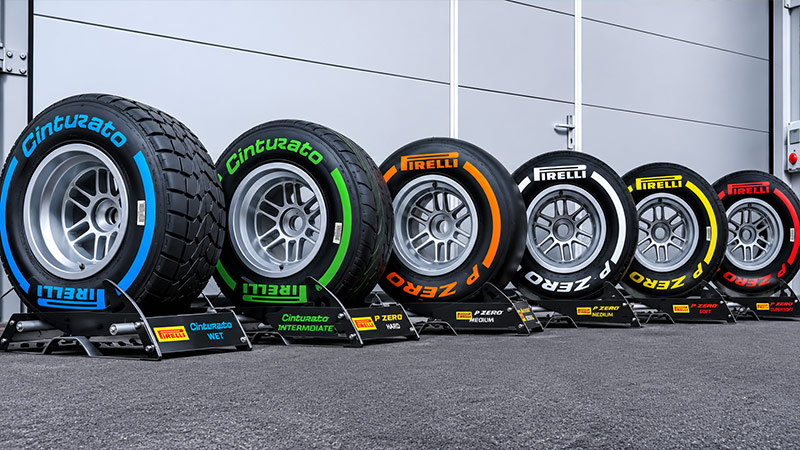
All F1 tire types carry a similar estimated price, but they differ sharply in grip, lifespan and when teams use them. Pirelli builds a range of slick compounds numbered from C1, the hardest, up to the softest (six in the 2025 season), and picks three for each Grand Prix based on the track.
| Tire | Sidewall color | Best for | Typical behavior |
|---|---|---|---|
| Soft | Red | Qualifying, short stints | Most grip, fastest wear |
| Medium | Yellow | Balanced race stints | Mix of pace and durability |
| Hard | White | Long stints, hot or abrasive tracks | Least grip, longest life |
| Intermediate | Green | Damp or drying track | Grooved to clear light water |
| Full wet | Blue | Heavy rain | Deep grooves to clear standing water |
The colored sidewall makes strategy easy for fans to follow on TV. In a dry race, each driver must normally use at least two different slick compounds, which is why pit stop timing and tire choice decide so many results.
From a cost angle, the softest tire is the “priciest” to run. It may last only 15 to 20 laps at some circuits, so its cost per mile is often two to three times higher than the hard compound.
How Many Tires Does an F1 Team Use?
Each driver receives up to 20 sets, or 80 tires, at a standard race weekend, so a two-car team has up to 160 tires on hand. The sporting regulations set the allocation, which typically looks like this:
- 13 sets of dry slicks, split across the three nominated compounds (sprint weekends usually get 12)
- 4 sets of intermediates for damp conditions
- 3 sets of full wets for heavy rain
Not every tire turns a wheel in anger. Drivers must hand back some sets after practice sessions, and wet tires often go unused on dry weekends. Still, across a 24-race calendar, a single team has access to roughly 3,840 tires, plus extra sets for official testing.
Across the full grid of 11 teams in 2026, total production for a season runs into the tens of thousands. Every one is barcoded and tracked by the FIA, so a team cannot swap, share or hide tires between sessions.
What this means for cost: a soft-tire stint of 20 laps at a 5 km circuit covers about 100 km, or roughly 62 miles. At around $10,000 per set, that works out to well over $150 per mile of racing, before fuel, staff or wear on the car.
Who Actually Pays for F1 Tires?
Teams pay a fixed annual fee for their tires, while the supplier absorbs most of the true production cost in exchange for exclusive rights and global exposure. Three parties share the bill.
The teams: Each team pays a yearly supply fee, widely reported at around $1.5 million to $2 million. That covers its full allocation, trackside fitting and technical support. For a top team, this is a small slice of an operating budget limited by the F1 cost cap.
The tire supplier: Pirelli has been Formula 1’s sole tire supplier since 2011, with its current agreement running to at least 2027. It pays to be the official supplier and funds most of the development work. In return, it gets its name on every sidewall, in every broadcast and on every podium shot, reaching hundreds of millions of viewers each season.
Formula 1 itself: The commercial rights holder benefits from the supplier deal as a major sponsorship partner. The single-supplier model also keeps costs predictable and prevents an expensive “tire war” between rival brands.
This model explains why the value of the tires far exceeds what teams pay. A tire war in the early 2000s pushed development costs sharply higher and created large performance gaps, which is exactly what the single-supplier system is designed to avoid.
The Hidden Costs Behind Every Set
The price of the rubber is only part of the story; heating, people, data and disposal add a significant layer of cost to every set.
- Tire blankets. Electric warmers heat tires before they go on the car so they reach working temperature faster. The permitted temperature has been reduced in recent seasons, but teams still need dozens of blankets and control units, each costing thousands of dollars.
- Tire engineers. Every team employs specialists who study pressures, temperatures and wear to plan strategy. Their salaries, simulation tools and travel sit inside the team budget.
- Fitting crews. The supplier’s trackside staff mount and balance thousands of tires each weekend, working around the clock before the cars run.
- Data and monitoring. Sensors track pressure and temperature in real time, and the FIA checks minimum pressures to keep running safe.
- Disposal and recycling. Used tires go back to the supplier rather than staying with the teams. They are shredded and recycled into materials for other uses, which adds freight and processing cost but keeps race tires off the open market.
When you add these extras to the value of the rubber, the real cost of keeping a two-car team on fresh tires for a season can reach eight figures.
F1 Tires vs. Other Racing and Road Tires
An F1 tire costs roughly four to five times more than a NASCAR or IndyCar tire and more than ten times a typical road tire, yet it lasts only a fraction of the distance.
| Tire type | Estimated cost per tire (USD) | Estimated cost per set (USD) | Typical life |
|---|---|---|---|
| Formula 1 | $2,000 – $2,700 | $8,000 – $11,000 | A few dozen laps |
| IndyCar | $500 – $700 | $2,000 – $2,800 | One race stint |
| NASCAR Cup Series | $450 – $600 | $1,800 – $2,400 | One race stint |
| Track-day performance tire | $300 – $600 | $1,200 – $2,400 | A few track days |
| Everyday passenger car | $100 – $250 | $400 – $1,000 | 40,000+ miles |
The contrast with your own car is striking. A road tire is designed to last years and tens of thousands of miles.
An F1 tire is designed to deliver peak grip for a short, precisely planned window, then be thrown away. You pay for durability on the road; F1 teams pay for speed.
Can You Buy a Real F1 Tire?
Yes, but rarely, and usually as a collector’s piece rather than something to drive on. Because race tires are tracked and returned for recycling, genuine examples reach the public mainly through team auctions, charity sales, official merchandise ranges and specialist memorabilia dealers.
Typical price ranges on the collector market look like this:
- Display or show tires (often unused, sometimes mounted on a rim): about $500 to $2,500
- Race-used tires with documentation: about $1,500 to $5,000
- Signed or historically significant tires (a championship-winning car, a famous race): $5,000 and up, sometimes far more at auction
Buying tips to protect yourself:
- Ask for a certificate of authenticity and proof of where the tire came from.
- Check the sidewall markings and any barcode against the claimed season and event.
- Buy from established dealers or official team channels rather than anonymous listings.
- Budget for shipping, as a mounted F1 wheel and tire is bulky and heavy.
One important note: F1 tires are not road legal and will not fit a road car. They make striking coffee tables and office décor, but they belong in a showroom, not on your driveway.
Conclusion
So, how much do F1 tires cost? A single tire is worth roughly $2,000 to $2,700, and a full set runs about $8,000 to $11,000. Yet teams pay far less than that value suggests, thanks to an annual supply fee of around $1.5 million to $2 million.
The real expense lies in everything around the rubber: years of research, specialized materials, precision manufacturing, global logistics and expert trackside crews. Each tire delivers peak grip for only a few dozen laps before it is recycled.