When the chequered flag falls on Sunday, the race is over for the drivers. For the logistics crews, the next race has already started.
Within hours, every team’s race cars, spare parts, garage equipment and IT systems are packed, labelled and on the move. A few days later, the same kit is rebuilt thousands of kilometres away, ready for Friday practice.
So how does F1 transport vehicles worldwide? The short answer is a carefully planned mix of chartered cargo jets, ocean freight and long-haul trucks. The longer answer reveals one of the most precise supply chains in any industry.
This guide walks through each stage, from how a car is crated to how customs paperwork keeps freight moving across borders. It also explains how the sport is cutting emissions, and what global businesses can learn from its playbook.
The Scale of F1’s Global Logistics Operation
F1 logistics is a year-round, five-continent operation that moves well over 1,000 tonnes of freight to each long-haul race. Figures commonly shared by the sport put each team’s air freight for a flyaway event at roughly 30 to 50 tonnes.
That freight follows a calendar of around two dozen Grands Prix, running from Melbourne in March to Abu Dhabi in December. Some rounds sit just seven days apart, on different continents.
The eleven teams are only part of the picture. Formula One Management ships broadcast and timing equipment, the FIA moves its technical and safety kit, and Pirelli brings well over a thousand tyres. Fuel suppliers, hospitality partners and support series add their own freight on top.
Coordinating the core of this effort is DHL, F1’s official logistics partner since 2004. Its specialists work alongside each team’s in-house logistics staff, who plan shipments down to the individual crate.
Why logistics is the hidden competition
In Formula 1, a missing crate can mean a missing upgrade. A delayed aircraft can leave a garage empty on Thursday, with practice starting the next morning.
Transport also costs real money. Freight sits inside the sport’s financial regulations, so every kilogram saved frees budget that can go into car performance.
That is why the best teams treat logistics as a performance department, not a back-office function. Their goal is simple: arrive complete, on time and undamaged, every single race.
Air, Sea and Road: The Three Ways F1 Moves Its Freight
F1 splits its freight by urgency: time-critical items fly, bulky long-life equipment sails, and European rounds run on trucks.
| Mode | What travels | Typical lead time | Main use |
|---|---|---|---|
| Air freight | Race cars, power units, spare parts, timing and broadcast kit | Days | Flyaway races outside Europe |
| Sea freight | Garage panels, furniture, kitchen equipment, generators, bulk tools | Weeks to months | Long-haul rounds planned far ahead |
| Road freight | Cars, garage builds, hospitality units, spares | One to a few days | European rounds |
Air freight: speed for what matters most
For flyaway races, the cars and the most critical parts travel on chartered wide-body freighters, such as Boeing 747 and 777 aircraft. A single event can call for several of these flights, timed to land close together.
Freight is loaded into unit load devices, or ULDs: aluminium containers and pallets shaped to fit the curved fuselage. Teams design their crates around these dimensions so no space is wasted.
Late upgrades often follow on separate flights, sometimes as hand-carried luggage with team staff. A new front wing finished on Wednesday can still reach the track for Friday.
Sea freight: the leapfrogging kits
Sea freight is F1’s quiet workhorse. Each team owns several identical sets of non-urgent equipment, typically five or six, that leapfrog around the globe.
While one set is in use at a race, others are already at sea, heading to rounds weeks or months later. These containers carry items such as garage structures, tables, chairs, catering equipment and heavy tools.
Shipping costs a fraction of flying and produces far lower emissions per tonne. That is why the sport keeps moving more items from aircraft to ships.
Road freight: the European trucking operation
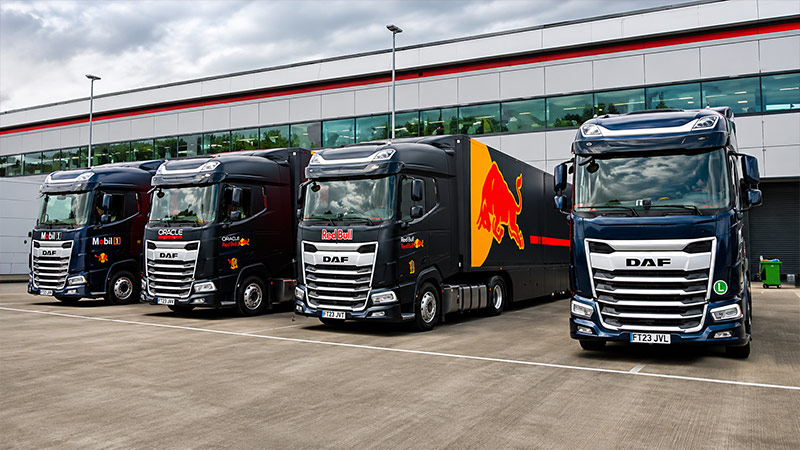
In Europe, teams switch to their own fleets of articulated trucks. Most teams have European bases, so road transport is faster, cheaper and more flexible than flying.
The trucks carry the cars, the full garage build and the striking hospitality units known as motorhomes. The largest of these multi-storey structures take a dedicated crew several days to assemble and dismantle.
How an F1 Car Is Prepared and Packed for Travel
An F1 car never travels fully assembled. It is partly stripped, drained of fuel and secured in a custom-built cradle or crate that protects its carbon-fibre structure.
The process follows a strict sequence:
- Release from parc fermé. After the race, cars stay under FIA control for post-race checks. Teardown can only begin once officials release them.
- Remove the delicate parts. Front and rear wings, wheels, mirrors and some bodywork panels come off. Each piece goes into a foam-lined box cut to its exact shape.
- Drain the fuel. Fuel is removed to meet dangerous-goods rules for air transport. Other fluids are handled according to team procedures and carrier requirements.
- Decide on the power unit. Depending on the team’s plan, the power unit may stay in the chassis or travel in its own protective crate.
- Crate, barcode and record. The rolling chassis is strapped into its cradle. Every item carries a barcode and appears on a detailed packing list.
Teams also carry a spare monocoque, the car’s core survival cell, plus thousands of spare components. If a car is heavily damaged on Saturday, the crew must be able to rebuild it from what is in the crates.
That is the real test of F1 car transport. The freight is not just cargo; it is a complete travelling workshop.
Race Week: From Chequered Flag to the Next Garage
A typical flyaway turnaround runs from Sunday-night teardown to a fully built garage by Wednesday or Thursday. Here is how those days usually unfold:
- Sunday evening. Within minutes of the race ending, crews start packing. Garages, pit equipment and IT systems are dismantled through the night.
- Sunday night to Monday. Crated freight moves to the airport, where it is consolidated, weighed and loaded onto chartered freighters.
- Monday to Tuesday. Aircraft fly to the next venue. Customs documents are prepared in advance so freight clears quickly on arrival.
- Tuesday to Wednesday. Freight reaches the circuit. Advance crews unpack and build the garages, often working long shifts.
- Thursday. Cars are reassembled and checked. FIA scrutineering, media duties and final setup work follow.
- Friday. First practice begins, and the whole weekend depends on nothing having gone missing.
Speed comes from preparation, not improvisation. Teams rehearse pack-down sequences, number every crate and plan the loading order so the first items needed are the first to come off the aircraft.
The same discipline applies at the factory. Engineers work back from freight deadlines, so a new part must be finished, inspected and packed before its slot closes.
Customs, Carnets and the Paperwork Behind Every Border
The document that lets most F1 freight cross borders is the ATA Carnet, an international customs form often described as a passport for goods.
A carnet allows equipment to enter a country temporarily without paying import duties or taxes, provided it leaves again. For a championship that visits many countries a year, that saves enormous time and cost.
Every carnet lists the items in each shipment, often with serial numbers and declared values. If officers find a mismatch, freight can be held at the border, so accuracy is non-negotiable.
Where a host country uses different rules, teams follow temporary-import procedures agreed well in advance. Restricted items, such as fuel, lithium batteries and some electronics, need extra permits and dangerous-goods paperwork.
The move to fully sustainable fuels under the 2026 regulations changes what goes in the tank. It does not relax the strict rules on how that fuel is shipped and stored.
Back-to-Backs and Triple-Headers: Logistics Under Maximum Pressure
Back-to-back races leave only a few days between the final lap at one circuit and the garage build at the next. Triple-headers stretch that pressure across three straight weekends.
Intercontinental pairings are the hardest. Freight must fly, clear customs and be rebuilt while staff manage jet lag, time-zone changes and long shifts.
Teams handle this through redundancy. Duplicate garage kits wait at the next venue, multiple sets of tools exist, and a second wave of air freight carries late upgrades straight from the factory.
Recent seasons have closed with a demanding run through Las Vegas, Qatar and Abu Dhabi. Stretches like this explain why planning starts months ahead, with backup flights and alternative routes lined up before they are needed.
Weather, airport congestion, industrial action and wider global disruption can all force last-minute changes. Experienced logistics leads treat every plan as a first draft and every contingency as essential.
Greener Freight: How F1 Is Cutting Its Logistics Footprint
Logistics is the largest single share of F1’s carbon footprint, at roughly 45 percent of emissions in the sport’s 2018 baseline. Hitting its Net Zero by 2030 target depends on changing how freight moves.
The main measures so far:
- Biofuel-powered trucks. Since 2023, a dedicated truck fleet running on renewable biofuel has served the European rounds, cutting those trucks’ emissions by around 80 percent compared with diesel.
- More sea freight. Moving non-urgent items from aircraft to ships sharply reduces emissions per tonne carried.
- Newer freighter aircraft. More fuel-efficient wide-body freighters burn less fuel for the same load.
- Remote operations. Much of the broadcast production now runs from a technology centre in the UK, so less equipment and fewer staff travel to each race.
- Smarter calendar planning. Grouping nearby events, such as moving Japan to spring and pairing Canada with Miami, removes unnecessary long-haul legs.
The challenge is built into the sport. A world championship has to travel the world, so the aim is to make every kilometre count.
Lessons Global Businesses Can Learn from F1 Logistics
F1’s freight model is a practical blueprint for any company that moves high-value goods on tight deadlines. Six principles stand out:
- Split freight by urgency. Fly only what is time-critical, and ship everything else early and at lower cost.
- Build in redundancy. Duplicate kits and spare parts turn a disruption into a delay, not a disaster.
- Make documentation flawless. Accurate manifests and customs forms prevent the most avoidable hold-ups.
- Design packaging around the transport. Crates sized to aircraft and truck dimensions use every cubic metre.
- Rehearse the process. Repeated, timed pack-downs build speed and cut errors.
- Treat sustainability as a design rule. Mode shifts, smarter routes and cleaner fuels can lower costs and emissions together.
For supply chain leaders, the message is clear. In Formula 1, logistics is not support work; it is part of the performance.
Conclusion
How F1 transports vehicles worldwide comes down to one principle: the right item, on the right mode, at the right moment.
Race cars and critical parts fly on chartered freighters. Bulky equipment sails weeks ahead in duplicate kits.
European rounds run on dedicated truck fleets, increasingly powered by biofuel. Customs carnets, barcoded crates and rehearsed pack-downs hold the whole system together.
The result is a travelling factory that rebuilds itself on a new continent, sometimes within days. As the sport chases Net Zero, its logistics teams are proving that speed and responsibility can work together.