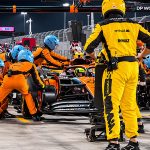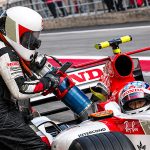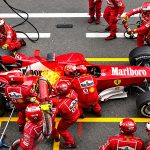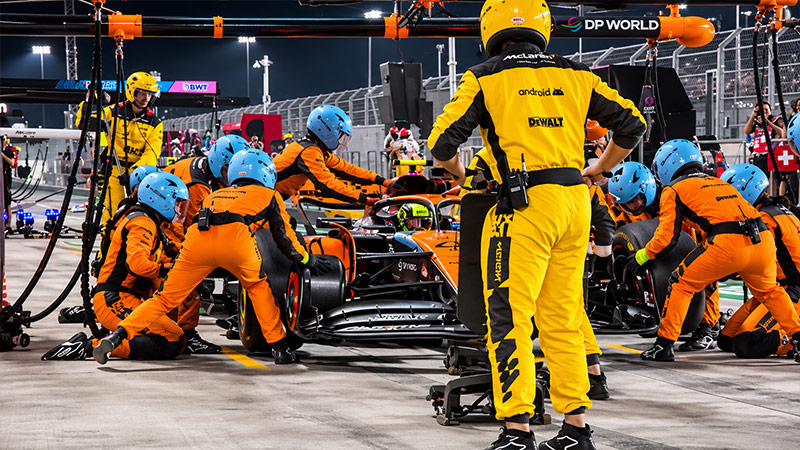
The fastest Formula 1 pit stop ever recorded lasted just 1.80 seconds. McLaren changed all four tyres on Lando Norris’s car at the 2023 Qatar Grand Prix in less time than it takes to read this sentence aloud.
That number is the peak of a long arms race in the pit lane. Since refuelling was banned in 2010, a stop has been a pure tyre change, and the best crews have cut it from roughly three seconds to under two.
In this guide, you’ll find every stop that broke the world record, the driver and race behind each one, how a crew of around 20 people pulls it off, and why the clock has barely moved since 2019.
Whether you’re new to Formula 1 or you follow every strategy call, you’ll come away knowing exactly what separates a good stop from a historic one.
Key Takeaways
- The world record is 1.80 seconds, set by McLaren for Lando Norris at the 2023 Qatar Grand Prix.
- Red Bull dominated the record book, holding it with Mark Webber in 2013 and breaking it three times in 2019 alone.
- The previous mark of 1.82 seconds stood for almost four years, from the 2019 Brazilian Grand Prix until Qatar 2023.
- Rule changes slowed the chase. A 2021 safety directive and the heavier 18-inch wheels introduced in 2022 made sub-two-second stops harder.
- Speed comes from repetition, not luck. Top crews rehearse hundreds of stops a season and study every one in slow motion.
Every Record-Breaking F1 Pit Stop at a Glance
Eight stops have set the official world record since 2012, and Red Bull owns five of them.
| Rank | Time (seconds) | Team | Driver | Grand Prix |
|---|---|---|---|---|
| 1 | 1.80 | McLaren | Lando Norris | 2023 Qatar |
| 2 | 1.82 | Red Bull | Max Verstappen | 2019 Brazil |
| 3 | 1.88 | Red Bull | Max Verstappen | 2019 Germany |
| 4 | 1.91 | Red Bull | Pierre Gasly | 2019 Britain |
| 5 | 1.92 | Williams | Felipe Massa | 2016 Europe (Baku) |
| 6 | 1.923 | Red Bull | Mark Webber | 2013 United States |
| 7 | 2.05 | Red Bull | Mark Webber | 2013 Malaysia |
| 8 | 2.31 | McLaren | Jenson Button | 2012 Germany |
All times are stationary times: the clock runs from the moment the car stops in its box until it starts to pull away. Broadcast graphics can differ from team timing by a few hundredths of a second.
How a Modern F1 Pit Stop Works
A sub-two-second stop is a rehearsed routine performed by around 20 crew members, each with one job. Nobody improvises, and nobody does two things at once.
Who does what
- Wheel crews (12 people): three per corner. One runs the wheel gun, one pulls the old wheel off, and one fits the new one.
- Front and rear jack operators: they lift the car the instant it stops and drop it the moment all four wheels are secure.
- Stabilisers: crew at the sidepods who keep the car steady while it is in the air.
- Front wing crew: on standby to adjust the wing angle or fit a new nose after contact.
- Release controller: watches the pit lane for traffic and clears the car to leave, today usually through a set of lights rather than the old lollipop board.
The sequence, step by step
- The driver brakes onto precise marks in the box after travelling down the pit lane at the speed limit, which is 80 km/h at most circuits.
- The jacks slide under the nose and rear as the car arrives, lifting it in a fraction of a second.
- Wheel guns spin off the single centre-locking nut on each wheel; old wheels come off and new ones go on.
- Each gunner signals that their corner is secure, often with a button on the gun itself, and the jacks drop.
- The release system confirms the lane is clear, the light turns green, and the driver accelerates away.
The stationary time is only part of the cost. A full stop, from pit entry to pit exit, typically costs around 20 seconds or more depending on the circuit, which is why strategists treat every tenth saved in the box as track position earned.
The Record-Breaking Stops, Counted Down
Each stop below held the title of fastest pit stop ever recorded at the moment it happened. Together they tell the story of how Formula 1 crews went from good to almost impossibly quick.
8. McLaren, 2.31 seconds: Jenson Button, 2012 German Grand Prix
McLaren set the tone for the modern record chase at Hockenheim in 2012, turning Jenson Button’s car around in 2.31 seconds.
Two years after the refuelling ban, teams were still discovering how fast a tyre-only stop could be.
McLaren’s answer was faster than most rivals believed possible. The stop signalled that a pit crew could be as valuable to a team as its wind tunnel.
7. Red Bull, 2.05 seconds: Mark Webber, 2013 Malaysian Grand Prix
Red Bull took the record at Sepang in 2013 with a 2.05-second stop for Mark Webber, landing within touching distance of the two-second barrier.
The race is better remembered for the “Multi 21” team-orders row, when Sebastian Vettel ignored an instruction and passed Webber for the win. Behind the drama, Red Bull’s crew was quietly building the system that would define the next decade.
6. Red Bull, 1.923 seconds: Mark Webber, 2013 United States Grand Prix
At Austin in November 2013, Red Bull broke the two-second barrier, servicing Webber’s car in 1.923 seconds. It came in the final weeks of Webber’s Formula 1 career, a fitting send-off after seven seasons with the team.
This was the moment the paddock realised sub-two-second stops could be repeated, not just achieved once. Every team’s target changed overnight.
5. Williams, 1.92 seconds: Felipe Massa, 2016 European Grand Prix
Williams proved that pit-lane excellence was not reserved for front-runners. At the first Formula 1 race in Baku, its crew serviced Felipe Massa’s car in 1.92 seconds, edging past Red Bull’s mark.
Williams built its reputation in that era on consistency, producing quick stops race after race. Its record stood for three years, a long time in a sport that measures progress in thousandths.
4. Red Bull, 1.91 seconds: Pierre Gasly, 2019 British Grand Prix
Red Bull reclaimed the record at Silverstone in July 2019 with a 1.91-second stop for Pierre Gasly. It opened the most remarkable run in pit-stop history: three world records in a single season.
Gasly was only weeks away from being moved back to Toro Rosso, yet his crew delivered one of the cleanest stops of his career.
3. Red Bull, 1.88 seconds: Max Verstappen, 2019 German Grand Prix
Two weeks later, at a rain-soaked Hockenheim, Red Bull cut the record to 1.88 seconds for Max Verstappen. Changing conditions forced teams to pit again and again, and Red Bull’s crew handled the pressure better than anyone.
Verstappen won one of the most chaotic races of the season. The lesson was clear: in mixed conditions, a slow stop can lose a race and a fast one can win it.
2. Red Bull, 1.82 seconds: Max Verstappen, 2019 Brazilian Grand Prix
At Interlagos in November 2019, Red Bull produced a 1.82-second stop for Verstappen, its third record of the year. He went on to win the race from pole position.
This mark stood for nearly four years, through the pandemic-hit 2020 season, a safety crackdown and a full rewrite of the car rules. Many in the paddock assumed it might never fall.
1. McLaren, 1.80 seconds: Lando Norris, 2023 Qatar Grand Prix
McLaren set the current world record at Lusail in October 2023, changing Lando Norris’s tyres in 1.80 seconds. Tyre-safety concerns had limited every stint to 18 laps, so each driver had to stop at least three times, and McLaren’s crew made the most of every chance.
The achievement is even more striking in context. It came on heavier 18-inch wheels, under stricter release rules, and beat a mark set in a far more permissive era. It is the stop every crew in the pit lane now chases.
What Makes These Stops So Fast
The quickest crews win on four fronts at once: the people, the equipment, the rehearsal and the release system. Weakness in any one of them shows up instantly on the clock.
Athletes in team kit
Pit crew members train like athletes, with strength, mobility and reaction work built into their weeks. Each wheel and tyre weighs well over 10 kilograms, and it must be lifted, aligned and seated in a blink.
Most crew members are also mechanics and technicians with full-time jobs at the team. The pit stop is one part of a demanding race weekend, not their only task.
Purpose-built equipment
Wheel guns are high-pressure tools that spin a single centre-locking nut off and on in a fraction of a second. The nuts are retained in the wheel, so they cannot be dropped or lost under pressure.
Front jacks are designed to slide under the nose in one movement and swing clear the instant the car drops. Every piece of kit is shaped around one goal: zero wasted motion.
Relentless rehearsal
Teams film stops with high-speed cameras and break each one down frame by frame. Crew members adjust foot positions, grip and timing by centimetres and milliseconds.
Practice happens at the factory and at every race weekend, so the routine becomes muscle memory. When pressure peaks on a Sunday afternoon, the body already knows what to do.
The release system
Sensors and signals from each corner tell the release controller when the car is ready to go. The final call blends automation with human judgement, and that balance is exactly where the regulators stepped in.
Why the Record Stood Still for Four Years
Red Bull’s 1.82-second mark survived from November 2019 to October 2023 largely because the rules made the job harder on purpose.
The 2021 safety directive
In mid-2021, the FIA issued a technical directive targeting the most automated parts of the release process. Its aim was to keep human judgement firmly in the loop and cut the risk of unsafe releases.
The directive set minimum reaction times for key steps in the stop. That removed some of the tiny margins the fastest crews had been exploiting.
Bigger, heavier wheels from 2022
The 2022 car rules replaced 13-inch wheels with 18-inch rims and low-profile tyres. The new wheels are heavier and bulkier, so they are slower to carry, align and seat.
Crews had to relearn their movements almost from scratch. Times rose across the pit lane while teams adapted.
Consistency over heroics
The DHL Fastest Pit Stop Award scores teams across a whole season, so it rewards reliable stops rather than one-off records. Many teams now prize a steady run of quick stops over a single headline time.
That context is what makes McLaren’s 1.80 so remarkable. It beat every stop from the more permissive era, on heavier equipment and under tighter rules.
Lessons From the Pit Lane for High-Performance Teams
F1 pit crews are one of the clearest models of teamwork under pressure, and organisations far beyond motorsport study them. Great Ormond Street Hospital in London famously learned from F1 crews to redesign how patients are handed over from surgery to intensive care.
Five lessons stand out for any team chasing peak performance:
- Give every person one clear job. Twenty people work inches apart without collisions because nobody wonders what to do next.
- Rehearse the failure, not just the routine. Crews practise recovering from a stuck wheel nut or a faulty jack, so a problem costs seconds rather than a race.
- Measure everything, then review it. Frame-by-frame video turns gut feeling into hard evidence about where time is lost.
- Shape the tools around the task. Captive wheel nuts and swivelling jacks exist because someone asked what slowed the crew down.
- Never trade safety for speed. The 2021 directive is a reminder that a fast result delivered unsafely is not progress at all.
The biggest lesson is that consistency compounds. A crew that delivers 2.2-second stops all season often earns more for its team than one that sets a record and then fumbles under pressure.
Conclusion
From McLaren’s 2.31 seconds at Hockenheim in 2012 to Lando Norris’s 1.80 in Qatar, the history of the fastest F1 pit stops is a story of people, practice and precision.
Red Bull rewrote the record five times, Williams proved a midfield team could beat the giants, and McLaren reset the benchmark under the toughest rules yet.
Each stop shows that a race can be won or lost while the car stands completely still. The next record will demand even sharper teamwork, smarter equipment and nerves of steel.