Every Formula 1 car on the grid is a study in compromise. Engineers want enough fuel to reach the checkered flag at full attack, yet every extra kilogram costs lap time.
That tension makes fuel one of the most strategic, and most misunderstood, numbers in the sport.
If you have ever wondered how much fuel an F1 car carries, why teams talk in kilograms instead of liters, or how a 1,000-horsepower machine finishes a 300 km race without a single refueling stop, this guide has you covered.
The Short Answer
From 2019 through 2025, an F1 car could start a Grand Prix with a maximum of 110 kg of fuel, roughly 145 liters or 38 US gallons. Refueling has been banned since 2010, so that single load must last the full race distance of about 305 km.
The 2026 regulations changed the formula. The rules now cap the energy flowing from the fuel rather than its mass, and teams are expected to start races with around 70 kg, or roughly 95 liters.
F1 Fuel Numbers at a Glance
These are the core figures behind F1 fuel, drawn from the FIA’s technical and sporting regulations and widely reported team data. Exact values vary by circuit, fuel blend, and team strategy.
| Measure | Figure |
|---|---|
| Maximum race fuel load (2019–2025) | 110 kg |
| Equivalent volume | About 143–153 liters (roughly 38 US gallons) |
| Expected race fuel load (2026 rules) | Around 70 kg |
| Maximum fuel flow (2014–2025) | 100 kg per hour above 10,500 rpm |
| Maximum fuel energy flow (2026 rules) | 3,000 MJ per hour |
| Typical use per lap | About 1.5–2.0 kg |
| Road-car equivalent economy | About 5 mpg (roughly 45 L per 100 km) |
| Minimum fuel kept for FIA testing | 1 liter |
| Refueling during races | Banned since 2010 |
Kilograms vs. Liters: Why F1 Measures Fuel by Weight
F1 regulates fuel by mass because mass is what decides both performance and fairness. A liter of fuel expands and contracts with temperature, but a kilogram is always a kilogram.
Racing fuel has a density of roughly 0.72 to 0.77 kg per liter, depending on its blend and temperature. That is why 110 kg converts to a range of about 143 to 153 liters rather than one fixed number.
Measuring by mass also removes any reward for chilling fuel to pack more energy into the tank, a trick the FIA further blocks with strict temperature rules.
For perspective, a typical family hatchback holds 45 to 55 liters. A fully fueled 2019–2025 F1 car carried nearly three times that amount.
How the F1 Fuel Limit Has Changed
Today’s fuel rules are the product of four decades of shifting priorities, from raw speed to safety and, more recently, efficiency.
| Era | Refueling | Race fuel rule |
|---|---|---|
| 2026 onward | Banned | Energy flow cap; loads around 70 kg |
| 2019–2025 | Banned | 110 kg maximum |
| 2017–2018 | Banned | 105 kg maximum |
| 2014–2016 | Banned | 100 kg maximum |
| 2010–2013 | Banned | No mass cap; V8 cars used roughly 150–160 kg |
| 1994–2009 | Allowed | No race cap; cars ran partial loads between stops |
| 1984–1993 | Banned | Tank-size caps during the turbo years |
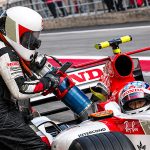
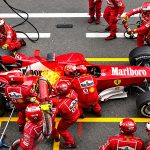
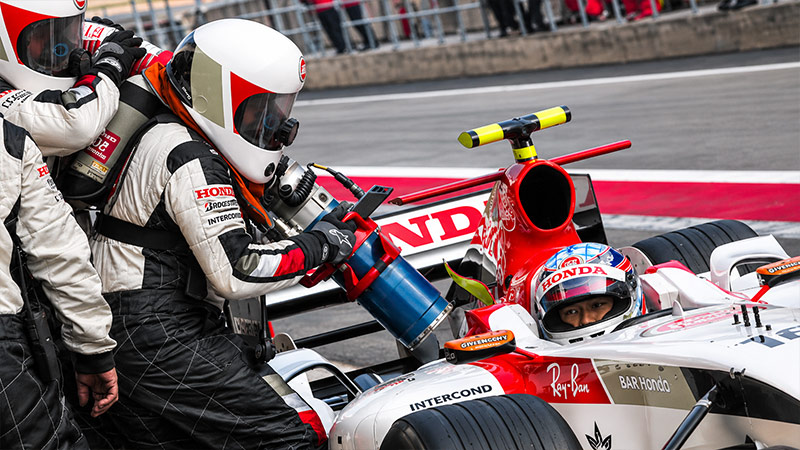
Refueling returned in 1994 and turned races into a series of strategic sprints. Cars carried only enough fuel for each stint, and stops often lasted 7 to 10 seconds while fuel flowed in at around 12 liters per second.
The FIA banned refueling again from 2010 to cut costs, end the shipping of heavy fuel rigs around the world, and remove the fire risk in the pit lane. Overnight, cars needed tanks big enough for a full race distance.
The 2014 hybrid era introduced the first hard mass limit of 100 kg. It rose to 105 kg in 2017 as wider, faster cars burned more fuel, then to 110 kg in 2019 so drivers could race harder instead of coasting to save fuel.
Inside the F1 Fuel Tank
An F1 fuel tank is not a rigid metal box but a flexible bladder made from Kevlar-reinforced rubber. It is designed to deform rather than split open in a heavy impact.
The tank sits inside the carbon-fiber survival cell, directly behind the driver’s seat and ahead of the power unit.
That position keeps the mass low and near the car’s center for better balance, and it wraps the fuel in the strongest structure on the car.
Key design features include:
- Aviation-grade toughness: Bladders meet the FIA’s FT5 safety standard, which grew out of aircraft fuel-cell design and resists tearing and puncture.
- One tank only: The rules allow a single fuel tank, and it must sit within the survival cell.
- Collectors and lift pumps: Small internal chambers keep fuel at the pickup during hard braking and high-speed corners, when g-forces push fuel to one side.
- High-pressure injection: Fuel reaches the combustion chamber at up to 500 bar, helping it burn quickly and completely.
How Much Fuel Does an F1 Car Use per Lap?
An F1 car typically burns about 1.5 to 2.0 kg of fuel per lap, depending on circuit length, layout, and how hard the driver pushes. Across a full race, that adds up to roughly 100 kg.
Consumption varies sharply from one track to the next:
- Power circuits such as Monza, Spa-Francorchamps, and Baku keep drivers at full throttle for long stretches, which pushes usage up.
- Street circuits such as Monaco involve more braking and lower average speeds. Monaco’s shorter race distance of about 260 km also means teams need noticeably less fuel there.
- Hot, humid races such as Singapore run close to the two-hour limit, which makes fuel and energy management a central part of the strategy.
- High-altitude venues such as Mexico City have thinner air, which changes how teams run their power units and cooling.
In road-car terms, an F1 car averages around 5 mpg, or roughly 45 liters per 100 km. That sounds thirsty, but context matters.
The 2014–2025 power units produced around 1,000 hp from a 1.6-liter V6 and turned more than 50% of the fuel’s energy into useful work. Most road car engines manage roughly 30 to 40%.
Why Teams Rarely Fill the Tank to the Maximum
Carrying more fuel than you need is one of the costliest mistakes in F1, because weight equals lap time. Engineers commonly estimate that every 10 kg of fuel costs around 0.3 seconds per lap, though the exact figure depends on the circuit.
At a full 110 kg, a car could be more than three seconds per lap slower at the start than on an empty tank.
As the fuel burns off, the penalty shrinks, but across a full race it still adds up to well over a minute. At the start, fuel made up close to 14% of a 2025 car’s minimum weight of about 800 kg.
That is why teams often underfuel on purpose. Strategists calculate the smallest load that will reach the finish with the required sample left over, then plan for the driver to save the difference on track. Common techniques include:
- Lift and coast: The driver lifts off the throttle a few meters before the braking point and coasts into the corner, saving fuel for a tiny time loss.
- Short-shifting: Changing up earlier lowers engine revs and consumption.
- Engine mode changes: Engineers switch the power unit to leaner settings during quieter phases of the race.
- Using the slipstream: Following another car on the straights cuts drag and fuel use, though it can heat tires and brakes.
Safety car periods matter too. A few slow laps behind the safety car can save several kilograms, so strategists weigh how likely a neutralization is at each circuit before deciding how much fuel to carry.
The Rules Beyond the Tank
Total fuel is only one of several limits. The FIA also polices how fast fuel is used, how it is stored, and what must remain at the finish, and two high-profile disqualifications show how strictly those rules are enforced.
Fuel flow limit
From 2014 to 2025, a power unit could burn no more than 100 kg of fuel per hour above 10,500 rpm.
A sealed, FIA-approved flow meter in the tank checked this thousands of times per second. Daniel Ricciardo learned the cost of a breach at the 2014 Australian Grand Prix, when Red Bull was excluded from his second-place finish.
Fuel sample
Every car must keep at least one liter of fuel on board after qualifying and the race so the FIA can test it. Sebastian Vettel lost second place at the 2021 Hungarian Grand Prix when Aston Martin could recover only about 0.3 liters from his car.
Fuel temperature
Fuel in the car may not be more than 10°C below the ambient temperature. That stops teams from chilling fuel to make it denser and squeeze more into the tank.
Fuel fingerprinting
Each blend must be approved before use. Officials compare race samples against the approved blend’s chemical “fingerprint” using gas chromatography, so any unapproved change is quickly exposed.
What Goes Into an F1 Fuel Tank
F1 fuel is surprisingly close to the premium unleaded at a roadside pump, and the rules intend it that way. The regulations require blends built largely from compounds found in commercial gasoline, which keeps development relevant to everyday cars.
Beneath that familiar base, every blend is highly engineered. Energy partners such as Shell, which has worked with Ferrari for decades, and Petronas, partner to Mercedes, fine-tune hundreds of hydrocarbon compounds for energy density, combustion speed, and resistance to engine knock. Teams can test dozens of candidate blends in a season.
The chemistry has also moved steadily toward lower carbon emissions:
- 2022: E10 fuel arrived, with 10% advanced sustainable ethanol in every blend.
- 2026: Cars switched to 100% advanced sustainable fuel, made from non-food biomass, municipal waste, or captured carbon rather than fossil crude oil.
Because the new fuels must deliver competitive energy under an energy-based limit, the race to perfect them has become a major competitive front.
2026 and Beyond: A New Era for F1 Fuel
The 2026 regulations bring the biggest change to F1 fuel in more than a decade. Three shifts stand out:
- Energy, not mass. Instead of capping fuel flow at 100 kg per hour, the rules cap the energy the fuel delivers at 3,000 MJ per hour. The focus moves from how much fuel a car burns to how much usable energy each blend contains.
- A bigger electric share. The MGU-K now delivers up to 350 kW, nearly three times its previous output, and the MGU-H has been removed. Electrical power makes up close to half of total output.
- Fully sustainable fuel. Every drop in the tank now comes from non-fossil feedstocks, as covered above.
The practical result is a much lighter fuel load. Teams are expected to start races with around 70 kg instead of more than 100 kg, which also helps the cars meet a lower minimum weight of 768 kg.
Exact loads vary by team and circuit as engineers learn how to balance fuel energy, battery deployment, and energy recovery under the new rules. Fuel management has not disappeared; it has simply become part of a wider energy management puzzle.
Key Takeaways
- From 2019 to 2025, an F1 car could start a race with up to 110 kg of fuel, about 145 liters.
- The 2026 rules cap fuel energy flow at 3,000 MJ per hour, and race loads are expected to be around 70 kg.
- Refueling has been banned since 2010, so one load must last the entire race.
- Cars burn roughly 1.5 to 2.0 kg per lap, or about 5 mpg in road-car terms.
- Every 10 kg of fuel costs about 0.3 seconds per lap, so teams often underfuel and save fuel on track.
- At least one liter must remain after qualifying and the race for FIA testing.
Conclusion
So, how much fuel is in an F1 car? For most of the 2014–2025 hybrid era, the answer was up to 110 kg, roughly 145 liters, enough for about 305 km without a single stop.
Under the 2026 rules, that figure is expected to fall to around 70 kg of sustainable fuel, governed by energy rather than mass.
Yet the number in the tank is only half the story. Every kilogram shapes lap times, pit strategy, and the driver’s workload from lights out to the flag.
Next time you watch a Grand Prix, listen for the lift and coast calls and the math behind them. Share this guide with a fellow fan, and keep exploring the engineering that defines F1.