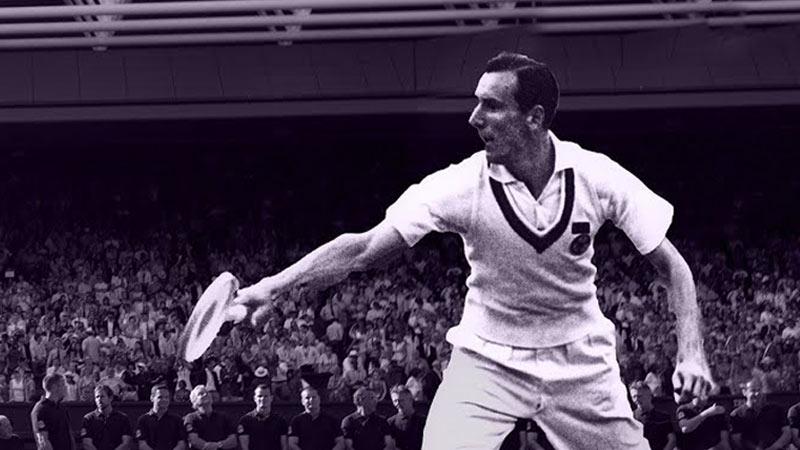
Fred Perry won a total of 5 Wimbledon titles during his legendary career, establishing a dominance that defined a generation.
This tally includes a historic “three-peat” of three consecutive Gentlemen’s Singles titles from 1934 to 1936, alongside two consecutive Mixed Doubles titles in 1935 and 1936.
As the last British man to win the singles championship for 77 years until 2013, Perry’s legacy is etched into the very grass of the All England Club.
His ruthless efficiency, exemplified by winning 62 consecutive sets, remains a gold standard for technical excellence and competitive grit in professional tennis history.
Breaking Down the Fred Perry Wimbledon Title Count
To understand the magnitude of Fred Perry’s impact on the sport, one must look at the variety and consistency of his victories during the mid-1930s.
The Iconic Gentlemen’s Singles Hat-Trick
Fred Perry achieved a historic hat-trick by winning the Gentlemen’s Singles Championship three consecutive times in 1934, 1935, and 1936. He was the first and only British man to achieve this consecutive singles “three-peat”.
His 1934 victory served as a breakthrough when he defeated the defending champion, Jack Crawford, in straight sets.
This momentum carried him through the next two years, where he successfully defended his title against his greatest rival, Baron Gottfried von Cramm.
Dominance in the Mixed Doubles Category
Beyond his legendary singles career, Perry was a formidable force in the mixed doubles discipline, securing two additional titles. In partnership with Dorothy Round, he won consecutive Mixed Doubles championships in 1935 and 1936.
Their 1935 victory saw them defeat Nell Hall Hopman and Harry Hopman with a commanding 6–1, 6–1 score.
In 1936, they faced a tougher challenge from Sarah Palfrey Fabyan and Don Budge but eventually triumphed in a three-set battle. These victories brought his total tournament wins to five.
A Comprehensive Summary of Fred Perry’s Wimbledon Finals
The following table details every final Fred Perry participated in at the All England Club, showcasing his remarkable efficiency in high-stakes matches.
| Year | Event | Partner | Opponent(s) in Final | Score | Result |
|---|---|---|---|---|---|
| 1934 | Gentlemen’s Singles | N/A | Jack Crawford | 6–3, 6–0, 7–5 | Won 🏆 |
| 1935 | Gentlemen’s Singles | N/A | Gottfried von Cramm | 6–2, 6–4, 6–4 | Won 🏆 |
| 1935 | Mixed Doubles | Dorothy Round | Nell Hall Hopman / Harry Hopman | 6–1, 6–1 | Won 🏆 |
| 1936 | Gentlemen’s Singles | N/A | Gottfried von Cramm | 6–1, 6–1, 6–0 | Won 🏆 |
| 1936 | Mixed Doubles | Dorothy Round | Sarah Palfrey Fabyan / Don Budge | 7–9, 7–5, 6–4 | Won 🏆 |
Analyzing the 1936 Final: A Record-Breaking Blitz
The 1936 singles final remains one of the most significant moments in tennis history, representing the absolute peak of Perry’s athletic prowess.
The Fastest Final in Grand Slam History
In 1936, Perry faced Baron Gottfried von Cramm in a rematch of the previous year’s final. The match was a devastating display of dominance, with Perry winning in a mere 45 minutes.
The final score of 6–1, 6–1, 6–0 stands as one of the fastest and most one-sided men’s singles finals in the history of Grand Slam tennis. This victory cemented his status as an invincible force on grass before he transitioned into the professional circuit.
Mastery Without Dropping a Single Set
A key highlight of Perry’s 1936 campaign was his ability to navigate the entire tournament without losing a single set. He holds the record for the most Wimbledon titles won without dropping a set across the duration of the event.
This is a rare feat that places him in an elite group of champions, including Björn Borg and Rafael Nadal, who have won three major titles under similar conditions.
During his three championship years, he set an extraordinary record by winning 62 consecutive sets on the Wimbledon grass.
The Social Impact of Fred Perry’s Working-Class Legacy
Fred Perry’s journey was not merely defined by trophies but by a constant struggle against the rigid social structures of the 1930s.
Conflicts with the All England Club Establishment
Despite his unmatched success on the court, Perry’s relationship with the Wimbledon hierarchy was famously strained.
As the working-class son of a socialist MP, his ruthless and aggressive style of play often clashed with the elitist culture prevalent at the All England Club.
Upon winning his first title in 1934, he notoriously overheard a committee member telling his opponent, Jack Crawford, that “the best man didn’t win”.
Even the presentation of his club member’s tie was handled with cold indifference, as it was left draped over a chair in the changing room rather than presented to him personally.
From the Professional Circuit to the Bronze Statue
The divide between Perry and the tennis establishment became permanent when he chose to forfeit his amateur status to play professionally at the end of 1936.
At the time, turning professional was seen as a betrayal of the amateur ideals held by major tournaments. However, as decades passed, the All England Club eventually softened its stance on the legend.
In 1984, the club finally honored his immense contribution to British sport by unveiling a bronze statue of him on the grounds, forever marking his place in history.
Comparing Perry’s 77-Year Record to Modern Tennis
The longevity of Fred Perry’s records provided a shadow that loomed over British tennis for nearly eight decades.
The Long Wait for a British Successor
Following his 1936 victory, a massive drought began for British tennis that would last for 77 years. Perry remained the last British man to hold a Wimbledon singles title until Andy Murray finally broke the streak in 2013.
For generations, Perry’s name was synonymous with a standard of excellence that seemed unattainable for his successors. His 1936 title was the final milestone of a golden era for the nation’s tennis fans.
Standing Alongside Legends Like Nadal and Borg
When evaluating Perry’s technical achievements, he remains in the conversation with the greatest players of the modern era. His ability to win majors without dropping a set is a benchmark shared only with icons like Rafael Nadal and Björn Borg.
Furthermore, his “three-peat” puts him in an exclusive club of players who have successfully defended the most prestigious title in the world multiple times. His legacy is not just one of British pride, but of global athletic supremacy.
Essential Questions Regarding Fred Perry’s Legacy
How many singles titles did Fred Perry win at Wimbledon?
Fred Perry won the Gentlemen’s Singles title 3 times, achieving a historic “three-peat” from 1934 to 1936.
Did Fred Perry win any other titles at Wimbledon?
Yes, he won the Mixed Doubles title 2 times, in 1935 and 1936, both times partnering with Dorothy Round.
Who was Fred Perry’s most frequent opponent in Wimbledon finals?
Baron Gottfried von Cramm was his most frequent opponent in singles finals, facing him in both 1935 and 1936.
Why did Fred Perry have a difficult relationship with Wimbledon?
His working-class background and aggressive playing style often clashed with the elitist, upper-class culture of the All England Club during that era.
When was the Fred Perry statue unveiled at Wimbledon?
The All England Club honored his legacy with a bronze statue on the tournament grounds in 1984.
How long was the gap between Fred Perry and the next British male winner?
There was a 77-year gap between Fred Perry’s final victory in 1936 and Andy Murray’s win in 2013.
The Eternal Standard of Excellence
Fred Perry was more than a champion; he was a disruptor who changed the perception of what a tennis player could be.
His five Wimbledon titles—three singles and two mixed doubles—represent a level of dominance that was not replicated by a British man for over three-quarters of a century.
Whether it was his record-setting 45-minute final or his 62-set winning streak, Perry’s statistical achievements are staggering.
However, it is his grit in the face of an unwelcoming establishment that truly defines his character. He proved that greatness is not inherited through class but earned through relentless performance.
As we look back at the history of the All England Club, Fred Perry remains the benchmark for every athlete who steps onto the hallowed grass of Centre Court.