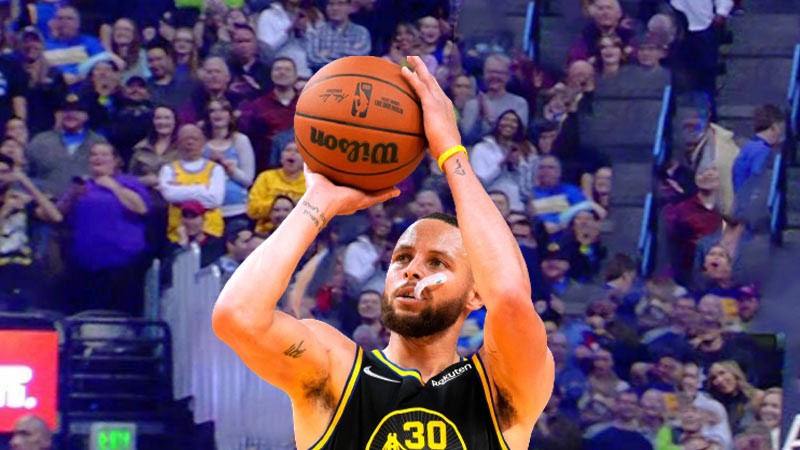
Stephen Curry has fundamentally transformed the game of basketball, evolving from a skilled point guard into the most lethal scoring threat in history.
While many fans attribute his success to a “natural gift,” the reality is far more clinical. His dominance is the result of a meticulously engineered shooting system that merges advanced biomechanics, high-level physics, and rigorous neurological conditioning.
By breaking down the components of his release, we can uncover a blueprint of efficiency that defies traditional coaching. This deep dive explores the precise technical and physiological reasons behind his unprecedented accuracy and range.
The Physics of the One-Motion Shot
Standard basketball coaching often emphasizes a “two-motion” shot, where a player jumps to their peak and then releases the ball.
Curry, however, utilizes a scientifically optimized one-motion shot, which is the foundation of his efficiency. This mechanic allows for a seamless transition of power from the floor through his fingertips.
Fluid Momentum and Energy Transfer
The primary benefit of a one-motion shot is fluid transfer. By releasing the ball while his body is still moving upward—rather than waiting for the apex of his jump—Curry captures the kinetic energy generated by his legs.
This mechanical efficiency provides him with infinite range, as he does not need to exert excessive upper-body force to propel the ball from deep distances.
Outside of the source material, this is known as a “proximal-to-distal” kinetic chain, where energy moves from larger muscles to smaller ones with minimal loss.
The 0.3-Second Release Advantage
In the high-pressure environment of the NBA, the window to shoot is often less than a second. Curry has mastered a quick release, timed at approximately 0.3 seconds.
This is significantly faster than the league average, making his shot nearly impossible for even the most elite defenders to contest or block. This speed is not just about hand movement; it is about the preparation and the lack of a “hitch” in his motion.
| Metric | Stephen Curry | Average NBA Player |
|---|---|---|
| Release Speed | ~0.3 Seconds | ~0.5 – 0.7 Seconds |
| Release Point | On the way up (One-motion) | At the peak (Two-motion) |
| Primary Power | Lower-body momentum | Shoulder and tricep force |
Mastering Geometry: The 55-Degree Arc
Shooting is a game of angles, and Curry plays it better than anyone else. Most players shoot with a flat trajectory, which significantly reduces the margin for error. Curry’s secret lies in the perfect geometry of his flight path, specifically his launch angle.
The Mathematics of a High Launch Angle
Curry typically launches the ball at an angle between 50 to 55 degrees. This is intentionally higher than the 45-degree angle often taught in basic basketball camps.
By increasing the arc, he utilizes physics to increase the effective target size of the rim. A ball traveling on a flatter arc sees the rim as an oval, whereas a ball on a high arc sees a more perfect circle.
Vertical Entry and Rim Surface Area
The steep entry angle forced by his high arc means the ball drops more vertically into the rim. When a ball enters the hoop at a vertical angle, the “available” space of the 18-inch rim is maximized.
This widened entry effectively makes the hoop opening feel wider, allowing for “swishes” even when the ball isn’t perfectly centered. It is a mathematical insurance policy against slight misses in left-right accuracy.
Anatomical Alignment and the 10-Degree Turn
A common gap in traditional shooting instruction is the insistence on “squaring” the shoulders to the basket. Curry’s form deviates from this to achieve flawless alignment and reduce physical tension in the shooting arm.
Challenging the Square-Shoulder Myth
Rather than keeping his toes pointed directly at the hoop, Curry angles his feet approximately ten degrees to the left (as a right-handed shooter). This subtle shift is crucial for anatomical health and shooting consistency.
By turning his feet, he creates a linear release path. This alignment ensures that his right hip, elbow, and shoulder are stacked in a straight line toward the basket.
Establishing a Repeatable Rhythm
Consistency in shooting requires a repeatable starting point. Curry utilizes a consistent dip, catching the ball and bringing it to his waist before beginning his upward motion.
This dip acts as a rhythmic trigger, ensuring that every shot begins with the same tension and momentum regardless of whether he is shooting off the dribble or a catch-and-shoot.
- Foot Position: 10-degree turn to the left.
- Kinetic Stack: Alignment of hip, elbow, and shoulder.
- Rhythm Trigger: The waist-level dip.
Elite Neuro-Muscular Conditioning
The physical mechanics of a shot are useless if the brain cannot execute them under duress. Curry’s ability to maintain his form while exhausted is the result of elite neuro-muscular conditioning. His training focuses on brain-body connection just as much as muscle memory.
Cognitive Training and Sensory Overload
Curry employs sensory overload training to sharpen his reaction times. This often involves wearing flashing light goggles while performing ball-handling or shooting drills.
These goggles partially obstruct his vision and force his brain to process information faster, training him to track targets even when he is under extreme mental fatigue.
This ensures that in a chaotic game environment, the rim always feels like a clear, stationary target.
Rapid Heart Rate Recovery
Precision is heavily influenced by the autonomic nervous system. Curry specifically trains to lower his heart rate rapidly during brief timeouts or stoppages in play.
By mastering his breath and cardiovascular recovery, he can step to the free-throw line or take a game-winning shot with a calm, focused mind even after sprinting for several minutes.
Furthermore, his tireless off-ball running and elite stamina ensure he is shooting with fresh legs even in the closing moments of the fourth quarter.
Rigorous Practice Volume and Game-Speed Simulation
The final pillar of his success is the sheer volume and quality of his preparation. Curry does not believe in “empty calories” when it comes to practice; every movement is purposeful and high-intensity.
The Myth of Casual Practice
Curry avoids slow-paced shooting drills. Instead, he focuses on game-speed reps, ensuring that every practice drill mimics the intense pressure and speed of a real NBA game.
This bridges the gap between practice performance and game-day execution, ensuring his mechanics do not break down when a defender is closing in.
The 100-Make Drill and Precision Tracking
To maintain his status as the world’s best shooter, Curry adheres to a rigorous practice volume. He frequently concludes his training sessions with the 100-Make Drill, where he must make 100 three-pointers.
However, the standard is even higher than just “making” the shot; his team often tracks precise swishes, where the ball does not touch the rim at all. This hyper-focus on perfection ensures that his “misses” still often result in points.
Frequently Asked Questions
Why does Stephen Curry turn his feet when shooting?
Curry turns his feet about ten degrees to the left to align his shooting side (shoulder, elbow, and hip) with the basket.
This reduces tension in the shoulder and creates a straight, repeatable path for the ball, which is more anatomically natural than being perfectly square.
How fast is Stephen Curry’s shot release?
Stephen Curry’s release takes approximately 0.3 seconds. This elite speed is achieved through a “one-motion” shooting style where the ball is released before the peak of his jump, catching the upward momentum of his legs.
Does a higher arc really help you shoot better?
Yes. Curry shoots at a 50 to 55-degree angle. Mathematically, a higher arc makes the rim appear “wider” to the ball because it enters more vertically. This increases the margin for error compared to a “flat” shot.
What is sensory overload training?
Curry uses flashing light goggles to simulate chaos and track targets under mental fatigue. This cognitive training helps him remain focused on the rim and his mechanics even when he is physically exhausted or distracted by defenders.
How does Curry stay fresh for late-game shots?
Beyond standard conditioning, Curry trains to lower his heart rate quickly during breaks. His elite stamina allows him to move constantly off the ball, ensuring that when he finally takes a shot, his legs are not too fatigued to maintain his one-motion mechanics.
Conclusion: The Blueprint of Greatness
Stephen Curry’s shooting is not an enigma; it is a masterclass in applied science. By combining the physics of a one-motion release, the geometry of a 55-degree arc, and the anatomical precision of a 10-degree turn, he has maximized the probability of every shot he takes.
When you add his neuro-muscular conditioning and game-speed practice habits, you get a shooter who has not only mastered the game but rewritten its rules.
For players looking to improve, the lesson is clear: mastery is found in the details. Whether it is aligning your kinetic chain or training your brain to handle sensory overload, the “Curry Method” proves that with enough scientific rigor and dedicated practice, the impossible becomes routine.