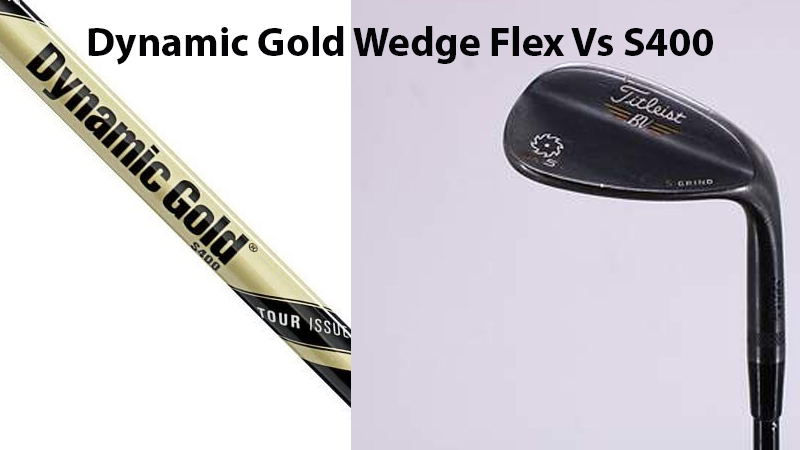
When you buy a brand-new wedge off the rack, the label on the shaft often carries a generic, somewhat mysterious title: “Wedge Flex.” For many golfers, this is the end of the inquiry.
However, for those looking to optimize their short game, the comparison between this “stock” offering and the legendary Dynamic Gold S400 is one of the most important gear decisions you can make.
While they may look identical at a glance, the differences in weight, manufacturing tolerances, and performance characteristics can significantly impact your consistency from within 100 yards.
The Mystery of “Wedge Flex” Unveiled
The term “Wedge Flex” is not actually a specific technical flex in the way “Stiff” or “Extra Stiff” is; rather, it is a designation used by original equipment manufacturers (OEMs) to simplify the buying process.
In the majority of high-end wedges—most notably Titleist Vokey Design—the “Wedge Flex” label is almost always a Dynamic Gold S200 shaft.
Technically, the S200 is a “Stiff” flex shaft, but it sits at the lighter end of the Dynamic Gold spectrum. According to official product specifications, a tapered Dynamic Gold S200 weighs approximately 129 grams, whereas an S300 weighs 130 grams, and an S400 weighs 132 grams.
Other sources suggest the “Wedge Flex” S200 can be as light as 127 grams, creating a total gap of about 5–6 grams between a stock wedge shaft and the S400.
For the average amateur, 5 grams might seem negligible. However, in the scoring zone, where feel and timing are paramount, that weight difference represents a shift in how the club behaves during the swing.
The Manufacturing Secret: Weight Sorting
To understand why the S400 is often preferred over the S200 (Wedge Flex), you have to understand how True Temper manufactures these shafts.
The Dynamic Gold S200, S300, and S400 all share the exact same step pattern and bend profile. They are effectively the same shaft design.
The distinction happens after the shafts are produced. True Temper uses a process called weight sorting. When shafts come off the production line, they naturally vary slightly in weight due to manufacturing tolerances.
- The lightest shafts in the batch are labeled as S200.
- The “median” weight shafts become the industry-standard S300.
- The heaviest shafts, which typically have slightly thicker walls as a result of the extra material, are labeled S400.
Because the S400 is heavier, it naturally plays a fraction stiffer than the S200, though the difference in flex is considered “negligible” by many club fitters. The real story isn’t the stiffness; it’s the heft.
Why the S400 is the “Gold Standard”?
The Dynamic Gold S400 is widely considered the industry standard for high-performance wedges, even for players who use different brands or models for their irons. But why would a golfer intentionally choose a heavier shaft for their most delicate shots?
Timing and Stability
In the short game, you are rarely taking “full-throttle” swings. Most wedge play involves three-quarter, half, or even quarter-swings.
A heavier shaft like the S400 provides more stability on these less-than-full-swing shots. The added mass helps the golfer “feel” where the clubhead is throughout the delivery, which is critical for timing.
The “Falling” Effect
There are three common philosophies regarding wedge weight: lighter for feel, identical to irons for transition, or heavier for gravity-assisted swings. Many pros and high-level amateurs prefer the third school of thought.
A heavier shaft allows the club to “fall” into the ball via gravity with less required “push” from the player, leading to more consistent turf interaction and contact.
PGA Tour Dominance
The S400 is not just a marketing term; it is the most-played wedge shaft on the PGA Tour. Currently, 71 PGA Tour players have an S400 in their bag.
This list includes elite ball-strikers like Scottie Scheffler, Hideki Matsuyama, Collin Morikawa, and Brooks Koepka.
Even Tiger Woods, who is famously perceptive of gear changes, uses a heavier, softer flex (S400) in his wedges compared to the Extra-Stiff shafts in his irons.
Performance Data: What the Launch Monitor Says
In head-to-head testing between the S200 (Wedge Flex) and the S400, the data reveals subtle but important trends in ball flight.
Spin Rates
In randomized equipment tests, the S400 often produces lower spin than its lighter counterparts. While the clubhead is the primary driver of spin, the heavier weight of the S400 influences the player to deliver the club with a lower dynamic loft.
In one specific test, the S400 spun at roughly 9,946 RPM, while the S200 spun higher at 10,530 RPM.
Launch and Trajectory
Because the S400 helps neutralize delivery, it tends to produce a lower, more controlled “nippy” flight. This is the preferred window for better players who want to see their ball hop and stop rather than balloon into the wind.
Consistency
Data shows that heavier shafts can help keep the strike pattern more centralized on the face. Lighter shafts (like the 115g variants) often lead to more “dancing” strike patterns across the face for players used to heavier equipment.
Standard S400 vs. S400 Tour Issue
If you decide to move from a standard Wedge Flex to an S400, you will likely encounter the “Tour Issue” version. This is where quality control becomes a factor.
A standard S400 has a relatively wide weight dispersion coming off the line. A Tour Issue S400, however, is weight-sorted to even tighter tolerances—usually within +/- 0.5 grams of each other.
For a “feel player,” removing variables is essential. While many amateurs may not be able to “blind test” the difference, the Tour Issue provides peace of mind that every wedge in your bag is perfectly matched in weight. As one golfer noted, it “made a difference with my ball flight and my confidence”.
The Danger of the “Weight Gap”
While the S400 is the gold standard, it is not for everyone. The biggest mistake a golfer can make is following the “pro’s lead” without considering their own iron specs.
If you are a “skinny dude” or a player with lower swing speeds using 85g or 95g shafts in your irons, jumping to a 132g S400 wedge shaft is a massive leap.
A 50-gram weight difference can feel like “slicing garlic with a scythe” and may lead to a total loss of control on delicate shots.
General fitting wisdom suggests that your wedge shaft should be no more than 10–15 grams heavier than your iron shafts.
If you play 105g irons, an S200/Wedge Flex (129g) might already be pushing the limits of a comfortable weight gap. If you play 130g X100s in your irons, the S400 is the perfect transition.
Traditional Insights and Final Thoughts
The debate between Wedge Flex (S200) and S400 ultimately comes down to a trade-off between effortless speed and controlled stability.
- Choose Wedge Flex (S200) if you want a club that feels a bit more “active,” if you have a slower swing speed, or if you prefer a lighter overall club weight to match a lighter set of irons.
- Choose S400 if you want the ultimate in stability, a lower/controlled launch, and the same heft that the world’s best players use to navigate tight lies and pressure-packed chips.
As equipment expert Ian Fraser notes, “These shafts will affect your timing. That’s the number one takeaway”.
You cannot always trust “what it says on the tin” to give you the performance you need; the only way to truly know if the S400 is worth the upgrade is to get into a fitting bay and see how that extra 5 grams influences your delivery.
Whether you stick with the stock Wedge Flex or graduate to the S400, understanding that the shaft is the “engine” of your scoring clubs is the first step toward a sharper short game. Trust the process, test the weights, and find the heft that lets you play with total confidence.