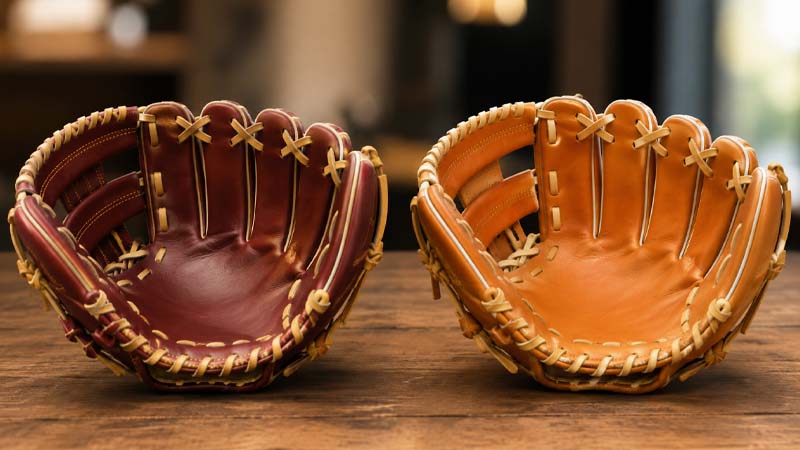
Stepping onto the diamond with the right equipment can entirely change how you handle ground balls, turn double plays, and command the infield.
When you narrow down your choices for a new defensive tool, you often arrive at a crucial crossroads: should you choose an 11.5-inch or an 11.75-inch baseball glove?
While a quarter-inch might sound negligible on paper, it completely alters the pocket depth, weight distribution, and transfer speed of your leather.
Whether you are a middle infielder splitting time between second base and shortstop, or a third baseman guarding the hot corner, understanding the mechanical differences between these two sizes is essential for elevating your defensive performance.
The Quick Comparison At-a-Glance
Understanding Infield Glove Anatomy
Before diving into the specific sizes, it helps to understand how a glove’s dimensions dictate its performance. Infield gloves are engineered for speed.
Unlike outfield mitts designed to track down fly balls with deep pockets, infield gloves prioritize a fast, clean release.
Pocket Depth and Leather Tension
The length of a glove directly affects the web architecture and the palm span. An 11.5-inch pattern keeps the leather taut, minimizing the room a baseball has to move around once it hits the palm.
An 11.75-inch pattern offers slightly more breathing room in the palm and web, creating a natural funnel that helps swallow up high-velocity line drives.
Weight and Hand Fatigue
A lighter glove allows for quicker wrist snaps and reactionary movements. While a quarter-inch of leather adds minimal absolute weight, the distribution of that mass changes the balance point of the glove, shifting it slightly further from your wrist.
When to Choose an 11.5-Inch Glove
The 11.5-inch glove is widely considered the gold standard for middle infielders who prioritize quickness above all else.
If your primary job description involves turning double plays and making lightning-fast barehand or glove-side transfers, this size delivers unmatched performance.
1. Ultra-Shallow Pocket Design
The shorter length naturally creates a shallow pocket. When a ground ball enters an 11.5-inch glove, it rests right near the surface.
The ball does not get lost or trapped deep inside the leather, which eliminates precious milliseconds spent searching for the seams.
2. Maximum Transfer Speed
In the middle infield, fractions of a second separate a successful double play from a runner safe at first base.
Because the ball sits closer to the surface in a smaller glove, you can grab it out of the pocket with your throwing hand instantly. This seamless transition is the hallmark of elite middle infield play.
3. Superior Control and Agility
A smaller glove feels like a direct extension of your hand. It offers superior maneuverability, making quick reactionary glove flips, backhand stabs, and low-profile transfers significantly easier to execute cleanly.
When to Choose an 11.75-Inch Glove
The 11.75-inch glove stands out as the ultimate utility infield size, striking a fine balance between the agility of a middle-infield model and the security of a third-base mitt.
1. Deeper, Funnel-Shaped Pocket
The extra quarter-inch of leather allows the pocket to form a deeper well. This design securely traps the ball, reducing the chances of a hard-hit ball popping out upon impact.
2. Defense Against Hard-Hit Balls
Third basemen—the guardians of the hot corner—frequently face high-velocity line drives and hard-hopping grounders.
An 11.75-inch glove provides the extra surface area and structural stability needed to absorb that velocity without stinging your palm or knocking the glove backward.
3. Forgiving Reach and Range
When you are ranging deep into the hole between shortstop and third base, or leaping to snag a sharply hit liner over your head, that extra quarter-inch of reach can be the difference between a web gem and an extra-base hit.
4. Pitcher-Friendly Versatility
Many pitchers favor an 11.75-inch glove paired with a closed web. This size is large enough to completely conceal finger grips from base coaches and opposing hitters while remaining light enough to field comebacker grounders efficiently.
The Shortstop Dilemma: Which Size Fits Your Style?
Shortstop is unique because it sits right on the borderline between both glove sizes. Players at this position can comfortably choose either 11.5 or 11.75 inches depending on their personal playing style and environment.
- Choose the 11.5-inch model if: You are a highly technical, sure-handed fielder who relies on quick footwork and lightning-fast double-play turns. If you pride yourself on clean, rapid hand-to-hand transfers, the smaller size will reward your quickness.
- Choose the 11.75-inch model if: You play on choppy, poorly maintained fields where bad hops are common. The extra safety net of a slightly larger pocket provides peace of mind when ground balls take unpredictable bounces.
Age Groups, League Levels, and Hand Fit
Choosing the right glove size is not just about your defensive position; it also depends heavily on your physical maturity, hand size, and competitive level.
Youth Leagues (Ages 9–12)
Young players often struggle with control if their glove is too large. An 11.5-inch glove is generally recommended for youth infielders because it matches smaller hand dimensions and prevents wrist fatigue.
Squeezing a larger 11.75-inch glove can be difficult for smaller hands, leading to dropped balls and poor catching habits.
High School and Travel Ball (Ages 13–18)
At this competitive stage, players usually solidify their specific infield positions. Dedicated second basemen typically stick with 11.5-inch models, while versatile utility players and third basemen lean toward 11.75-inch options to handle higher ball velocities.
Collegiate and Adult Leagues
Adult players choose based strictly on positional demands and personal comfort. Elite leather models like the Wilson A2000 series (such as the popular 1786 pattern for 11.5 inches and the 1787 pattern for 11.75 inches) offer pro-stiff leather that molds securely to the player’s hand over time, making break-in time an important factor to consider alongside the raw dimensions.
Maintenance and Break-In Considerations
No matter which size you select, proper break-in and maintenance dictate how well your glove performs on the field.
Shaping the Pocket: An 11.5-inch glove benefits from a traditional, double-hinge or two-in-the-pinky break-in that maintains its shallow, wide pocket. An 11.75-inch glove often takes well to a deep-pocket mold with a thumb-to-ring-finger closure to maximize the funnel effect.
Leather Conditioning: Infield gloves take a beating from dirt, sweat, and sliding cleats. Conditioning the leather sparingly with approved baseball glove oils keeps the material supple without adding excess weight that slows down your hand speed.
Making Your Final Decision
Selecting between an 11.5-inch and an 11.75-inch baseball glove ultimately comes down to a simple trade-off between speed and security.
If your game is built around rapid-fire double plays, superior hand speed, and a lightning-fast transfer at second base, the 11.5-inch glove is your ideal match.
If you need a bit more reach, a deeper pocket to handle scorching line drives at third base, or a reliable safety net on uneven fields, the 11.75-inch glove will serve you best.
Evaluate your position, your playing surface, and your personal hand comfort to choose the leather that helps you make every play with confidence.