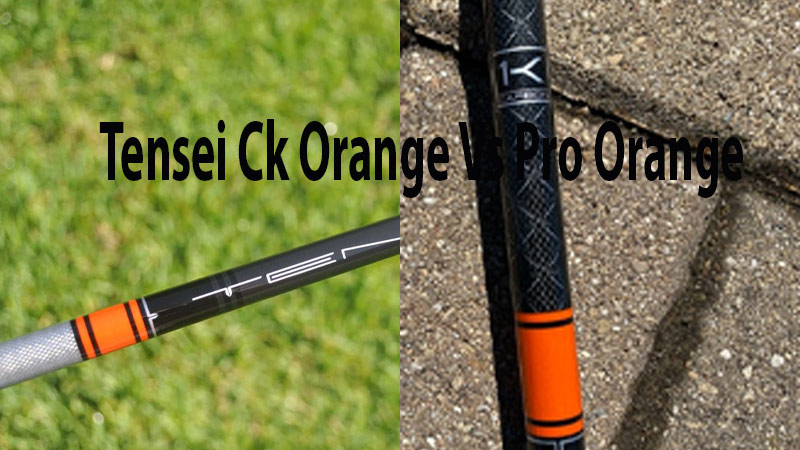
Mitsubishi’s TENSEI “Orange” label generally signals a counterbalanced design—extra mass is shifted toward the grip end so the club can feel lighter in swing weight, helping some players add speed or build heavier/higher-MOI driver setups without the head feeling overly heavy.
Mitsubishi explains this counterbalance idea plainly in its Orange-family descriptions: weight and material are concentrated more in the handle to change how the club loads and to help create speed and stability.
Where things get confusing is that Tensei CK Orange (often a “non-Pro” / retail or OEM-type offering) and Tensei CK Pro Orange (tour-level aftermarket) share the color and the CK branding, but they’re built to target different players and different delivery patterns.
GolfWRX discussions even note they’re “very different shafts and only share a name,” reflecting how big the profile/material differences can be in real-world fittings.
Below is a practical, golfer-first comparison of how CK Orange stacks up against CK Pro Orange—what’s different inside the shaft, how that changes launch/spin/feel, and how to pick the right one.
Construction and materials: “CK” similarities, “Pro” upgrades
What they share: CK weave for feel and stability
Both CK Orange and CK Pro Orange are part of the CK-era Tensei family that features the Carbon Fiber / DuPont™ Kevlar® (“CK”) weave in the butt section.
That weave is widely described as contributing to stability and feel in the handle area. Retail product descriptions for CK Orange highlight the CK weave as a core technology for stability and feel.
Likewise, CK Pro Orange descriptions also call out the same CK weave in the butt section.
So yes—both can feel “solid” in the hands compared with many generic stock shafts, because that butt-section structure is a real design feature rather than marketing paint.
Where Pro Orange pulls away: tip reinforcement and multi-material tuning
The bigger separation comes from what Mitsubishi (and fitters/retailers) describe in the tip section and material stack of the Pro Orange.
CK Pro Orange commonly lists:
- Tungsten-infused prepreg placed in targeted locations (used to influence balance point and/or stability)
- A tip section reinforced with MR70 (Mitsubishi’s strongest carbon fiber in these descriptions), aiming for lower torque and “tour preferred” stability/control.
- Fitter commentary that contrasts “non-Pro” tips vs Pro tips: the Golf Shaft Reviews write-up notes that non-Pro versions lack certain tip materials used in Pro lines, and specifically says Pro Orange uses MR70 and that its stiffness profile supports the claim of being stiffer/more stable.
Meanwhile, CK Orange (non-Pro) is often presented as a smoother, versatile counterbalanced profile built around the CK weave concept without the same tour-grade tip package.
One CK Orange product description frames it as building on Mitsubishi’s “classic, smooth bend profile” and emphasizes the CK weave.
Bottom line:
- CK Orange = counterbalanced, CK weave, generally smoother/less “locked-in” feeling.
- CK Pro Orange = counterbalanced plus a more aggressive stability recipe (MR70 tip reinforcement + tungsten-infused prepreg), built to hold up under stronger, faster, more abrupt transitions.
Bend profile and playing characteristics: mid vs low, smooth vs “tip-stout.”
Launch and spin tendencies (what most golfers notice first)
Most descriptions position CK Pro Orange as low launch / low spin, with a notably stiff tip for control. For example, one retailer description explicitly calls it “low-launching low-spinning” and counterbalanced.
Golf Monthly’s driver shaft guide similarly characterizes CK Pro Orange as counterbalanced with an “extreme tip-stiff” design, reinforced by MR70 for control and lower torque.
CK Orange, on the other hand, is often described more as mid launch with controlled spin (and in some testing writeups it can look mid–mid). A CK Orange review notes it can present as mid launch and mid spin, depending on the player, while still being counterbalanced.
Another product description frames it as “mid-launch” and “low-spin” but emphasizes versatility and smoothness. (That difference in labeling is common across retailers and reviewers—because “spin” is highly player-dependent and marketing categories are broad.)
A useful way to think about it:
- If you already fight ballooning, high spin, or a left miss from an aggressive release, Pro Orange’s tip stability is designed to reduce twisting and keep the head from over-closing or adding dynamic loft.
- If you want counterbalance benefits but don’t want the shaft to feel “boardy,” CK Orange is more likely to give you a smoother load/unload without demanding tour-level speed.
Torque and “feel” in the swing
Feel is personal, but torque and tip stiffness usually shape that feel.
- CK Pro Orange is repeatedly described as having lower torque and tour-level stability, largely credited to the MR70 tip reinforcement.
- CK Orange is more often described in terms of a classic, smooth bend profile and versatility—language you typically see when a shaft is meant to work for a wider range of tempos.
A good shorthand:
- Pro Orange often feels like it “stays with you” through transition and doesn’t kick hard at the bottom unless you really load it.
- CK Orange more readily gives that “helping hand” sensation—still stable, but more willing to bend and return.
3) Counterbalance: why it matters (and why Pro Orange uses it differently)
Counterbalance is not automatically “more distance.” It’s a build and delivery tool.
What counterbalance can do well:
- Let you play a heavier driver head (or add lead tape/hot melt) for forgiveness without the swing weight becoming unmanageable.
- Allow a slightly longer build while keeping the club from feeling like a sledgehammer.
- Help some players increase clubhead speed because the club feels easier to move.
In GolfWRX chatter about the Pro Orange, golfers specifically point out how the Pro Orange’s butt section design and tungsten influence can make it feel very firm in the handle area compared with standard Orange options. That lines up with the broader idea: Pro Orange uses counterbalance as part of a stability-first package, not just as a comfort feature.
So if you’re choosing between them:
- Want counterbalance mainly to fix swing weight/club build issues and keep feel smooth? CK Orange is the safer starting point.
- Want a counterbalance to support aggressive speed + heavy head + tight dispersion? CK Pro Orange is built for that job.
4) Which shaft fits best
Tensei CK Orange: best for…
- Players who like a smooth load and don’t want the shaft to feel harsh.
- Golfers who benefit from counterbalance (swing weight management) but still need the shaft to help them launch the ball.
- Players with moderate to moderately fast swing speeds or smoother transitions who still want stability from the CK weave.
A practical sign you’d like CK Orange:
You swing well when the shaft gives you a sense of timing—you can feel it load, and you don’t fight big blocks because the shaft never seems to “wake up.”
Tensei CK Pro Orange: best for…
- Faster swing speeds and/or aggressive transitions (hard from the top).
- Players who already launch plenty and want to knock down spin and tighten dispersion.
- Golfers who like a shaft that feels extremely stable in the tip and doesn’t overreact through impact.
A practical sign you’d like Pro Orange:
You tend to “overpower” smoother shafts—your miss becomes a high-spinny ball, a hook, or a wipey push because the head is arriving inconsistently.
Buying and identification tips (important with “Orange” paint jobs)
Because “Tensei Orange” exists in multiple generations (CK, AV Raw/AV, 1K, OEM variants) and because counterfeits exist in the aftermarket, it’s smart to verify what you’re actually holding.
A helpful detail from GolfWRX discussions: golfers mention MR70 text near the tip on some Pro Orange versions as one identifier, consistent with the idea that Pro Orange uses MR70 reinforcement.
Also, Golf Shaft Reviews emphasizes that non-Pro versions do not include the same tip reinforcement materials as the Pro versions, reinforcing that “Pro” is not just a label—it signals a different build.
If you’re shopping used:
- Ask for clear photos of the labeling near the tip, the serial/printing quality, and the butt graphics.
- Buy from reputable sellers whenever possible, because “Orange” paint alone doesn’t guarantee the actual model.
How to choose without guessing: a simple fitting roadmap
Even with “low/mid launch” labels, the right pick depends on your delivery. Here’s a clean way to decide:
- Start with your miss and flight
- High, floaty, spinny shots or inconsistent face control → lean Pro Orange.
- Need help with timing/launch, want counterbalance but not harsh → lean CK Orange.
- Pay attention to the transition tempo
- Smooth tempo: CK Orange often feels easier to sync.
- Quick, violent tempo: Pro Orange tends to hold up better.
- Test properly
Use the same head and ball, and compare averages over a real sample (10–15 good strikes). That advice is echoed in general spec/selection guidance: treat shaft specs as a system and validate on a launch monitor while controlling variables.
Conclusion: “Orange” is the theme, but “Pro Orange” is a different level of intent
If you strip it down to one sentence:
- Tensei CK Orange is the smoother, more broadly playable counterbalanced option built around the CK weave’s stability and feel.
- Tensei CK Pro Orange is the counterbalanced, tour-stable, tip-stiff version, enhanced by MR70 tip reinforcement and tungsten-infused prepreg to keep launch/spin down and dispersion tight for stronger deliveries.
If you tell me your driver swing speed (or carry distance), typical miss (right/left/high/low), and current shaft weight/flex, I can recommend a starting weight/flex range for each and what you should expect to change in launch, spin, and dispersion.