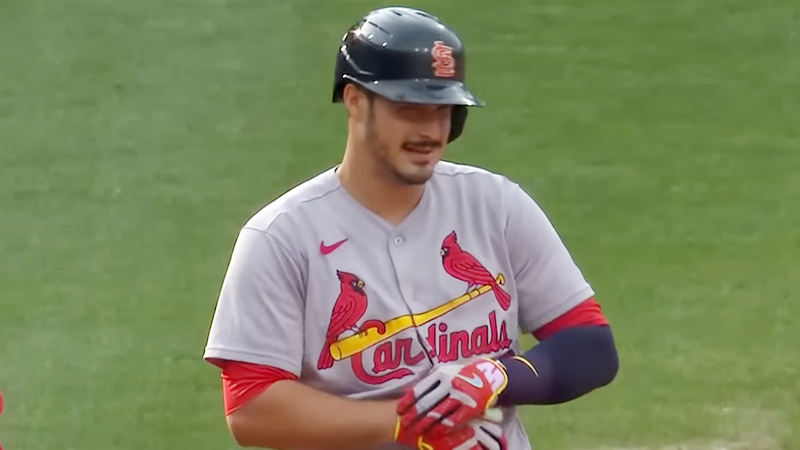
St. Louis gave up five players to land Nolan Arenado: left-handed pitcher Austin Gomber, infielder Elehuris Montero, right-handed pitcher Tony Locey, infielder Mateo Gil, and right-handed pitcher Jake Sommers. On top of taking those players, Colorado sent $51 million to St. Louis to cover part of Arenado’s contract.
When the trade became official on February 1, 2021, it stunned the baseball world. The Rockies were moving the best defensive third baseman of his generation, a player who already owned eight straight Gold Gloves and five All-Star selections.
The Cardinals got him without surrendering a single core big-league player or a top-100 prospect.
More than five years later, the deal still comes up in every conversation about lopsided trades. This breakdown covers exactly what St. Louis gave up, why Colorado agreed to it, how the money changed the math, and how each franchise fared once the dust settled.
The Trade at a Glance
One superstar went to St. Louis; five players went to Colorado, and $51 million in cash followed Arenado east. The deal was finalized on February 1, 2021.
| Player | Position | Profile when traded |
|---|---|---|
| Austin Gomber | LHP | Big-league swingman who had pitched as both a starter and reliever for St. Louis |
| Elehuris Montero | 3B/1B | Power-hitting corner infield prospect who had already reached Double-A |
| Tony Locey | RHP | Hard-throwing 2019 draftee out of the University of Georgia |
| Mateo Gil | SS/INF | 2018 high school draftee and son of former major leaguer Benji Gil |
| Jake Sommers | RHP | 2019 college draftee viewed as an organizational pitching depth piece |
The structure tells the story. St. Louis traded quantity for star power, keeping its top young talent while Colorado absorbed five lottery tickets and still paid a large share of the salary going out the door.
Why Colorado Was Ready to Move Its Franchise Star
The Rockies did not trade Arenado because they wanted to. They traded him because the relationship had broken down beyond repair.
In February 2019, Arenado signed an eight-year, $260 million extension, the richest contract in franchise history.
Within a year, the mood had flipped. After a 71-91 season in 2019 and a quiet winter with few roster upgrades, Arenado publicly said he felt disrespected by the front office. His frustration was aimed squarely at general manager Jeff Bridich, and the rift never healed.
Three forces pushed the deal across the finish line:
- Leverage was slipping. Arenado’s contract included an opt-out after the 2021 season. Colorado faced a real chance of watching him walk away with nothing in return.
- The roster was heading the wrong way. The Rockies finished below .500 again in the shortened 2020 season. Paying a superstar on a team without a path to contention made little sense.
- Arenado controlled his destination. His full no-trade clause meant he had to approve any deal. St. Louis, a perennial contender with a strong clubhouse culture, was a place he was willing to go.
The fallout came quickly. Bridich and the Rockies parted ways in April 2021, barely two months after the trade.
The Five Players St. Louis Sent to Colorado
None of the five ranked among baseball’s top 100 prospects at the time of the deal. That single fact drove much of the early criticism of Colorado’s side of the trade.
Austin Gomber, LHP
Gomber was the headliner and the only player with meaningful big-league experience. A fourth-round pick out of Florida Atlantic in 2014, he had bounced between the rotation and the bullpen in St. Louis.
Colorado handed him a full-time starting job, and he became a durable innings-eater who took the ball 30 times in 2024. Pitching half his games at Coors Field, his ERA generally landed between the mid-4s and mid-5s.
Elehuris Montero, 3B/1B
Montero was the most intriguing bat in the package. Signed out of the Dominican Republic, he had flashed real power in the minors, and some evaluators pictured him as Arenado’s long-term successor at third base.
He debuted in 2022 and received extended looks over several seasons, but he never locked down an everyday role and spent long stretches at Triple-A.
Tony Locey, RHP
A 2019 third-round pick from the University of Georgia, Locey brought a power fastball but battled command throughout his development. Colorado shifted him toward relief, yet he did not grow into a big-league contributor for the Rockies.
Mateo Gil, INF
Gil, a 2018 third-round pick and the son of former major league infielder Benji Gil, was a young middle infielder drafted on projection. His bat never developed enough to push him up the ladder, and he did not reach the majors with Colorado.
Jake Sommers, RHP
Sommers, a 2019 college draftee, profiled as organizational pitching depth when the deal was made. Like Locey and Gil, he did not reach the majors with Colorado.
Taken together, the package produced one dependable rotation arm and four long shots. For a player of Arenado’s caliber, that is a thin return.
The $51 Million Factor: How the Money Changed Everything
The cash is what turned a good trade for St. Louis into a historic one. Colorado’s $51 million payment cut the Cardinals’ bill for a perennial All-Star by roughly a quarter.
| Contract piece | Amount |
|---|---|
| Salary remaining on Arenado’s deal (2021–2026) | About $199 million |
| Cash sent by Colorado | $51 million |
| Net cost to St. Louis (2021–2026) | About $148 million |
| Effective cost per season to St. Louis | About $24.7 million |
| Original average annual value of the deal | $32.5 million |
The contract was also reworked as part of the trade. A $15 million season was added for 2027, and Arenado kept his opt-out after the 2021 campaign. The added year was a sweetener for the player; the opt-out was the main risk for the Cardinals, who could have lost him after one season.
Arenado erased that risk himself. After the 2021 season, he passed on the opt-out and stayed in St. Louis, just as he had said he would when he arrived. That decision locked in the Cardinals’ discounted price for his peak years.
What Arenado Delivered in St. Louis
Arenado gave the Cardinals two elite seasons, a solid third, and then a gradual decline as he moved into his mid-30s.
| Season | AVG | HR | RBI | Notable honors | Cardinals finish |
|---|---|---|---|---|---|
| 2021 | .255 | 34 | 105 | All-Star, Gold Glove | 90-72, lost NL Wild Card Game |
| 2022 | .293 | 30 | 103 | All-Star, Gold Glove, Platinum Glove, Silver Slugger, 3rd in NL MVP voting | 93-69, NL Central champions |
| 2023 | .266 | 26 | 93 | All-Star | 71-91, last in NL Central |
| 2024 | .272 | 16 | 71 | None | 83-79 |
His 2021 debut season paired 34 home runs with his ninth straight Gold Glove and helped power a franchise-record 17-game September winning streak that carried St. Louis into the postseason.
In 2022 he was even better, teaming with eventual NL MVP Paul Goldschmidt to form one of the most productive corner-infield duos in the sport. That year also brought his tenth consecutive Gold Glove.
The decline started in 2023, when his Gold Glove streak ended and the Cardinals fell to last place. His power faded further in 2024, and injuries limited him in 2025.
By then, St. Louis had already shifted toward a younger roster and had explored moving his contract; in December 2024, Arenado reportedly declined to waive his no-trade clause for a deal to Houston.
Even so, the peak was the point. By any wins-above-replacement measure, his first two seasons in St. Louis alone outproduced the entire return Colorado received.
How the Return Played Out for Colorado
For the Rockies, the trade became a cautionary tale less about the players received than about what the move failed to set in motion.
Gomber gave Colorado exactly what it needed most: innings. He held a rotation spot for four seasons and gave a thin staff stability. Montero offered occasional power but never claimed a starting job, and the three lower-level players did not become major league contributors in Denver.
The bigger issue was direction. Trading Arenado freed up roughly $148 million in future salary, but that flexibility never turned into a competitive turnaround. Colorado has not posted a winning season since the deal and lost 100 or more games in each of 2023, 2024 and 2025.
The math looks especially harsh in hindsight. The Rockies paid $51 million to move their best player and came away with one back-end starter. Few modern trades have left a franchise with so little to show for a superstar.
Verdict: Who Won the Arenado Trade?
St. Louis won the trade decisively, even after accounting for Arenado’s later decline. Three measures settle it:
- Production: Arenado delivered two top-tier seasons, three All-Star selections and a third-place MVP finish. Colorado’s return produced one durable starting pitcher.
- Cost: The $51 million subsidy meant St. Louis paid about $24.7 million a year for a star, well below his original contract value.
- Opportunity cost: The Cardinals kept every top prospect and core player. None of the five players they sent became a cornerstone in Colorado.
There is one honest caveat. Winning a trade is not the same as winning a title. The Cardinals lost the 2021 Wild Card Game, were swept by Philadelphia in the 2022 Wild Card Series, and slipped soon after. The window Arenado was meant to extend closed sooner than expected, and the final years of his deal became something the club tried to move.
Lessons for front offices
- Leverage disappears once a rift goes public. When a star says he feels disrespected, every rival club knows the seller has to deal.
- Opt-outs shift risk to the team holding the contract. Colorado had to act before Arenado could walk; St. Louis accepted that risk for a discount.
- Quantity rarely matches quality. Five mid-level pieces almost never equal one elite player, especially when none ranks among the top prospects in the game.
The Bottom Line
So, what did St. Louis give up for Nolan Arenado? Five players: Austin Gomber, Elehuris Montero, Tony Locey, Mateo Gil and Jake Sommers. In exchange, the Cardinals received one of the finest third basemen of his era plus $51 million to help pay him.
The price was modest, the payoff was immediate, and the deal remains the benchmark whenever a club weighs moving an unhappy star.
For St. Louis, it was a masterclass in buying low on elite talent. For Colorado, it was a reminder that the cost of a broken relationship is often paid on the trade market.