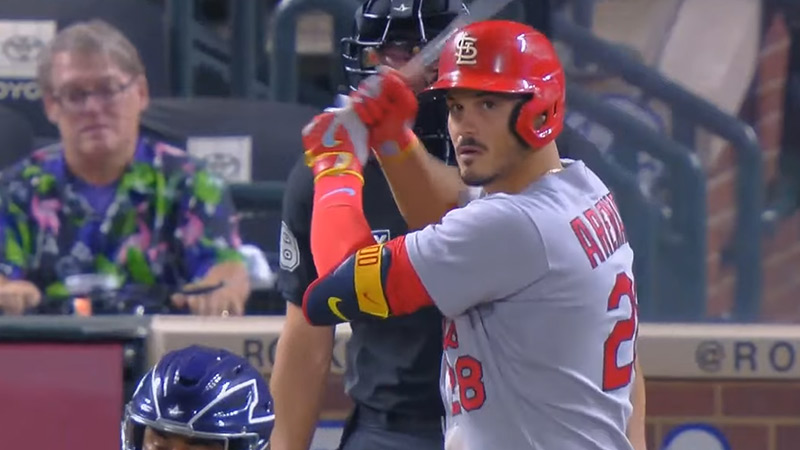
Nolan Arenado is no longer a St. Louis Cardinal. In January 2026, the club traded its veteran third baseman to the Arizona Diamondbacks for right-handed pitching prospect Jack Martinez.
The deal closed a five-year chapter that began with championship hopes and ended with a full organizational reset.
If you have been asking what happened to Arenado, the answer comes down to three things. The front office chose youth over veterans. Arenado agreed to waive his no-trade clause. And St. Louis paid most of his remaining salary to make the move work.
Then came the twist that Cardinals fans could not ignore. Arenado bounced back in the desert, putting together his best power season in years. Below, we walk through the full story: his arrival in 2021, the decline that followed, the trade itself, his 2026 rebound, and what comes next in 2027.
The Trade at a Glance
St. Louis sent Arenado and $31 million to Arizona for one pitching prospect. Here are the core terms in one place.
| Detail | What happened |
|---|---|
| Date | January 2026 |
| Teams | St. Louis Cardinals to Arizona Diamondbacks |
| Return to St. Louis | Jack Martinez, right-handed pitching prospect |
| No-trade clause | Waived by Arenado |
| Salary remaining | $42 million |
| Cardinals’ share | $31 million |
| Diamondbacks’ share | $5 million in 2026, $6 million in 2027 |
| Contract ends | After the 2027 season |
Arenado’s Five Years in St. Louis (2021–2025)
Arenado arrived from the Colorado Rockies in February 2021, and at first the deal looked like a franchise-altering win. He came to St. Louis as one of the best defensive third basemen of his generation, with a Gold Glove streak that started in his 2013 rookie season.
His peak in red came in 2022. He hit 30 home runs, drove in 103 runs, added another Gold Glove, and finished third in National League MVP voting. Alongside Paul Goldschmidt, who won the MVP that year, he gave the Cardinals one of the most feared corner-infield pairs in baseball.
The team results never matched the individual ones. St. Louis reached the postseason in 2021 and 2022 but lost in the Wild Card round both times. There were no series wins and no deep October runs.
Then came 2023, the year the floor gave way. The Cardinals finished last in the NL Central, and Arenado’s season ended early with back trouble. In 2024 and 2025, he remained a steady glove at third base, but his bat no longer anchored the middle of the order.
By the end of 2025, the picture was clear. St. Louis had an aging star on a large contract and a roster that was no longer contending. In baseball, that combination almost always leads to the same conversation.
Why the Cardinals Moved On: The Chaim Bloom Rebuild
The trade was not a reaction to one bad season. It was a decision about direction. Chaim Bloom took over as President of Baseball Operations after the 2025 season, succeeding longtime executive John Mozeliak, and he committed the club to a youth-focused rebuild.
Bloom’s logic is simple and familiar to anyone who has followed a rebuilding team. Veteran salary on a non-contender ties up money and blocks playing time. Young players need regular at-bats to show whether they belong in the long-term plan.
Third base was the clearest example. Keeping Arenado meant fewer chances for Blaze Jordan, Thomas Saggese, and Nolan Gorman, all of whom fit the timeline of the next competitive Cardinals roster. Moving Arenado opened the door for all three.
This split had been building for more than a year. St. Louis explored trading Arenado during the 2024–25 offseason, and he declined to waive his no-trade clause for a proposed deal with Houston.
That episode made one thing obvious: any trade would need his blessing, which meant the destination mattered as much as the return.
How the Money and the No-Trade Clause Worked
St. Louis covered roughly three-quarters of what Arenado was still owed. With $42 million left on his contract, the Cardinals sent $31 million to Arizona. The Diamondbacks took on just $11 million in total: $5 million for 2026 and $6 million for 2027.
That split says a lot about the negotiation. Arizona landed an established everyday third baseman at a fraction of his real cost. St. Louis accepted the expense in exchange for roster flexibility, playing time for young hitters, and a pitching prospect.
The fit made sense on the Arizona side too. The Diamondbacks had an opening at third base after trading Eugenio Suárez to Seattle in July 2025, and a low-cost veteran filled it without a long commitment.
The final piece was personal. Arenado held full control through his no-trade clause, and he used it with care. Arizona offered something few other suitors could: a club in the West, much closer to his roots in Southern California. That made it a move he was willing to approve.
Arenado’s 2026 Bounce-Back in Arizona
Arenado answered the biggest question about him: he still had plenty left. Across 147 games with the Diamondbacks, he produced 28 home runs and 3.0 WAR, a clear step up from his final seasons in St. Louis.
| Stat | 2026 with Arizona |
|---|---|
| Games | 147 |
| Slash line | .250/.325/.464 |
| OPS | .789 |
| Home runs | 28 |
| RBIs | 79 |
| WAR | 3.0 |
The power stands out most. Twenty-eight home runs was his highest total since his 30-homer season in 2022, and it came from a player many had written off as past his prime.
Durability mattered just as much. Playing 147 games gave Arizona a dependable everyday presence at third base, and he heads into 2027 healthy.
Several factors likely helped. A fresh start removed the weight of a long, public trade saga. A new clubhouse and a new role can reset a veteran’s approach. And for a player who values being near family, the move West may have mattered more than any swing adjustment.
What the Cardinals Got Back
For St. Louis, this trade was never about winning in 2026. It was about two long-term assets: Jack Martinez and open playing time at third base.
Martinez, a right-handed pitching prospect, adds another arm to an organization that needs pitching depth for its next contending window. Prospects like him are judged over several seasons of development, so his true value to the deal will not be clear for some time.
The bigger payoff is opportunity. Blaze Jordan, Thomas Saggese, and Nolan Gorman now have a real path to regular at-bats. A rebuild only works if young players get the reps to prove themselves, and third base became the place where that test plays out.
There is also a cultural side. Moving a respected veteran sends a clear signal about priorities. It tells fans, players, and the rest of the league that the Cardinals are building for the next decade rather than patching holes for one more season.
Who Won the Trade, and What 2027 Holds
Arizona holds the early edge. The Diamondbacks paid $5 million in 2026 for 28 home runs and 3.0 WAR from their everyday third baseman, which is outstanding value by any measure.
Still, grading this trade on one season misses why St. Louis made it. A rebuild runs on a longer clock. If Martinez develops into a reliable big-league pitcher, or if one of the young third basemen takes hold of the position, the Cardinals will have little to regret.
They traded a declining veteran’s final years for flexibility and a future piece, and that matched the plan.
The 2027 season is the last year of Arenado’s contract, and it raises several open questions:
- Can he repeat the power? Matching 28 home runs would cement the rebound as real rather than a one-year spike.
- Will he stay in Arizona beyond 2027? At $6 million owed by the Diamondbacks next year, he is one of the best bargains on their roster.
- How does his legacy look? With well over 300 career home runs, a decade-long Gold Glove streak, and multiple Platinum Gloves, his Hall of Fame case will draw serious debate when the time comes.
The Bottom Line
Nolan Arenado did not simply fade out in St. Louis. He was traded at the exact moment his timeline and the Cardinals’ timeline stopped lining up. The club wanted a clear runway for its future, and Arenado wanted to finish his career closer to home.
So far, the results reward both choices. Arizona got a 28-homer, 3.0 WAR season for just $5 million. St. Louis cleared third base for Blaze Jordan, Thomas Saggese, and Nolan Gorman, and added Jack Martinez to its pitching pipeline.