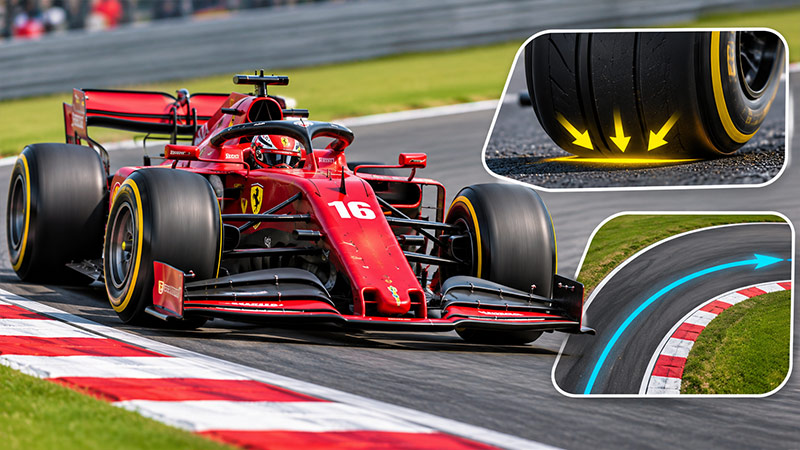
Grip is how much force the tires can hold before they slide. Bite is how quickly and how sharply that force arrives when the driver turns, brakes or accelerates.
A car can have plenty of grip and still feel lazy on turn-in, or bite hard on entry and then let go halfway through the corner.
This guide explains both terms the way drivers actually use them, from karting and club racing to sim racing and professional series.
You will learn the physics behind each word, what each one feels like from the seat, how setup and track conditions shift the balance, and how to describe what you feel so an engineer, a teammate or your own data can act on it.
Grip vs Bite: Two Words, Two Different Jobs
Grip is a capacity. It is the total cornering, braking and traction force the tires can deliver before they lose adhesion. Think of it as the size of your bank account.
Bite is a response. It describes how fast the tire builds force once you turn the wheel, press the brake or squeeze the throttle, and how positively it holds that first load. Think of it as how quickly you can withdraw from that account when you need the money.
| Grip | Bite | |
|---|---|---|
| What it describes | The maximum force the tires can hold | How quickly and sharply that force arrives |
| When drivers notice it | Mid-corner, long fast bends, peak braking | Turn-in, first brake application, first throttle |
| Typical complaint | “No grip anywhere, the whole car slides” | “Lazy front end, it won’t point” |
| What data shows | Peak lateral g, minimum corner speed | How fast yaw rate builds after steering input |
| Common fixes | Tire temperature, pressure, compound, downforce | Front geometry, roll stiffness, toe, brake balance |
The two are linked, but they are not the same thing. A wet track offers low grip, yet a well-balanced car can still bite cleanly within that lower limit. A worn tire on a hot afternoon may still produce reasonable peak grip but feel numb and slow to respond. That is exactly why drivers name them separately.
The Physics Behind Grip and Bite
You do not need an engineering degree to understand these terms, but four simple ideas explain almost everything drivers feel.
1. The contact patch
Each tire touches the road through a patch roughly the size of a hand on a road car, and larger on a wide racing slick. Every bit of force that turns, stops or launches the car passes through those four small patches.
Rubber grips in two ways: it deforms into the tiny peaks and valleys of the surface, and it forms a short-lived molecular bond with the asphalt. Heat makes rubber softer and better at both, which is why temperature matters so much.
2. Slip angle: where bite and grip separate
A tire produces cornering force when it rolls at a small angle to the direction the car is actually travelling. As that slip angle grows, force rises steeply, reaches a peak, then falls away as the tire starts to slide.
This curve is the clearest way to separate the two words. The steepness of the early rise is bite, which engineers call cornering stiffness.
The height of the peak is grip. A tire with a steep early slope feels crisp and immediate; a tire with a high peak lets you carry more speed once you are committed.
3. The friction circle
A tire has one budget of force that it shares between braking, turning and accelerating. If you use all of it to brake, nothing is left for turning.
Skilled drivers blend the two, easing off the brake as they add steering, a technique known as trail braking. This keeps the tire near its limit the whole way to the apex.
4. Load and weight transfer
The basic relationship between load and available force is simple:
Fmax = μ × Fz
Here F max is the peak force a tire can generate, μ is the friction coefficient, and F z is the vertical load pressing the tire into the road. In reality, μ drops slightly as load climbs, so a tire gains grip with load but at a falling rate.
When the car rolls in a corner, weight shifts to the outside tires, and the axle as a whole loses a little total grip. Managing how much and how fast that weight moves is the core of chassis setup.
What Bite Feels Like from the Driver’s Seat
Drivers feel bite at the moments when they ask the car to change direction or speed. It shows up in three places, and each one sends a different signal through the steering wheel, the pedals and the seat.
Front bite on turn-in
With good front bite, the nose responds the instant the wheel moves. Steering weight builds smoothly, the car rotates toward the apex, and you feel confident adding lock.
Without it, there is a short delay, the wheel feels light, and the car runs wide before it finally turns. Drivers call this initial understeer or a lazy front end.
Too much front bite is also a problem. The car feels darty and nervous, reacts to tiny inputs, and can make the rear step out on entry. The ideal is a front end that responds instantly but progressively.
Braking bite
Braking bite is how quickly deceleration builds when you first press the pedal. Strong initial bite lets you brake later and with more confidence. Weak bite feels like a soft, wooden pedal that takes a moment to wake up.
Drivers also use the word for brake pads themselves: cold pads, or a pad compound with a low friction rating, will feel short on initial bite until they come up to temperature.
Rear bite on exit
On corner exit, bite means the rear tires hook up as you open the throttle. The car drives forward cleanly, with little wheelspin and a stable rear. When rear bite is missing, the back squirms, the traction control works hard, and you have to wait before going to full power.
A note on other uses of the word
In karting, drivers often talk about how much a kart “bites” into the surface. Too much grip can stop the inside rear wheel from lifting, making the engine bog down mid-corner.
In clutch work, the bite point is where the clutch starts to engage. The core idea is the same in every case: the moment when force starts to transfer.
What Builds Grip and What Takes It Away
Grip is never fixed. It rises and falls with the tires, the track and the weather, often within a single session. The table below shows the factors drivers deal with most and how each one tends to affect grip and bite.
| Factor | Effect on grip | Effect on bite | What drivers say |
|---|---|---|---|
| Tire temperature | Peaks inside the compound’s operating window; falls when too cold or overheated | Cold tires feel numb and slow to respond | “Tires aren’t switched on yet” |
| Tire pressure | Too high shrinks the contact patch; too low overheats the shoulders | Higher feels sharper but skittish; lower feels soft and vague | “The car feels floaty” |
| Compound and wear | Softer compounds grip more but wear faster; worn rubber grips less | Worn or grained tires lose their crisp response | “The fronts have gone off” |
| Track surface | Abrasive asphalt offers more mechanical keying than smooth, polished surfaces | A rubbered-in line feels sharper than a dusty one | “The track has more bite today” |
| Track temperature and weather | Cold tracks slow warm-up; hot tracks overheat tires; rain and dew cut grip sharply | Response fades as the tire leaves its window | “It’s greasy out there” |
| Downforce | Adds load without adding mass, so grip rises with speed | Fast corners feel planted; slow corners feel looser | “Great in the quick stuff, lazy in the hairpins” |
Of all these, tire temperature causes the most confusion. Many drivers blame setup for poor bite on an out-lap when the real issue is simply cold rubber. Before judging the car, give the tires two or three building laps and watch the temperature trend.
How Setup Changes Bite and Grip
Setup rarely creates grip out of nothing. What it does is decide where the available grip goes, front or rear, and how quickly it arrives. The adjustments below are the ones engineers reach for first when a driver asks for more front bite or more overall grip.
| Adjustment | To add front bite or front grip | The trade-off |
|---|---|---|
| Front tire pressure | Small changes, often in half-psi steps, to bring the tire into its window | Too low feels vague; too high reduces mid-corner grip |
| Front camber | More negative camber keeps the tire flatter as the car rolls, adding mid-corner grip | Too much hurts braking and straight-line stability |
| Front toe | A touch of toe-out sharpens turn-in response | Less stability on straights and more tire heat |
| Front anti-roll bar | Softening it shifts grip toward the front and reduces understeer | The car can feel slower to respond in quick direction changes |
| Rear anti-roll bar | Stiffening it helps the car rotate on entry and mid-corner | Rear can become loose, especially on exit |
| Dampers | Shape how quickly weight arrives on the front tires, which drivers feel as bite | Too stiff skips over bumps; too soft feels lazy |
| Brake bias | Moving bias rearward helps the car rotate on entry | Too far back risks rear lock-up and instability |
| Differential | Less locking on entry helps rotation; more on exit improves traction | Each gain on one phase can cost the other |
| Front wing or splitter | More angle adds front grip at speed | More drag and a car that may feel nervous at the rear |
The golden rule never changes: adjust one thing at a time, write it down, and compare consistent laps on similar tires. Two changes at once tell you nothing about which one worked.
How Grip Changes Across a Race Weekend
The same car can feel completely different from Friday morning to Sunday afternoon without a single setup change. Understanding why helps you avoid chasing problems that the track will solve on its own.
- Green track. The first session usually brings dust, debris and little rubber on the surface. Grip is low and the car feels loose everywhere.
- Track evolution. As more cars run, rubber builds up on the racing line and grip climbs lap by lap. A setup that felt sharp in the morning can feel too pointy by the afternoon.
- Heat of the day. A hot track pushes tires past their window faster, and drivers often report the car feeling less sharp before lap times drop much.
- Rain or overnight weather. Rain washes rubber away and resets the surface. The next dry session can feel like a green track again.
- Tire life in a stint. An out-lap has little bite, the next few laps bring peak performance, and then grip and response fade as the rubber wears.
Mixed conditions add another layer. On a drying track, a narrow dry line offers plenty of grip while everything off it stays slippery. Drivers who understand the difference between a lack of bite and a lack of grip can tell whether the car needs a change or simply needs a few more laps.
How to Describe Bite and Grip So Your Feedback Gets Used
Good feedback is specific about where, what and why. Before you speak to an engineer or log a note, answer three questions:
- Where in the corner? Entry, middle or exit, and which corner.
- What did the car do? Push wide, rotate, slide, spin the wheels or feel nervous.
- Was it response or limit? A delay in reaction points to bite; a car that reacts and then runs out of hold points to grip.
The table below turns common sensations into clear language.
| What you feel | What to say | What it usually points to |
|---|---|---|
| The car is slow to react to steering | “Lacking front bite on entry” | Front response: pressure, toe, roll stiffness |
| It turns in well, then washes wide | “Good bite, but front grip runs out mid-corner” | Front grip limit or overall balance |
| The rear steps out as you release the brakes | “Rear unsettled on entry” | Brake bias, differential, rear grip |
| Wheelspin as you open the throttle | “Lacking rear traction on exit” | Rear grip, differential, throttle application |
| All four tires slide together | “Low overall grip” | Tire temperatures, track conditions, downforce |
| The car darts on the smallest input | “Too much front bite, nervous on turn-in” | Toe, front bar, front pressure |
| The pedal feels soft on first press | “Low initial brake bite” | Pad temperature, pad compound |
Compare two notes. “The car understeers” gives an engineer almost nothing. “Turn 4 entry: the front takes a moment to bite, then pushes toward the outside kerb at the apex” tells them exactly where to look and what to change.
Common Mistakes Drivers Make When Chasing Bite and Grip
Even experienced drivers fall into these traps. Avoiding them will save you track time and tires.
- Treating every slide as a grip problem. A car that reacts late on turn-in has a bite issue, and adding overall grip may not fix it. Identify which one you are dealing with first.
- Overdriving to make up for missing bite. Winding on more steering lock scrubs the front tires, overheats them and reduces grip even further. Slow the entry slightly and let the tire build force.
- Judging the car on cold tires. Out-laps and early laps hide the car’s true balance. Wait until temperatures settle before deciding anything.
- Changing several settings at once. You may find a better car, but you will not know why, and you cannot repeat it next time.
- Ignoring the track. A setup change made during heavy track evolution can look brilliant or terrible for reasons that have nothing to do with the change.
- Using vague words. “It feels bad” wastes everyone’s time. Name the corner, the phase and whether it was response or limit.
Conclusion
Bite and grip sound alike, yet they answer different questions. Grip tells you how much the tires can hold.
Bite tells you how quickly and cleanly that hold arrives when you turn, brake or accelerate.
Once you can feel the difference, your feedback becomes sharper, your setup changes become purposeful, and your lap times start to reflect it.
Start small. On your next session, split each corner into entry, middle and exit, and note whether the car lacked response or ran out of limit. Change one setting at a time and compare consistent laps.