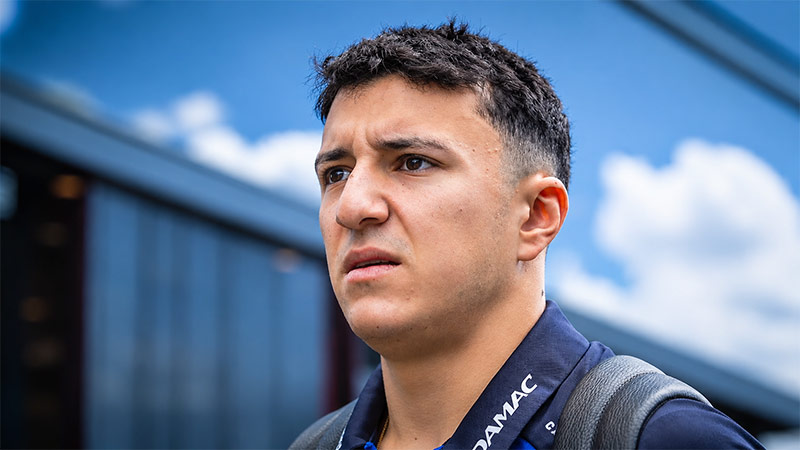
Yes. Isack Hadjar is not just going to Red Bull. He is already there. The young Frenchman races for Oracle Red Bull Racing in 2026 as Max Verstappen’s teammate, and the team has extended his contract through the end of 2027.
If you are asking “Is Isack Hadjar going to Red Bull?”, you probably remember the debate that followed his breakout rookie year with Racing Bulls in 2025. That question has now been settled, both on track and on paper.
This guide explains how the move happened, why Red Bull backed him, how his first season in the senior team is unfolding, and what the 2027 extension means for one of the most closely watched seats in Formula 1.
The Short Answer: He Is Already a Red Bull Driver
Hadjar was promoted from Racing Bulls to Red Bull Racing for the 2026 season, taking over the seat Yuki Tsunoda held in 2025. In September 2026, Red Bull confirmed a 2027 contract extension that keeps him alongside Verstappen for another year.
| Question | Answer |
|---|---|
| Current team | Oracle Red Bull Racing |
| Teammate | Max Verstappen, four-time world champion |
| Seat he took over | Yuki Tsunoda’s, from 2026 |
| Contract status | Extended through 2027 (announced September 2026) |
| Latest highlight | Third place at the 2026 São Paulo Grand Prix |
| Previous F1 team | Racing Bulls (2025) |
How the Move Happened: From Rookie to Promotion
Hadjar’s rise is a classic Red Bull Junior Team story, accelerated by one strong rookie season. Born in Paris on 28 September 2004, he joined Red Bull’s junior programme in 2022 after finishing runner-up in the 2021 Formula Regional European Championship.
He then worked through FIA Formula 3 and two seasons of Formula 2. His second F2 campaign, with Campos Racing in 2024, ended with him second in the championship behind Gabriel Bortoleto. That result secured his place on the Formula 1 grid with Racing Bulls for 2025.
A rookie year that turned on one bad moment
His debut could hardly have started worse. At the 2025 Australian Grand Prix, he crashed on the formation lap in wet conditions, and the image of a devastated rookie went around the world.
How he responded defined his year. Hadjar scored points at the Japanese Grand Prix just two races later and became one of the most consistent performers in the midfield. The peak came at Zandvoort, where he finished third at the Dutch Grand Prix for his first Formula 1 podium.
Why the senior seat opened up
Red Bull’s second seat had become a revolving door. Liam Lawson lasted two races alongside Verstappen in 2025 before being swapped with Yuki Tsunoda, who then held the seat for the rest of the year.
When Red Bull finalised its 2026 line-up, it chose Hadjar. Tsunoda moved into a reserve role, while Racing Bulls kept Lawson and promoted junior driver Arvid Lindblad. For Hadjar, it meant a jump to the top team after just one full season in Formula 1.
Why Red Bull Chose Hadjar
Red Bull picked Hadjar because he combined speed, resilience and timing at exactly the moment the team needed a long-term answer. Four factors stand out.
- Composure under pressure. Recovering from the Melbourne crash showed the mental strength the Red Bull seat demands. Drivers in that garage are judged every weekend, and Hadjar had already proved he could reset quickly after a setback.
- Consistent performance in a midfield car. Through 2025 he regularly qualified and finished higher than the Racing Bulls car seemed capable of. His Zandvoort podium was the headline, but the steady points finishes mattered just as much to the decision.
- Familiarity with the team’s leadership. Laurent Mekies ran Racing Bulls during Hadjar’s rookie season before becoming Red Bull Racing team principal in mid-2025. That gave the senior team a leader who already knew how Hadjar works, communicates and responds to pressure.
- Perfect timing with the 2026 rules. Formula 1 reset its technical regulations for 2026, and Red Bull introduced its first in-house power unit with Ford. A young driver without years of habits built around the old cars was well placed to adapt alongside the team.
There is also the long view. Hadjar, nicknamed “le petit Prost” during his junior career, is young enough to grow with this entire rules cycle. For a team that has spent years searching for a stable partner for Verstappen, that potential carried real weight.
Hadjar’s 2026 Season So Far
Hadjar’s first year at Red Bull Racing has coincided with the biggest technical overhaul in Formula 1 for more than a decade, and his recent São Paulo podium suggests he is coming to terms with it.
A new car, a new engine and a new rulebook
The 2026 regulations brought power units with a near-even split between combustion and electric power, fully sustainable fuels, active aerodynamics, and smaller, lighter cars. For Red Bull, the season also marked the debut of its own Red Bull Ford Powertrains engine.
That context matters when judging any driver’s year. Hadjar did not inherit a mature, well-understood car. He and Verstappen have been developing a brand-new package race by race, with every team learning the rules in real time.
The São Paulo podium
The standout result so far is his third-place finish at the São Paulo Grand Prix. Interlagos is a demanding circuit, with a short, busy lap, sharp elevation changes, heavy tyre wear and weather that can change quickly.
A podium there reflects more than raw pace. It points to good tyre management, clean racecraft and the ability to take chances when they appear.
The result also gives Hadjar podiums with two different teams in his first two Formula 1 seasons: Zandvoort with Racing Bulls in 2025 and Interlagos with Red Bull Racing in 2026. For a driver still early in his career, that is a meaningful marker of progress.
The 2027 Extension: What It Signals
The September 2026 extension is Red Bull’s clearest vote of confidence in Hadjar, and it was announced before the season had even finished. That timing tells you as much as the deal itself.
Here is what the new contract means in practice:
- Stability after years of churn. Red Bull has changed Verstappen’s teammate repeatedly since 2019. Committing to Hadjar for 2027 ends the constant speculation and lets everyone focus on performance.
- Continuity for the second year of the rules. Teams usually make their biggest gains in the second season of a new regulation cycle. Keeping the same driver pairing means engineering feedback and development direction carry straight into 2027.
- Less pressure, better performance. Several of Hadjar’s predecessors raced knowing one bad weekend could cost them the seat. A secure contract allows him to take measured risks, learn from mistakes and build towards peak form.
- A settled partner for Verstappen. With Verstappen’s own deal running through 2028, Red Bull now has a clear line-up for the next phase of the rules era.
For fans, the message is simple. Red Bull no longer sees Hadjar as an experiment. It sees him as part of the plan.
Racing Alongside Max Verstappen: The Toughest Seat in F1
Partnering Verstappen is widely seen as the hardest job in Formula 1, and recent history shows why. Every teammate since 2019 has been measured against a four-time world champion in a car often shaped around his driving style.
| Driver | Years alongside Verstappen | How it ended |
|---|---|---|
| Isack Hadjar | 2026 onwards | Extended through 2027 |
| Yuki Tsunoda | 2025 (from round 3) | Moved to a reserve role for 2026 |
| Liam Lawson | 2025 (2 races) | Returned to Racing Bulls |
| Sergio Pérez | 2021 to 2024 | Left after 2024, despite finishing runner-up in 2023 |
| Alexander Albon | 2019 to 2020 | Became reserve driver for 2021 |
| Pierre Gasly | 2019 (12 races) | Returned to Toro Rosso mid-season |
What success looks like for Hadjar
Beating Verstappen every weekend is not a realistic benchmark for anyone. A fairer test is whether Hadjar can:
- Stay close to Verstappen in qualifying, so he starts among the front-runners.
- Convert strong Saturdays into steady points on Sundays.
- Be there to take podiums when Verstappen or rival front-runners hit trouble.
- Score enough to keep Red Bull competitive in the constructors’ championship.
On that measure, a podium in São Paulo followed by a contract extension suggests Hadjar is meeting the standard that his predecessors often struggled to reach.
Isack Hadjar Career Timeline
Hadjar went from European junior single-seaters to a Red Bull Racing podium in five years. The key milestones, newest first:
| Year | Series and team | Milestone |
|---|---|---|
| 2026 | F1, Red Bull Racing | Third place at the São Paulo Grand Prix |
| 2026 | F1, Red Bull Racing | Contract extended through 2027 (September) |
| 2026 | F1, Red Bull Racing | Debut season as Verstappen’s teammate |
| 2025 | F1, Racing Bulls | First F1 podium, third at the Dutch Grand Prix |
| 2025 | F1, Racing Bulls | F1 debut at the Australian Grand Prix |
| 2024 | F2, Campos Racing | Championship runner-up |
| 2023 | F2, Hitech | Rookie Formula 2 season |
| 2022 | F3, Hitech | Joined the Red Bull Junior Team |
| 2021 | FRECA, R-ace GP | Championship runner-up |
His two championship runner-up finishes in the junior categories each came in the season that moved him up the ladder, and his first podiums in Formula 1 arrived in successive years with two different teams.
What to Watch Next
With his future secured for 2027, the focus shifts from whether Hadjar belongs at Red Bull to how far he can go there. These are the signals worth tracking over the closing rounds of 2026 and into next season:
- The qualifying gap to Verstappen. This is the clearest single measure of a Red Bull number two. A shrinking gap would show Hadjar is mastering the car, not just surviving in it.
- Consistency after São Paulo. One podium proves the speed is there. Repeat top-five finishes would prove it is sustainable.
- Development direction for 2027. The second year of new rules often reshapes the competitive order. Hadjar’s feedback will help decide how quickly Red Bull’s car and engine improve.
- His role inside the team. Watch for signs that the car is becoming more balanced between both drivers’ preferences, rather than tuned for Verstappen alone.
- The wider Red Bull family. How Lawson and Lindblad perform at Racing Bulls will shape future driver decisions and keep healthy pressure on everyone in the programme.
If these trends point the right way, the conversation in 2027 may turn from “Can Hadjar keep the seat?” to “Can Hadjar win in it?”
Conclusion
Is Isack Hadjar going to Red Bull? The answer is a firm yes, and the move is already complete.
After a rookie season with Racing Bulls that mixed early heartbreak with a podium at Zandvoort, Hadjar earned promotion to Red Bull Racing for 2026.
He has since handled a brand-new rulebook, a new in-house engine and the toughest teammate in the sport. A third place in São Paulo shows his speed is real, and the extension through 2027 shows Red Bull believes it.
The second seat has broken talented drivers before. Hadjar now has the time, support and stability his predecessors rarely enjoyed. How he uses that runway in 2027 will define the next chapter of his Formula 1 career.