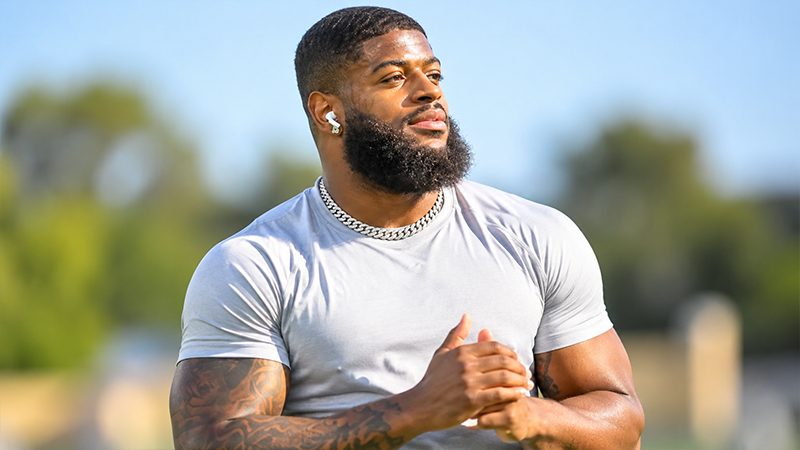
The 2024 NFL Draft will be remembered as the year of the offensive gold rush. With an unprecedented six quarterbacks selected within the first twelve picks, the collective eyes of the league were fixed firmly on the signal-callers.
This offensive frenzy created a unique market inefficiency, allowing blue-chip defensive talents to slide down the board. Chief among these undervalued assets was Jared Verse, an edge rusher out of Florida State whose professional ascent has been nothing short of meteoric.
Originally selected 19th overall by the Los Angeles Rams, Verse has transitioned from a mid-round pick into a top-tier defensive force, fundamentally altering how analysts and front offices view the 2024 class in retrospect.
When we look back through the lens of a redraft, the conversation surrounding Verse has shifted from “solid starter” to “generational cornerstone.”
His rookie campaign was a masterclass in power and persistence, leading to a near-unanimous selection as the NFL Defensive Rookie of the Year.
This production has caused his stock to skyrocket, with contemporary redraft simulations consistently placing him in the top five picks, often as the first defensive player off the board.
The Evaluation Gap: Why the League Missed at Nineteen
The central question haunting the fourteen teams that passed on defensive talent early in 2024 is simple: How did Verse fall to the 19th pick? The answer lies in a combination of draft-day psychology and a fundamental misunderstanding of his physical profile.
During the pre-draft cycle, Verse was frequently overshadowed by peers like Laiatu Latu and Dallas Turner. Scouts often pigeonholed these prospects into specific roles: Turner was viewed as the “high-ceiling” athletic freak, while Latu was heralded as the most technically refined pass rusher.
Verse, meanwhile, was classified as the “all-around” player—a label that sometimes serves as a backhanded compliment in an industry obsessed with specialized traits.
There was also a pervasive skepticism regarding Verse’s primary weapon: the bullrush. Many evaluators worried that the raw power Verse used to overwhelm collegiate offensive linemen would not translate to the professional level, where tackles are larger and technically superior.
This “power-rush projection” caused a slide that, in hindsight, looks like one of the most significant scouting misses in recent years.
As one analyst noted, some players simply possess a “freakish strength” that transcends the level of competition. Verse proved that his power wasn’t just a collegiate tool; it was an NFL-ready engine.
The Statistical Surge: Data-Driven Dominance
The argument for Verse as a top-five redraft pick is not merely based on the “eye test”; it is supported by elite-level production metrics.
Verse didn’t just participate in his first two seasons; he dictated the terms of the game. His impact was immediate, leading the Rams’ pass rush and consistently improving as his rookie season progressed.
This dominance culminated in a Pro Bowl selection and the prestigious Defensive Rookie of the Year award. By the end of his breakout period, he was being ranked among the top 10 edge rushers in the league across various analytical categories, including hits, hurries, and total pressures.
By 2026, Verse was recognized as the 35th-best player in the entire NFL by his peers, a testament to the respect he earned in a very short window.
His efficiency is what truly sets him apart. In critical stretches of his early career, Verse led the league in pressure percentage among defenders with significant snaps.
This ability to consistently collapse the pocket allowed the Rams (and eventually the Browns) to rebuild their defensive identity around his specific skill set.
The Redraft Hierarchy: Verse in the Top Five
In a 2024 redraft, the top three selections—Caleb Williams, Jayden Daniels, and Drake Maye—remain relatively stable due to the inherent value of the quarterback position.
However, the real drama begins at the fourth overall pick, currently held by the Arizona Cardinals. In the original draft, the Cardinals opted for Marvin Harrison Jr., but in contemporary redrafts, Verse is the frequent choice at number four.
The logic is compelling. While elite wide receivers are game-changers, a “game-wrecking EDGE” provides a unique level of defensive stability.
Analysts like Chris Trapasso have noted that teams like the Cardinals would likely not make the same mistake twice, opting to anchor their defensive front with a player of Verse’s caliber.
Further down the board, the competition for non-quarterbacks remains fierce. Verse is now routinely selected over high-impact offensive players like Malik Nabers, Joe Alt, and Brock Bowers.
The debate often settles on team needs, with Verse and Joe Alt frequently cited as the two premier non-QB targets available after the top three. Some analysts argue that Verse should even go ahead of quarterbacks like Bo Nix or Michael Penix Jr., given the immediate “justice” he dispenses on the field.
The Aaron Donald Mold: Muscle and Mentality
One cannot discuss Verse’s impact in Los Angeles without acknowledging the shadow of Aaron Donald. While Verse plays on the edge rather than the interior, the comparisons are unavoidable.
Fans and teammates alike have noted that Verse possesses a physical build similar to the legend, with some observing that he has “muscles growing off his muscles”.
This physical dominance is paired with a relentless mentality. Verse has been described as drawing double teams in a manner reminiscent of Donald, forcing opposing offenses to account for him on every single snap.
His presence is not just physical; it is psychological. He brings a “confident” persona to the locker room, one that demands excellence from himself and his teammates.
This leadership was evident in his relationship with fellow rookie Braden Fiske. The Rams’ decision to pair the two Florida State teammates was a masterstroke of roster construction, as they pushed one another to avoid contentment and continue challenging their limits.
Head coach Sean McVay has been vocal about his pride in how Verse handled his transition and the leadership he displayed, even after being moved to the Cleveland Browns later in his career.
Technical Masterclass: Dismantling Elite Competition
The ultimate proof of Verse’s value came against the NFL’s “gold standard” offensive lines. Many young pass rushers struggle when facing veteran, elite competition, but Verse appeared to relish these matchups.
During a notable performance against the Philadelphia Eagles—widely considered a top-three offensive unit—Verse was described as “dispensing freaking justice”. Experienced analysts noted that the Eagles simply could not block him, a rare feat for a player so early in his career.
Even in his “welcome to the NFL” moments, Verse showed a resilience that pointed toward greatness. When facing 49ers’ legendary left tackle Trent Williams, Verse attempted to move his hands only to find it was like “moving cinder blocks”.
While Williams laughed in the moment, the fact that Verse was already testing the strongest players in the league showed a lack of fear that is common among Hall of Fame talents.
By his third year, he had put on even more muscle, reaching the “best shape of his life” to ensure that he would never be moved easily again.
The Redraft Top 10: A Simulated Look
To understand how high Jared Verse truly goes, we must look at the specific team needs of the top ten in 2024:
- Chicago Bears: Caleb Williams. (No change; franchise QB remains the priority).
- Washington Commanders: Jayden Daniels. (No change; Daniels’ impact was immediate).
- New England Patriots: Drake Maye. (No change; the search for the next Brady continues).
- Arizona Cardinals: Jared Verse. (Originally Marvin Harrison Jr. The need for a defensive anchor outweighs the receiver in this scenario).
- Los Angeles Chargers: Joe Alt. (Alt remains a top-tier tackle, though Verse is heavily considered).
- New York Giants: Malik Nabers. (The Giants likely stick with the elite playmaker, though some mock Verse here at his “lowest” possible floor).
- Tennessee Titans: Jared Verse (If available). (Verse is seen as the ultimate value here, often going before Bowers or other offensive weapons).
- Atlanta Falcons: Jared Verse. (Commonly cited as the “best fit.” Pass-rushing was a glaring need that Verse would have solved immediately.
- Chicago Bears: Rome Odunze. (The Bears likely stick with the weapon for Williams, though the temptation to pair Verse with Montez Sweat is high).
- New York Jets: Brock Bowers or Bo Nix. (Verse is almost certainly off the board by this point in any realistic redraft).
Why the “Age Concern” Was a Fallacy
One of the secondary reasons Verse fell to 19 was his age. Entering the league at 24, some teams felt his “ceiling” was lower than that of younger prospects.
This has proven to be a flawed evaluation metric. Verse’s maturity allowed him to enter the league with an “adult” frame and a professional approach to the game.
Rather than needing two or three years of development in an NFL strength program, Verse was ready to “dispense justice” from day one. His age was not a limitation; it was a head start.
He entered the league at 24 and was already a top-10 edge rusher by age 25. This immediate ROI is incredibly valuable for teams in a “win-now” window, such as the Rams or the Browns.
The Cleveland Connection: A New Era
The narrative of Jared Verse took an unexpected turn when he was traded to the Cleveland Browns. While he left a lasting legacy in Los Angeles, his transition to Cleveland only cemented his status as a premier defender.
Sean McVay expressed significant admiration for how Verse handled the move, maintaining his professional standard and dominant play.
In Cleveland, Verse joined forces with other elite defenders to create one of the most feared units in football. His presence on the NFL Top 100 lists (ranking as high as #35 in 2026) suggests that his impact was not system-dependent; he is a transcendent talent capable of thriving in any environment. Whether wearing number 8 in Los Angeles or Cleveland, his objective remained the same: total backfield disruption.
Final Strategic Takeaway
Jared Verse is the definitive “lesson” of the 2024 NFL Draft. He is a reminder that production and power are often more reliable indicators of NFL success than raw “ceiling” or youthful projection.
For the Los Angeles Rams, he was the steal of the century at 19. For the rest of the league, he is the player they most regret passing on.
In any redraft scenario, Verse is no longer a mid-round gamble; he is a top-five cornerstone. He has proven that he can dismantle elite offensive lines, lead a locker room with infectious confidence, and produce at an All-Pro level from the moment he steps onto the field.
As the league continues to evolve into a pass-heavy environment, the value of a player who can “dispense justice” against the quarterback will only continue to rise. Jared Verse is not just a success story; he is the new blueprint for the modern NFL edge rusher.